MSP says assisted dying bill is 'bullet proof' after 175 amendments

 PA Media
MSPs have finished their revisions to the assisted dying bill with 175 amendments accepted during the past week.
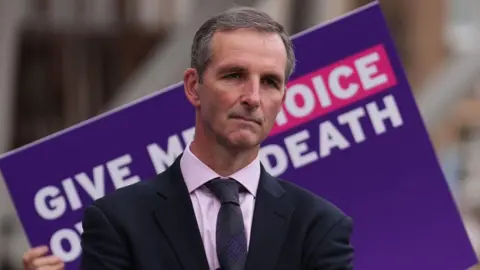
An unusual Friday sitting of the Scottish Parliament was held, allowing a fourth day of debate on Liam McArthur's members bill, which will be voted on next Tuesday.
McArthur said it was now "bulletproof" with extra safeguards added to the proposed law which would allow mentally competent adults with a terminal illness to seek medical help to end their lives.
However, the Royal College of Psychiatrists in Scotland and Royal College of Pharmaceuticals in Scotland withdrew support after a section offering "no duty, no detriment" protections for healthcare workers was removed.
Section 18 was dropped because of concern that it dealt with employment protections reserved to Westminster and therefore beyond the powers of the Scottish Parliament.
As an alternative, MSPs backed two amendments, proposed by McArthur and the bill's co-sponsor Ross Greer, that would prevent the law being implemented until protections were established via regulations at Westminster.
The UK government has said it would assist with this.
That was welcomed by the British Medical Association, but the Royal College of Psychiatrists in Scotland said it led to an unacceptable lack of clarity and scrutiny, and therefore it could no longer support the legislation.
 PA Media
Other amendments to the Assisted Dying for Terminally Ill Adults (Scotland) Bill include
- Patients must have a six month prognosis
- A doctor must carry out an assessment in private to ensure the patient is acting voluntarily.
- Doctors must make a request to a local authority to find out if the patient is receiving social or mental health care.
- Alternative treatment management options, palliative and hospice care must be discussed with the patient.
 PA Media
McArthur said: "Over the past four days MSPs have made this legislation bulletproof.
"This is now the toughest and most comprehensively safeguarded assisted dying bill in the world."
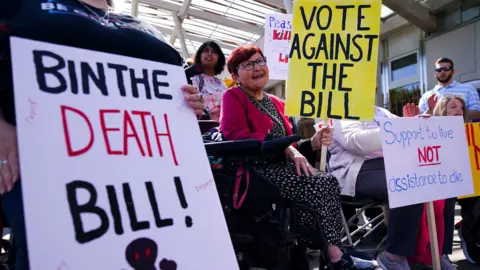
Opponents of the bill argue it could expose vulnerable people to pressure, and lead to people ending their lives because they feel like a burden on society or under financial strain.
There is particular concern about the potential impact on people with disabilities.
The Catholic Church, the Church of Scotland and the Free Church of Scotland have urged MSPs to reject the bill.
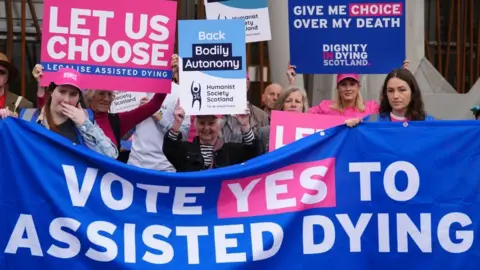
Supporters argue it could offer terminally-ill people compassion, relief from suffering and dignity in controlling the circumstances of their death.
They also say it would end the stress and expense of travelling abroad to countries like Switzerland where euthanasia is legal.