Scotland's plan to install heat pumps 'too slow' - climate advisers

 Nata Dietrich/Getty Images
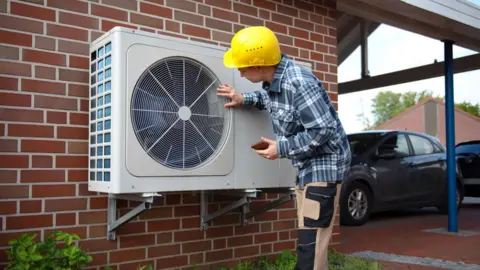
The Scottish government's plan to install more heat pumps in Scottish homes is "too slow", independent climate change advisors have warned.
Ministers proposed waiting until 2035 before significantly ramping up the rollout of the low-carbon alternative to gas and oil-fired boilers, with the vast majority needing to be completed just 10 years later.
But the climate change committee (CCC) has described that plan as "unambitious" and says it will be challenging for the supply chain to deliver.
Climate Action Secretary Gillian Martin said the government would use the feedback, alongside the results of a public consultation, to shape the final version of its climate change plan.
The chair of the committee, Nigel Topping, said the Scottish government had the powers to achieve most of the cuts required to greenhouse gas emissions "but only if they take action now".
He added: "Low carbon home heating is a critical part of Scotland's transition, and the next decade will be decisive for supply chains.
"Current plans for buildings are too slow and rely on a risky late 2030s catch-up. Scotland needs to accelerate the roll-out of heat pumps now."
The assessment forms part of the CCC's report to the Scottish Parliament on progress in reducing planet-warming greenhouse gas emissions.
It has also been assessing the Scottish government's draft climate change plan which sets out the policies needed to meet its targets.
The report praises the strides made already by reducing emissions by 51.3% by 2023 compared with baseline levels in 1990.
But it says the majority of emissions reductions already achieved have been delivered through decarbonisation of the energy sector, led by the UK government.
It adds that the majority of the remaining cuts will come from sectors with policy powers devolved to Scotland.
Why are we installing heat pumps?
In terms of keeping buildings warm, heat pumps are widely seen as the best way of cutting emissions of carbon dioxide and helping to achieve net zero goals.
They run on electricity and work by drawing a small amount of heat from the air which is then amplified using heat exchangers.
They don't have to be fitted in warm regions to work, with colder Scandinavian countries like Norway, Sweden and Finland recording some of the highest numbers of installations.
But with heat generated at lower levels for longer, properties do need to be well insulated to prevent the heat from escaping.
Scotland is already ahead of the rest of the UK on the roll out of heat pumps, with an 18% increase in installations between 2023 and 2024.
However, in its latest progress report the committee said that recent growth needed to be built upon and accelerated.
It said that plans to deliver the scale-up required to meet climate change targets "are currently missing".
The research charity Nesta estimates that 110,000 heat pumps need to be installed during the next Scottish parliamentary term.
Robin Parker, from Nesta Scotland, said the number "would support steady growth of the heat pump industry in Scotland without kicking the can down the road so that unrealistically rapid change is needed in the future".
Two years ago, the Scottish government announced it was ditching most of its climate change targets after it missed eight of the previous 12 annual goals.
It has since replaced them with carbon budgets which set the volume of greenhouse gases that can be emitted over five years.
The move, which brings Scotland into line with how other UK governments measure emissions, allows for annual fluctuations such as higher gas demand for home heating during colder winters.
 PA Media
Ministers were praised in the assessment report for showing "impressive growth" in public charging infrastructure for electric vehicles.
A target to provide 6,000 charge points by 2026 was met two years ago, although the report says the distribution across Scotland varies and satisfaction levels "could be substantially improved".
Woodland and peatland, which absorb carbon dioxide from the atmosphere, has seen growth although there's criticism of "stop-start funding" which leads to uncertainty and damages supply chains.
Cuts to the nature restoration budget in 2024, to pay for local authority pay rises, led to millions of tree saplings being destroyed and the tree nursery which grew them being put into administration.
Conservation charity WWF Scotland said ministers needed to significantly improve their plans if they were to be seen as credible.
Director Lang Banks said: "The more we delay, the more we add to the climate crisis and the longer people have to wait for the benefits of lower energy bills, warmer homes, healthier air and nature recovery."
Jamie Livingstone, head of Oxfam Scotland, added: "Progress, albeit against weakened climate ambition, is undoubtedly positive, but beneath the surface lies a clear warning: long-term plans lack credibility, cash and a clear route to delivery."
The Scottish government has already scrapped a commitment to bring forward legislation this parliamentary term on decarbonising heat in buildings.
It now says that will happen as early as possible in the next parliamentary session, should the SNP be returned to power.
Climate Action Secretary Gillian Martin said the draft climate change plan, published in November, included more than 150 actions.
She added: "It also describes how we will seize and fairly distribute the opportunities from the transition to net zero – from new jobs, inclusive growth and better infrastructure to improved public services and healthier people - thanks to cleaner air, warmer homes and wealthier communities."