Record number of seal pups born at shingle spit

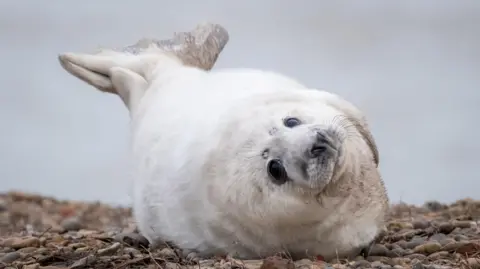 Hanne Siebers/National Trust Images
The number of grey seals born at a relatively new colony on the Suffolk coast has almost doubled this year, the National Trust revealed.
Rangers at the Orford Ness shingle spit say they have recorded 430 births this winter - an 88% increase on 2024-25.
Matt Wilson, countryside manager for the National Trust's Suffolk and Essex Coast portfolio, said: "This year, our peak counts have included 803 adults and 430 pups, which is by far the highest numbers we've seen since the seals' arrival in 2021."
The first 200 adult seals arrived after the first Covid lockdown when visitor access was significantly reduced. Numbers have increased as the colony has established itself.
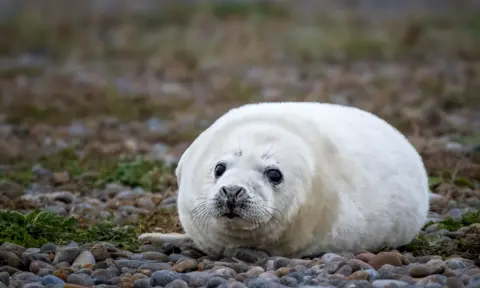 Hanne Siebers, National Trust Images
Orford Ness is believed to be home to Suffolk's first breeding colony, which was a Cold War nuclear weapons testing and radar site before it became a nature reserve.
It is thought the seals initially spilled over from well-populated colonies in Norfolk, including at Blakeney Point and Horsey Gap.
While not an exact science, Orford Ness rangers have counted:
- 2021-22: 25 births
- 2022-23: 66
- 2023-24: 133
- 2024-25: 228
Wilson said: "We're now in the fifth consecutive year of successful breeding at Orford Ness, which means that some of the adults having pups this year would have also been born here.
"It's a good sign that the habitats are healthy, with enough fish stocks to keep them sustained throughout the winter, and the shingle ridge providing shelter from storms."
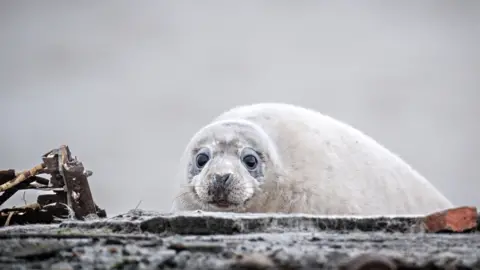 Hanne Siebers, National Trust Images
The National Trust site closes from the end of October until the spring, which coincides with pupping season.
Drones or any human activity which disrupts seals' normal behaviour can have an impact which means counting them has to be done at a distance.
Tom Allen, ranger at Orford Ness, said: "Seals are wild animals and therefore move around, which occasionally means we're unable to even get to some of their locations without the risk of disturbing them.
"We use a combination of telescopes and binoculars, which allows us to monitor the size and health of the colony from a safe distance. We try to be as accurate as possible, but there is always a chance that some may have been missed."
Orford Ness is a 10-mile long (16km) vegetated shingle spit running parallel to the mainland and joined to it just south of Aldeburgh.
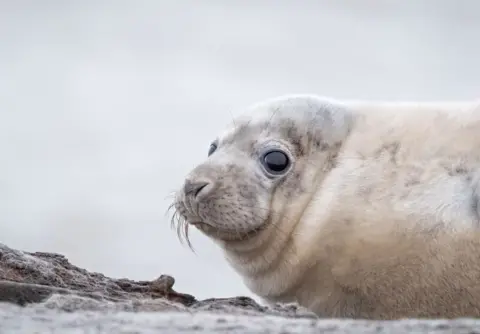 Hanne Siebers, National Trust Images
Orford Ness reopens on 4 May on selected days until 26 September and visitors will be able to see other wildlife including nesting and wading birds, hares and Chinese water deer.
There is no visitor access to the seals but some of them can be seen swimming along parts of the coast, either in the sea or the River Alde/Ore estuary on the western side of the spit.
In the wild, female grey seals, known as cows, have their first pups between the ages of three and five and usually return to the same place each year to give birth.
Pups remain on the shore for about three weeks until they have shed their white coats, revealing their sleek grey fur underneath.
Follow Suffolk news on BBC Sounds, Facebook, Instagram and X.