Swinney tells UK government to 'get a move on' with heating oil support
First Minister John Swinney has urged the UK government to "get a move on" with support for households hit by sharp increases in the cost of heating oil.
Chancellor Rachel Reeves has said she has "found the money" to help homeowners affected by rising energy prices in the wake of the US-Israel war in Iran, but no details have been announced yet.
About 130,000 Scottish households use heating oil to warm their homes. Average costs in Scotland rose from 67.92p per litre on 28 February to 147p per litre by 8 March, when the US and Israel launched attacks on Iran.
Swinney accused UK ministers of "twiddling their thumbs" while the cost of living for rural households skyrockets.
Minister for Energy Consumers Martin McCluskey said UK-wide support would be coming from Westminster "as quickly as possible", with details to be announced on Monday.
He told BBC Scotland's The Sunday Show "there will be support within that specifically for Scotland, because we know that heating oil in Scotland is much more of an issue than in other parts of the country.
"People who are on heating oil should be assured that the government is looking at this."
Why are energy prices going up?

 Getty Images
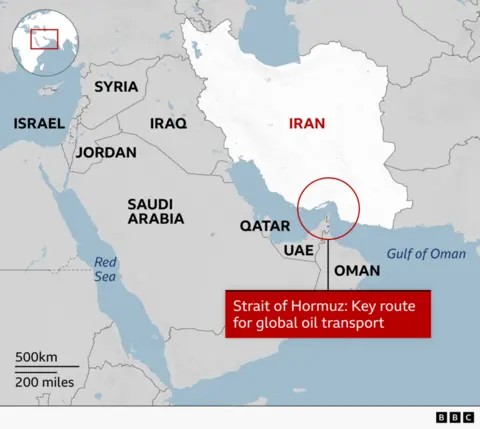
Part of Iran's response to strikes by the US and Israel has been to block the Strait of Hormuz - a key trade artery through which around 20% of the world's oil passes.
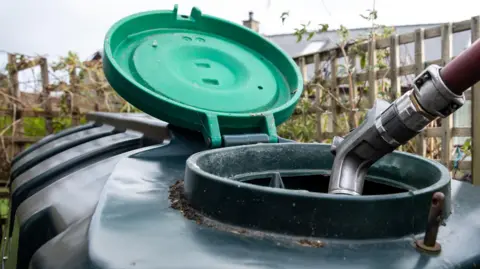
Since the start of the conflict, households using heating oil have seen their bills double and orders cancelled. Some have been unable to get heating oil at all.
Heating oil is mostly supplied by refineries in the Middle East and is commonly used in rural areas not connected to the main gas grid.
It is not covered by the regulator Ofgem's energy price cap, which is set to fall in April.
There have been calls for the UK government to issue urgent protections for the thousands of people in Scotland reliant on the fuel, in places which have long winters and a high proportion of older people.
Police in the Highlands and islands have also warned people that heating oil tanks could be targeted by thieves due to rising demand.
Also speaking on The Sunday Show, Swinney called on the UK government to "stop dithering" and "get on with taking some decision" about reducing energy costs.
He said: "Of course they are dithering, because we've had an announcement that something is coming and something is coming and something is coming, and it never comes from the UK government.
"They better get a move on, because people's heating costs are going through the roof and the UK government is sitting twiddling its thumbs."
The UK government previously said: "We know that people are concerned about the potential impact of global conflicts on the cost of living."
"While it is too soon to know the full impact of this crisis, as the chancellor said, she will take the necessary decisions to help families with the cost of living and protect the public finances."
Household energy bills are set to fall by 7% in April, Ofgem previously announced, following a shake-up in charges by the UK government.
However, prices are still about a third higher than before the war in Ukraine, and the number of people in debt has ballooned.
Gas and electricity bills could also face dramatic hikes from July - after Ofgem's price cap lifts - due to increases in wholesale gas prices.

The skyrocketing price of oil is a reminder that a foreign war can have major impacts here in Scotland.
Not that anyone really needed one, after the shock to energy prices which followed Russia's invasion of Ukraine in 2022.
The UK government rolled up its sleeves with energy bill subsidies on that occasion, and looks set to do so again now.
It will need to be slightly more targeted support - many households are protected for now by the energy price cap, but those which rely on heating oil are far more exposed.
The first minister is pushing for that to happen more quickly - which is a bit of a free hit for him, given the complexity of delivery falls entirely to counterparts in London.
But the truth is that as fast as ministers might move here, they are all still riding the waves of global events which are largely outside their control.
Because things are still moving very swiftly in the Middle East - and in unpredictable directions.