How Charles Dickens reinvented a 'dying' Christmas

 Getty
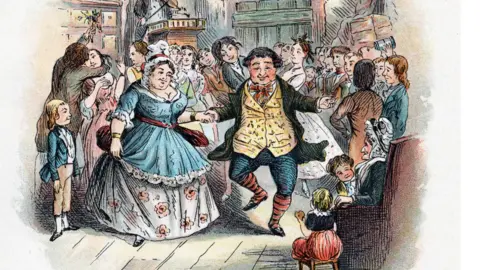
GettyAuthor Charles Dickens is widely claimed to have "reinvented and reinvigorated" Christmas when he published A Christmas Carol in 1843.
It tells the story of the miserly Ebenezer Scrooge, who is visited on Christmas Eve by the ghost of his dead business partner, Jacob Marley, who warns him that he risks an eternity in torment should he not change.
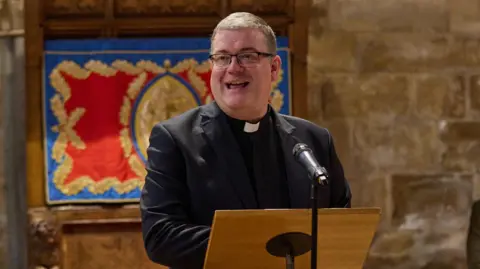
Historian and tour guide, Shane Waterman said his work helped to salvage a Christmas "dying" after years of Puritan efforts - led by Oliver Cromwell - to centre this period around Jesus's life rather than celebration.
He told Secret Kent: "Christmas was really only celebrated by the rich, the aristocracy - for everyone else it was just a normal day."
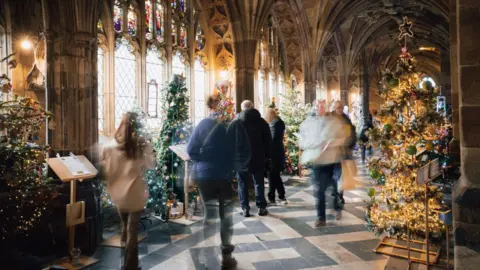
But Dickens' novel proved the "blueprint" to change this, with the author's love of Christmas born out of a visit to Rochester Cathedral.
Mr Waterman said Dickens shared the origins of this love at a dinner party some years after A Christmas Carol was published.
He said: "He recalled a walk on Christmas Eve when he was five with his parents and older sister.
"They went to the nearby cathedral and he experienced his first Christmas service in a cathedral... He found the good will and atmosphere absolutely captivated him at the age of five," the historian said.
Given it was 1817, the family could only have visited Rochester Cathedral.
"Right here is where our Christmas begins," Mr Waterman said, adding that Dickens was the inspiration for many traditions still seen today.
He added: "You've got Dickens to thank for your chocolate selection box... [and] five years later, he basically popularises the use of printed Christmas cards."
Rochester, and Kent more broadly, were always special to the author.
While he was born in Portsmouth, the Dickens family moved to Chatham when Dickens was five years-old.
A chalet, originally located at the family home at Gads Hill in Higham, is where Dickens wrote some of his other famous works.
The chalet was moved to its current location in nearby Rochester in the 1960s, and opened to the public last year.
A Christmas Carol, written while Dickens was in London, undoubtedly ranks among his most significant creations.
Mr Waterman said the 6,000 copies originally printed sold out by Christmas Day.
He said: "Between Christmas Day and New Years Day in 1844, they printed another 12,000. Those sold out. By October [1844], 180,000 copies had been sold..."
And the novel has never been out of print since.
Follow BBC Kent on Facebook, on X, and on Instagram. Send your story ideas to southeasttoday@bbc.co.uk or WhatsApp us on 08081 002250.