From Tolkien's favourite tree to a royal sapling

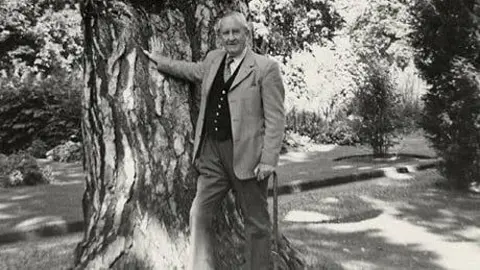 Michael George Tolkien
For about two centuries, a towering black pine stood in the University of Oxford Botanic Garden, becoming one of its most cherished landmarks.
JRR Tolkien loved sitting beneath its shade, Philip Pullman wove it into his fiction, and generations of visitors admired its grandeur.
But in 2014, it was felled and came to what many described as a tragic end.
Prof Simon Hiscock, director of the botanic garden and arboretum, reflects on its story and the hope now rooted in a sapling planted by King Charles III.
"There's quite a bit of mystery about the origin of the Oxford black pine," Prof Hiscock says.
An Oxford-trained botanist, he later helped found the University of Bristol's botanic garden, the youngest of its kind in Britain.
He now continues his career at the oldest one, in Oxford, which he describes as having been "fun and exciting".
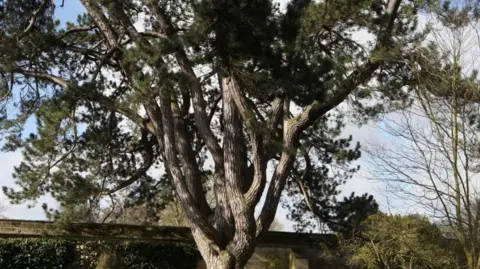 Oxford Botanic Garden, University of Oxford
The species, he explains, is called Pinus negra and is widely distributed across central and Eastern Europe, as well as western Asia.
"Nobody quite knows where the seeds were gathered for the black pine that became so famous here," he says.
"But it may have been on a collecting trip, or it might have been from a prolific nursery grower of conifers at that time."
He adds that it could have been an experiment by the well-known Oxford botanist and chemist Charles Daubeny.
Prof Hiscock describes black pines as "magnificent trees" that can grow to "awesome proportions".
"They often branch multiply from a low trunk and create this amazing upward array of arms that are the branches," he says.
"The black pine in he botanic garden was the largest tree in the garden at the time of its sad demise."
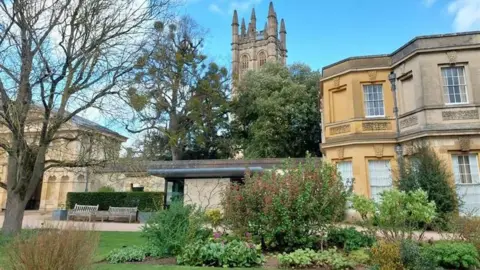
Initially thought to date from 1799, its rings revealed a later planting - probably in the mid-1830s.
The tree inspired deep affection.
"It became a favourite of JRR Tolkien who visited the garden regularly and used to sit under the tree," Prof Hiscock says.
"There are some very famous photographs of him with his beloved tree."
It is also mentioned in Pullman's His Dark Materials trilogy.
"Philip was very fond of the tree and has since been very fond of the wood that we've saved from it and have used to make wonderful wooden products that were available at our Christmas fair for the first time [this year]."
The garden's Black Pine Collection features products such as writing materials and cufflinks.
Prof Hiscock says he was told the items evoked "quite a flood of interest, particularly from members of the Tolkien Society".
By the time Prof Hiscock stepped into his role in July 2015, the tree had already gone.
"My understanding is it split in two because the branched stems were so heavy under their own weight and they'd got so tall that it just suddenly split," he says.
At the time, Dr Alison Foster, who worked on the garden, described the loss as "just heartbreaking".
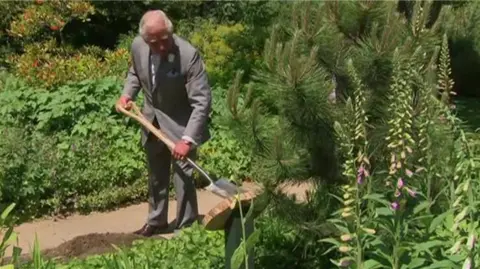
But a future black pine was planted by King Charles III on 8 June 2021, in celebration of the garden's 400th anniversary.
"He was so interested to learn about various trees and other plants," Prof Hiscock says.
"He planted a sapling grown from a seed that had been collected from the original black pine."
 Planet One Images
He adds that he was "impressed" by how much the King knows about plants, trees and woodland crafts.
"I've written to him a number of times since and met him a couple of times since, and he's always interested to know how his tree is doing," the professor says.
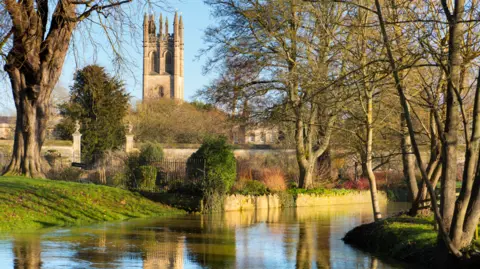
The young tree grows just a few feet away from where the original was, with "a magnificent view" of the Great Tower of Magdalen College.
"It's within a part that we call the Literary Garden because it details plants that are associated with English literature mainly, and often authors, poets, writers from Oxford," Prof Hiscock says.
He adds that it is about 20ft (6m) tall now, meaning it is growing "very, very quickly".
"It's in what you might call juvenile phase at the moment, so it looks like a big Christmas tree.
"That will all change as it continues its development and starts to branch out.
"But in 100 years it'll start looking really good."
You can follow BBC Oxfordshire on Facebook, X (Twitter), or Instagram.