Summary

  1. Trump raises global tariffs to 15% one day after Supreme Court rulingpublished at 19:57 GMT 21 February
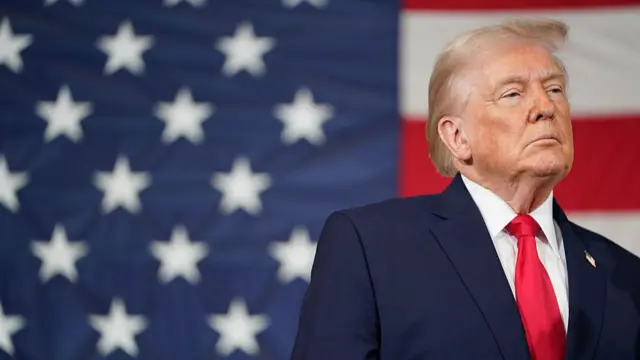
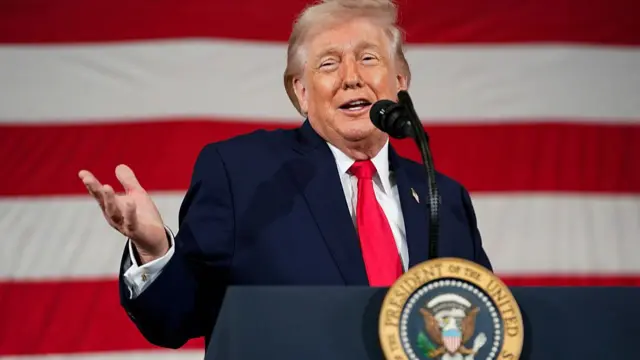
    President Donald Trump speaks during a visit to the Fort Bragg U.S. Army base on February 13Image source, Getty Images

    US President Donald Trump has announced that the US will raise global tariffs to 15%.

    This is an increase from the 10% rate announced on Friday, when the president invoked a never-before-used law known as Section 122 after the Supreme Court struck down his previous tariffs with a 6-3 majority.

    The law, which falls under the 1974 Trade Act, gives Trump the power to put in place tariffs up to a maximum of 15% for 150 days, at which point Congress must step in.

    Trump has called the Supreme Court's decision "ridiculous" and "extraordinarily anti-American".

    Some lawmakers are questioning the president's decision to continue the levies, with Democratic congressman Ted Lieu saying Trump is taking out his anger towards the top court on Americans. "These temporary tariffs will be challenged in court and Democrats will kill them when they expire," he writes on X.

    American allies have also weighed in on the changes, with German Chancellor Friedrich Merz warning about the uncertainty they bring the global economy. Meanwhile, the UK says it expects to retain its "privileged trading position with the US".

    We’ve wrapping up our live coverage for now, but you can read more in our news article.

  2. A look back at how we got herepublished at 19:38 GMT 21 February

    Kwasi Gyamfi Asiedu
    Live reporter

    Tariff decisions have often changed rapidly. Updates from the US government about tariff rates - and subsequent decisions about changing them - can happen in a matter of days.

    Nearly a year after Trump first announced his import taxes, here's a look back at how we got here:

    • 20 January 2025: Trump is inaugurated for his second term
    • 3 March 2025: Trump imposes 25% tariff on imports from Canada and Mexico
    • 2 April 2025: Trump announces "Liberation Day" tariffs imposing a baseline 10% tariff on nearly every country, with some countries given higher rates
    • 9 April 2025: Trump announces 90-day pause in Liberation Day tariffs
    • 14 April 2025: Wine importer V.O.S. Selections, Inc and others sue the Trump administration in US Court of International Trade
    • 22 April 2025: Two businesses - Learning Resources. and hand2mind - sue in federal court, challenging legality of the Liberation Day tariffs
    • 28 May 2025: The US trade court rules Trump's tariffs are illegal
    • 29 May 2025: The Federal court grants an injunction temporarily blocking the tariffs but the decision is stayed on appeal
    • 9 September 2025: Supreme Court consolidates the two lawsuits
    • 5 November 2025: Supreme Court hears oral arguments on Trump's tariffs
    • 20 February 2026: Supreme Court strikes down Trump's authority to impose tariffs without Congress in a 6-3 decision
    • 21 February: Trump announces he will impose global tariffs of 15%
  3. How lawmakers are responding to Trump's 15% tariffspublished at 19:17 GMT 21 February

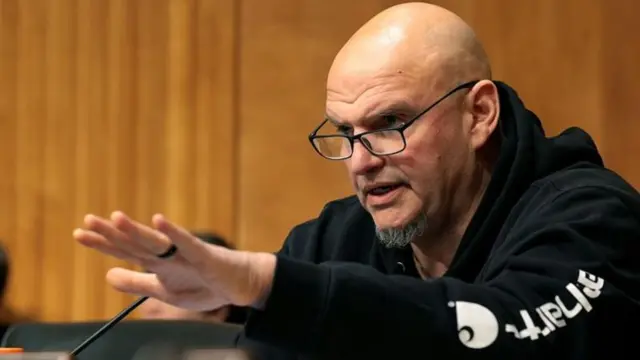
    John Fetterman wears a carhartt jumper. he gestures with his hand ahead of him. he wears black glasses. he is sitting in a senate hearing.Image source, Getty Images
    Image caption,

    Senator John Fetterman says he has an open mind about tariffs

    We've seen some reaction coming in today about the US president's new tariff decision.

    Democrat congressman Ted Lieu says Trump "feels hurt" by the Supreme Court decision and is "taking it out on the American people".

    "These temporary tariffs will be challenged in court and Democrats will kill them when they expire," he writes on X.

    Governor of California Gavin Newsom posts on X that "Donald Trump just announced a NEW 15% TAX on the American people. He does not care about you."

    Meanwhile, Democratic Senator John Fetterman told Fox News that has an “open mind” about Trump's tariffs and urged the president to work with lawmakers.

    “If we can use those tariffs to go after China... I would absolutely would vote for and support those things,” he says, but adds he does not understand tariffs on US allies.

    Speaking after Trump imposed the initial 10% tariffs, the senate majority leader, Republican John Thune, said tariffs can be an "important and effective tool" to level the playing field with foreign competitors.

  4. Tariffs bring continued uncertainty for US alliespublished at 18:55 GMT 21 February

    Simi Jolaoso
    Washington DC correspondent

    It’s not too surprising that Trump has used a different legal route to implement a new 15% global tariff.

    Tariffs have been central to the president's economic strategy, so the decision - which found that he overstepped his authority by imposing global tariffs under emergency economic powers - marked a significant check on his power.

    Trump has said that over the next few months, his administration will continue to determine and issue new permissible tariffs, insisting it will bring in even more money than the previous tariff regime.

    What it does bring for now is continued uncertainty for businesses and for US allies.

    Some nations, like the UK, Mexico and Germany, cautiously welcomed yesterday's ruling but have said they will simply watch to see what the president does next.

    Questions also remain over whether companies here that have paid the now-illegal tariffs will be issued refunds.

    This new tariff can only last 150 days without congressional approval.

  5. Trump's tariffs 'completely defensible' - Hassettpublished at 18:35 GMT 21 February

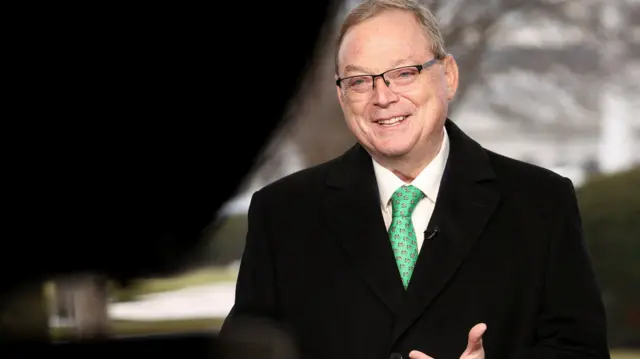
    White House economic adviser Kevin Hassett speaks to the media at the White House in WashingtonImage source, Reuters

    Kevin Hassett, director of the US National Economic Council, tells Fox News that Trump has said "from the beginning" that he would have a backup plan if the Supreme Court struck down the tariffs.

    "This is the way President Trump operates," says Hassett, adding that he believes that Trump's previous tariffs were, despite the Supreme Court ruling, "completely defensible".

    Hassett, who is one of Trump's most senior economic advisers, says that it’s a shame that "Democrats have to oppose President Trump no matter what happens".

    For context: Nine justices make up the Supreme Court. Six were nominated by Republican presidents and three by Democratic presidents. The three liberal justices - Ketanji Brown Jackson, Elena Kagan and Sonia Sotomayor - voted to strike down tariffs and were joined by three conservative justices - Amy Coney Barrett, Neil Gorsuch and John Roberts.

  6. UK business group says import taxes 'bad for trade'published at 18:17 GMT 21 February

    Trump's newly announced 15% import tariffs are "bad for trade, bad for US consumers and businesses" and will "weaken global economic growth", the leader of a UK business group says.

    William Bain, head of trade policy at the British Chambers of Commerce, says he feared that the president's response to the Supreme Court ruling "could be worse for British businesses".

    He adds: "Businesses on both sides of the Atlantic need a period of clarity and certainty. Higher tariffs are not the way to achieve that."

  7. UK expects 'privileged' trade position with US to continuepublished at 18:01 GMT 21 February

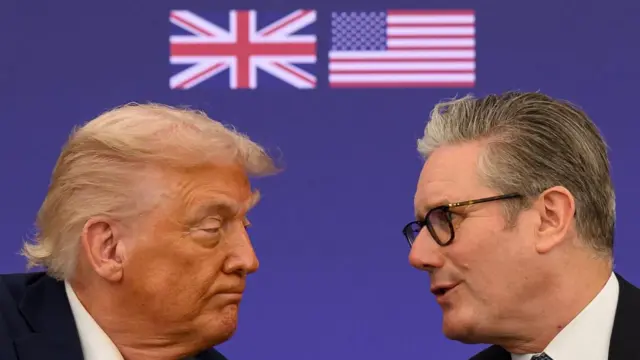
    trump and starmer speakImage source, Reuters

    The UK government says it expects Britain's "privileged trading position with the US" to continue.

    On Friday, a White House official said countries that previously reached trade deals with the US, including the UK, would face the global tariff under Section 122 rather than the tariff rate they had previously negotiated.

    However, the UK's deals around steel, aluminium, pharmaceuticals, autos, and aerospace sectors - which represent most of its trade with the US, were not impacted.

    The government says it is a "matter for the US to determine" whether those deals still stand, but it will "continue to support UK businesses as further details are announced.

    "Under any scenario, we expect our privileged trading position with the US to continue and will work with the administration to understand how the ruling will affect tariffs for the UK and the rest of the world", a spokesperson adds.

  8. What tariffs were found to be unlawful by the Supreme Court - and why?published at 17:45 GMT 21 February

    The US Supreme Court's decision relates only to tariffs that Trump had enacted under the International Emergency Economic Powers Act (IEEPA).

    The act gives a president the power to regulate trade in response to an emergency.

    Trump first invoked the act in February 2025 to tax goods from China, Mexico and Canada, saying fentanyl trafficking from those countries constituted an emergency.

    A few months later, on what Trump called "Liberation Day", he took a much bigger step, imposing levies between 10% to 50% on goods from almost every country in the world. In this case, the US trade deficit – where the US imports more than it exports – posed an "extraordinary and unusual threat", according to Trump.

    The court said the US Congress, and not the president, has the power to create new taxes, and that regulation under the IEEPA did not involve raising revenue.

    Still, a number of tariffs Trump has imposed over the last year were not part of the emergencies he declared under IEEPA and can remain regardless of the Supreme Court ruling.

    That includes industry-specific tariffs on steel, aluminium, lumber and automotives, which Trump put in place under a different US law, section 232 of the Trade Expansion Act of 1962, citing national-security concerns.

  9. Surprising Trump didn't impose 15% from outset, says ex-US trade negotiatorpublished at 17:35 GMT 21 February

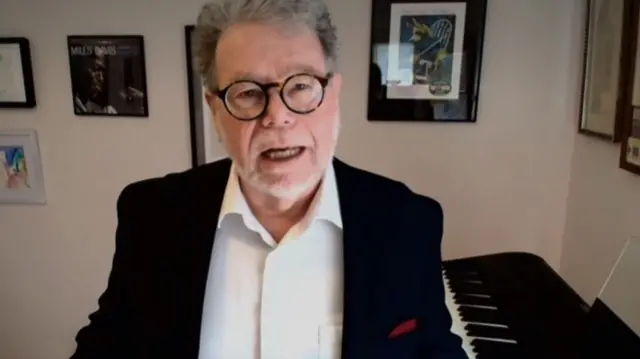
    Former US trade negotiator Daniel Mullaney in a suit speaking via video-link to BBC news from his house

    A former US trade negotiator says he is surprised that Trump did not announce 15% tariffs from the outset.

    Daniel Mullaney, who worked under both Trump and Obama, says it was widely expected that the president would resort to Section 122 if the Supreme Court ruled against previous tariffs. You can read more about Section 122 in our earlier post.

    "Most of us assumed he would use Section 122 and use the maximum, which is 15%," Mullaney tells the BBC. "The 10% I think was a surprise, the 15% of today is less of a surprise."

    On the impact on existing trade deals with various nations, Mullaney says it’s not yet clear which countries these new tariffs will apply to, or even whether this 15% will "stack on" or be inclusive of existing tariffs.

    "There’s been a history of putting out broad announcements and working out the details later, and I think this is an example of that."

  10. What Trump has said about the court decisionpublished at 17:25 GMT 21 February

    As a reminder, the US Supreme Court struck down Trump's tariffs, saying the president's decision to use a law reserved for national emergencies overstepped his authority.

    Trump called the decision "deeply disappointing" yesterday. Today, he has further derided the court on social media, calling the ruling "ridiculous, poorly written, and extraordinarily anti-American".

    The court ruled against Trump's tariffs in a 6-3 majority.

  11. Tariff uncertainty is 'poison', says Merzpublished at 17:17 GMT 21 February

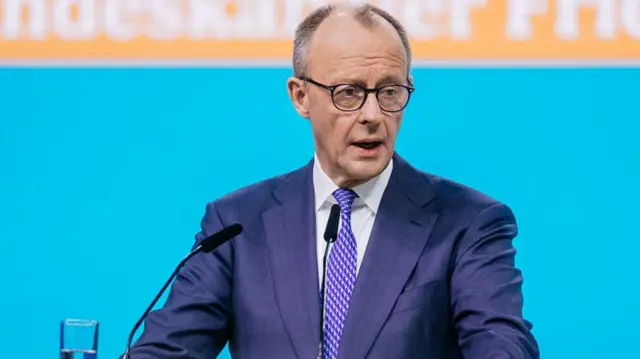
    : German Chancellor and leader of the Christian Democratic Union (CDU) Friedrich Merz speaks at the 38th CDU federal party congress on February 20,Image source, Getty Images

    German Chancellor Friedrich Merz had warned of the “poison” of more uncertainty around tariffs. He made the remarks on Saturday, before Trump announced the new levy rate of 15%.

    He told reporters in Germany that he would work closely with other EU countries on a joint position ahead of his upcoming trip to the US.

    “I will go to Washington with a coordinated European position,” he told reporters on Saturday, the Reuters news agency reports.

    "The biggest poison for the economies of Europe and the US is this constant uncertainty about tariffs. And this uncertainty must end," Merz added.

  12. 'We should aim for an approach of easing tensions' - Macronpublished at 17:11 GMT 21 February

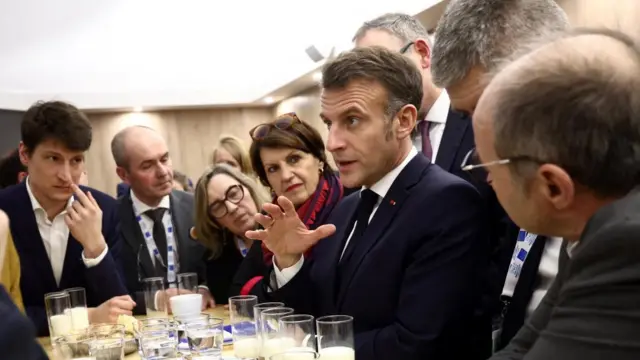
    French President Emmanuel Macron raises his left hand as he speaks at an agricultural fair in ParisImage source, Reuters

    In comments before Trump's new tariff rate was announced on Saturday, French President Emmanuel Macron said that his government would review what the consequences of new global tariffs would be.

    Macron says that France "will look exactly at the consequences, what can be done, and we will adapt."

    He adds that the "fairest possible rules involve reciprocity, not suffering unilateral decisions

    "So if this helps calm things down, then fine. And I think we should aim for an approach of easing tensions internationally, and continue modernising our economy."

  13. What to know about Section 122, the law covering Trump's new tariffspublished at 17:02 GMT 21 February

    resident Donald Trump speaks during a visit to the Fort Bragg U.S. Army base on February 13,Image source, Getty Images

    In the aftermath of the Supreme Court ruling that struck down his previous tariffs, Trump said he would impose new tariffs on almost all imports to the US under a never-used law known as Section 122.

    The law, part of the 1974 Trade Act, gives Trump the power to put in place tariffs up to a maximum of 15% for 150 days, at which point Congress must step in - which means this solution is temporary.

    However, there is a possibility Trump could work around lawmakers. Section 122 does not expressly prohibit the president from allowing the tariffs to lapse after 150 days and then declaring a new emergency to bring them back, according to the Cato Institute, a right-leaning think tank.

  14. What Trump said about the new levypublished at 16:49 GMT 21 February

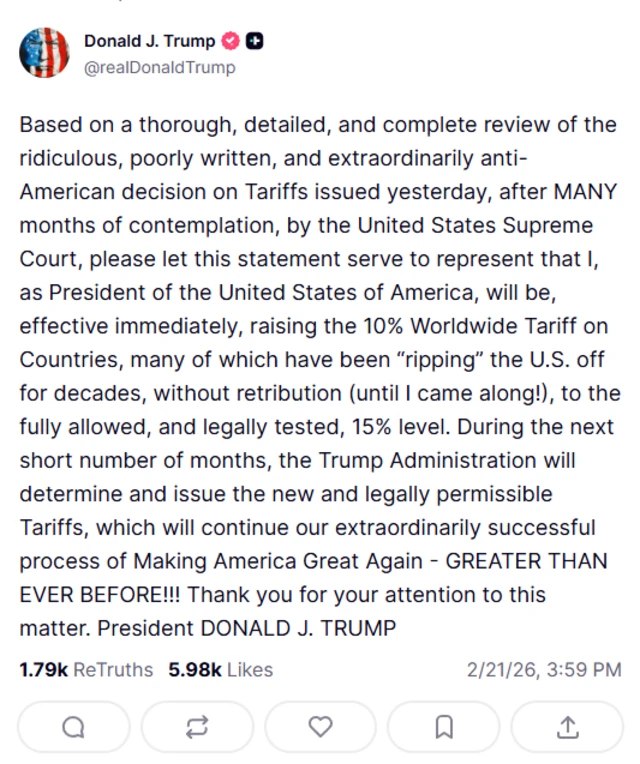
    On his social media platform Truth Social, Trump says he will be raising worldwide tariffs to 15% “effective immediately”.

    The president says the decision has been made based on a thorough review of the US Supreme Court’s “extraordinarily anti-American decision” to strike down his sweeping tariffs.

    He writes: “During the next short number of months, the Trump Administration will determine and issue the new and legally permissible tariffs, which will continue our extraordinarily successful process of Making America Great Again - GREATER THAN EVER BEFORE!!!”

    Based on a thorough, detailed, and complete review of the ridiculous, poorly written, and extraordinarily anti-American decision on Tariffs issued yesterday, after MANY months of contemplation, by the United States Supreme Court, please let this statement serve to represent that I, as President of the United States of America, will be, effective immediately, raising the 10% Worldwide Tariff on Countries, many of which have been “ripping” the U.S. off for decades, without retribution (until I came along!), to the fully allowed, and legally tested, 15% level. During the next short number of months, the Trump Administration will determine and issue the new and legally permissible Tariffs, which will continue our extraordinarily successful process of Making America Great Again - GREATER THAN EVER BEFORE!!! Thank you for your attention to this matter. President DONALD J. TRUMPImage source, Truth Social
  15. Trump says he will raise tariffs to 15% after Supreme Court rulingpublished at 16:43 GMT 21 February

    US President Donald Trump has said he will impose global tariffs of 15%, as he continues to rail against a Supreme Court ruling that struck down his previous import taxes.

    The move comes just one day after the highest court in the US struck down Trump's tariff policy.

    The president previously said he would replace the tariffs scrapped by the court with a 10% levy on all goods coming into the US.

    But in a Truth Social post on Saturday, Trump announced this would now be increased to 15%.

    We'll be following for reaction to this latest decision - stay with us.

  16. That's it from us for the daypublished at 23:29 GMT 20 February

    We're wrapping up our live coverage of the Supreme Court decision in Learning Resources, Inc v. Trump.

    The major ruling - and Trump's response - can be expected to have an effect on trade, the global economy, Americans' personal finances, politics and more.

    You can read what North America Correspondent Anthony Zurcher thinks it means for Trump's second-term agenda here, as well as how Canada, one of the top US trading partners, views the decision.

    We also have covered the major turns of the day here, and our White House correspondent Bernd Debusmann has described what it was like to cover Trump's press briefing about the ruling in this video.

    We'll be back when more big trade, Supreme Court, or other news breaks.

  17. Countries with US trade deals will face 10% tariff, official sayspublished at 22:59 GMT 20 February

    Danielle Kaye
    New York business reporter

    The BBC is learning new details about Trump's plans to impose new tariffs that could, essentially, replace those struck down by today's ruling.

    In a press conference after the decision was released, Trump said he planned to impose a new 10% global tariff under a never-used law known as Section 122, which gives him the power to put in place tariffs up to 15% for 150 days (at which point Congress must step in).

    That, along with the ruling, raised questions about the fate of trade deals many countries struck with the Trump administration to lower tariffs last year.

    Late Friday afternoon, a White House official said countries that previously reached trade deals with the US, including the UK, India and the EU, will now face the global 10% tariff under Section 122 rather than the tariff rate they had previously negotiated. Most UK goods had been subject to a 10% "baseline" rate., external

    The Trump administration expects those countries to keep abiding by the concessions they had agreed to grant in the trade deals, the official added.

  18. Analysis

    Supreme Court ruling diminishes one of Trump's top foreign policy toolspublished at 22:48 GMT 20 February

    Daniel Bush
    Washington Correspondent

    In addition to all of the economic ramifications, the Supreme Court ruling today also has a deep impact on President Trump's foreign policy agenda.

    Since returning to office more than a year ago, Trump has wielded tariffs to bolster American power on the world stage.

    That tool has largely been directed at trade, of course as Trump used sweeping global tariffs - the same ones struck down by the court on Friday - to force the UK, India and other key trading partners to negotiate new deals with the US.

    But Trump has also used tariffs, or the threat of them, to pressure other nations in ways not directly tied to the economy. The dispute over Greenland last month, for example, is a window into Trump's broader tariffs strategy.

    Trump called for the US to seize Greenland, only to face stiff resistance from the territory, Denmark (which controls it), and allies across Europe. He responded by threatening to levy taxes on goods from nations opposing his plan. The threat forced Denmark and Greenland to the negotiating table.

    And while that dispute remains unresolved, it showcased how Trump used tariffs as a tool in foreign affairs.

    The tariff threat-as-diplomacy tool hasn't entirely gone away with this decision. But it is greatly diminished.

  19. Ruling at first blush seems like good news for Canadapublished at 22:40 GMT 20 February

    Jessica Murphy
    BBC News, Toronto

    For Canada, this Supreme Court ruling will, at first blush, seem like good news, even vindication for many Canadians who felt unfairly targeted by their closest trading partner.

    But the ruling brings more uncertainty.

    Currently, the vast majority of trade have been sheltered by the USMCA, a sweeping trilateral North American trade agreement, from the fentanyl-related tariffs that Trump imposed and which were part of the ruling.

    Prime Minister Mark Carney has often said Canada is among the countries in the world with the lowest tariff rate due to the USMCA, although Canada is still feeling the pain of separate tariffs on goods from sectors like steel, autos and lumber.

    With the US president making clear that he will find a replacement for the tariffs struck down by the court, the question is: What’s next?

  20. Logistics of refunds 'a mess', economist sayspublished at 22:31 GMT 20 February

    Ahmed Adan
    BBC World Service

    Diane Swonk, the chief economist at KPMG US, offers this about the prospect of the money collected through Trump's emergency powers tariffs will be refunded: “Unfortunately, I'd say curb your enthusiasm, although I understand the desire for relief.

    "The reality is that the administration has been anticipating this and has warned that they will pull other levers to quickly reinstate any tariffs ruled illegal," she says.

    Already, Trump has said he plans to instate 10% levies through another part of US trade law.

    Speaking to the BBC World Business Express about the potential refund that businesses worldwide could seek, Swonk says: “The Supreme Court itself actually noted in their brief that the logistics of refunds are a mess and it will be very difficult to prove and be able to provide all the paperwork and the time involved.”

    That means small and mid-sized businesses are not likely to see refunds.

    Those who do "will be the ones that can literally dot all their I's and cross all their T's on the paperwork" and should expect to wait a while.

    She also says that the "other levers" could be harder to reverse later on.

    “So, there's an undercurrent to this that they're going to be using more statutory tariffs with investigations that, over time, could be harder to lift after they get implemented," she says.

Trending Now