Summary

  • The astronauts are aboard the spacecraft and carrying out checks as Nasa prepares for the first crewed mission around the Moon in more than 50 years - watch live above

  • There were emotional scenes as the crew waved goodbye to family members before heading to the launch site

  • US President Donald Trump says the US is "winning in space" in a message ahead of the launch

  • The crew on the 10-day Artemis II mission won't land on the Moon, but plan to circle it, while travelling further from Earth than anyone has ever been before

  • They will do it all in a capsule the size of a minibus - take a closer look at their spacecraft and rocket here

  • The launch is expected just after 23:20 BST (18:20 local time) at Florida's Kennedy Space Center, if the weather allows

  • Four astronauts are on board: Americans Reid Wiseman, Christina Koch and Victor Glover, and Canadian Jeremy Hansen - find out more about them

  • Listen on BBC Sounds:Follow the Artemis II mission with the BBC's space podcast, 13 Minutes

  1. Engineers trying to solve communications issuepublished at 21:46 BST
    Breaking

    Pallab Ghosh
    Science correspondent, reporting from the launch

    More now on that flight termination system issue.

    This is the onboard safety mechanism that would deliberately destroy the rocket if it veered off course, to prevent debris from endangering people or property downrange.

    Ground controllers have a communication issue with the system and cannot yet test the system hardware ahead of launch.

    The issue is at ground level and engineers are trying to solve it by using some hardware originally used to communicate with the Space Shuttle.

    If they are not able to solve the issue within the launch window the launch will be no go. But the countdown procedure is continuing.

  2. Nasa reports issue with flight termination systempublished at 21:40 BST
    Breaking

    Esme Stallard
    Science reporter

    In the last few minutes we have heard there is a problem with the termination system, identified in pre-launch testing.

    This is the system that will destroy the rocket in flight if it goes off track, to prevent it from harming anyone on Earth.

    At the moment the team are continuing with the other system checks whilst they try to figure this out - but if they cannot get the termination system to work the launch will not happen.

    We will bring you more on this as soon as we have it.

  3. Meet SLS, the rocket taking Nasa's crew into spacepublished at 21:30 BST

    The Visual Journalism Team
    BBC News

    The launch window is now just two hours away. Lets take a look at the rocket that will be taking the Artemis II crew into space:

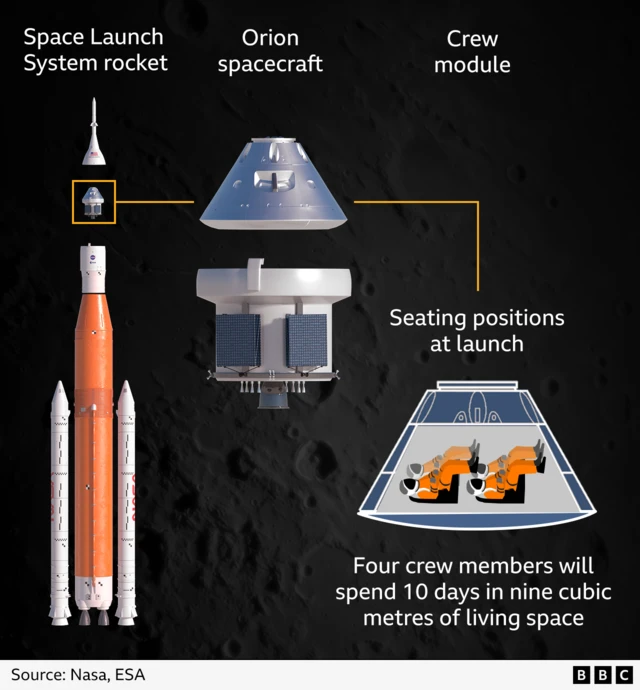
    The Artemis II astronauts will begin the mission on Nasa’s rocket, the Space Launch System (SLS). It is the most powerful rocket the US space agency has ever built.

    Standing 98m tall (322 ft), the SLS has four engines to provide the power to get off the ground. The core stage is essentially a giant fuel tank, containing more than three million litres of liquid hydrogen and liquid oxygen.

    Its job is to carry the Orion spacecraft - which houses the tiny crew module where the astronauts will spend the next 10 days - into space.

    SLS has flown only once before, launching in 2022 with no astronauts onboard for the Artemis I mission.

    The launch is one of the most dangerous parts of the mission - everything has to go perfectly. But if anything does go wrong during the early stages of the launch, the Launch Abort System, at the very top of the rocket, should propel the astronauts to safety.

    An illustration showing how the Artemis II astronauts will be arranged in the Orion crew module at launch. The four astronauts sit reclined, in two rows of two, facing up with their backs towards the ground. During the mission the four crew members will spend 10 days in about nine cubic metres of living space. The image shows that the crew module makes up about half of the Orion spacecraft - with the service module being around the same size - and that, on the launchpad, Orion is only a small section of the 98m (320ft) Space Launch System rocket.
  4. We forgot to mention, there's one other passenger along for the ridepublished at 21:21 BST

    Pallab Ghosh
    Science correspondent, reporting from the launch

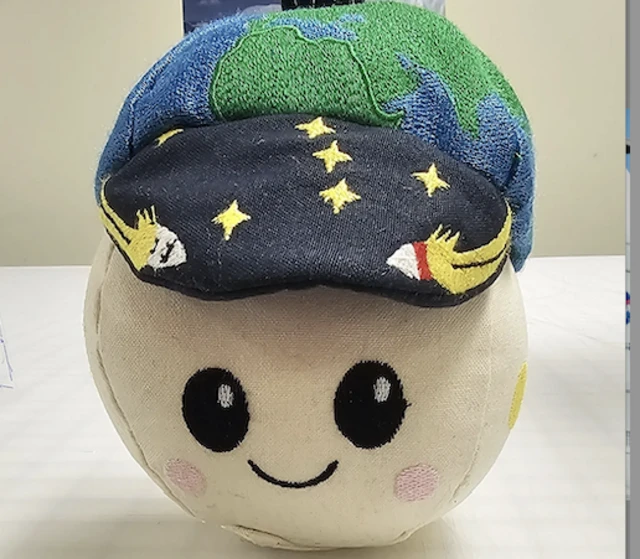
    a plush Moon in a cap embroidered with stars and a tiny EarthImage source, NASA

    Strapped into Orion with the astronauts today is a small, smiling stowaway called Rise – a plush Moon in a cap embroidered with stars and a tiny Earth.

    It was designed by eight‑year‑old Lucas Ye, a primary school pupil from California in the United States, whose sketch beat thousands of entries in Nasa’s global Moon Mascot design challenge.

    Inside the toy, engineers have tucked a micro SD card packed with messages, photos and hopes for the future from children around the world, turning it into a kind of digital time capsule that will loop out to lunar distance and back.

    As Rise floats in the cabin once they reach orbit, it will be both a zero‑gravity indicator for the crew and a reminder that this mission is meant to carry more than four astronauts’ ambitions – it is also carrying the dreams of the generation who might one day follow them to the Moon.

  5. Inside the tiny Orion crew modulepublished at 21:13 BST

    The Visual Journalism Team
    BBC News

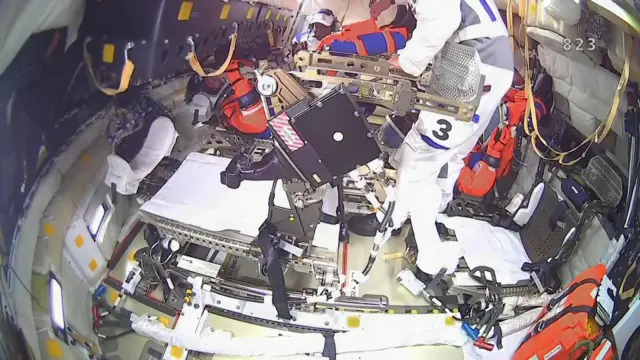
    The four Artemis astronauts will be spending 10 days cramped together in a space about the size of a minibus.

    The Orion crew module has similarities to the ones used for the Apollo missions 50 years ago, but the interior is very different.

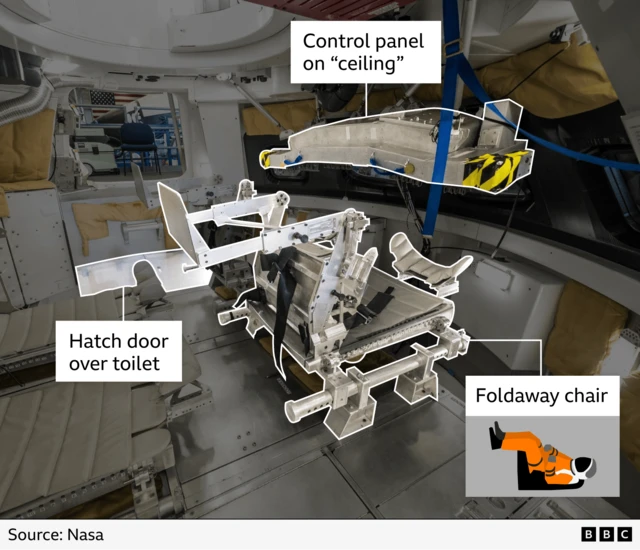
    The four seats the astronauts will use during the launch will be packed away for most of the time to give them more room. The weightless environment means they can make use of space that would otherwise be unusable - so the control panel can be on the "ceiling".

    Interior view of the Orion crew module highlighting a metal structure in the centre, labelled as a foldaway chair, another highlight shows the control panel mounted on the “ceiling”, while a third shows a panel labelled as a hatch door positioned over the toilet. The cabin includes padded wall sections, metal flooring, and equipment mounts. A small illustration in the corner shows an astronaut demonstrating how the foldaway chair is used.

    Most importantly, there is a toilet tucked away under the floor. It’s not very private but has been designed to overcome the challenges of going to the bathroom in space.

    And just above the toilet hatch, there is a step that doubles up as a flywheel exercise machine - the astronauts will each pull on the cable for 30 minutes of resistance and cardiovascular training every day to help counter the physical effects of being in space.

  6. From bibles to pendants, here's what the astronauts are taking on their journeypublished at 20:41 BST

    Alison Francis
    Senior science journalist

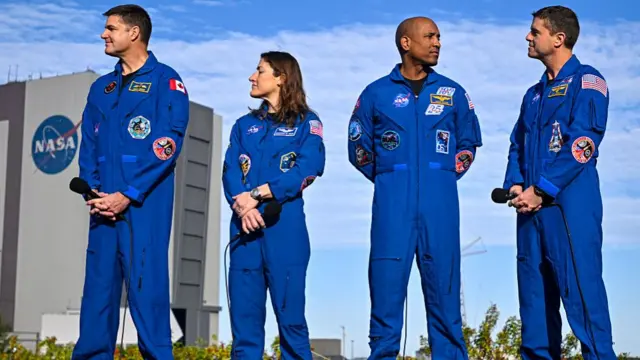
    (L-R) Canadian Space Agency astronaut, NASA Artemis II Mission Specialist Jeremy Hansen, NASA astronaut and Artemis II Mission Specialist Christina Koch, NASA astronaut and Artemis II pilot Victor Gloverand and NASA astronaut and Artemis II Commander Reid WisemanImage source, Getty Images
    Image caption,

    Jeremy Hansen, Christina Koch, Victor Glover and Reid Wiseman (pictured left to right)

    The Artemis astronauts have revealed the personal items they are taking with them on their lunar flyby.

    Victor Glover, the mission pilot, a committed Christian and Sunday school teacher, is packing his Bible.

    Canadian Space Agency astronaut Jeremy Hansen has four moon pendants. He bought them two years ago and gave them to his wife and children to wear. Now he has collected them back – they will travel with him on his history-making trip.

    Commander Reid Wiseman’s choice is very simple. Some notepaper and a pencil. He wants to record his thoughts while looking out at the spectacular views of the Moon and the Earth.

    Messages written by her loved ones are in mission specialist Christina Koch’s suitcase. She says having something in her hands that her family have held and taken time composing will carry a very special meaning for her when she’s a long way from home.

  7. Preparing for launchpublished at 20:31 BST

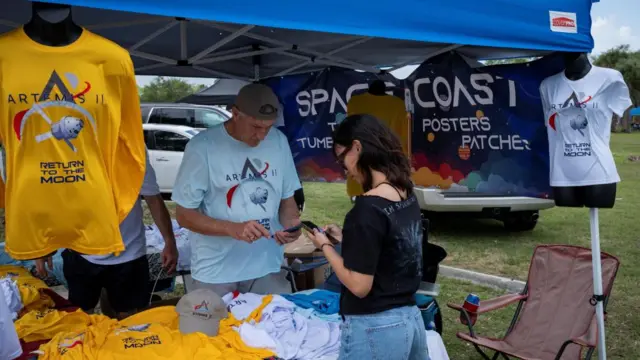
    A man sells t-shirts ahead of the upcoming Artemis launchImage source, Reuters
    Image caption,

    A man sells t-shirts and other merchandise ahead of the expected launch

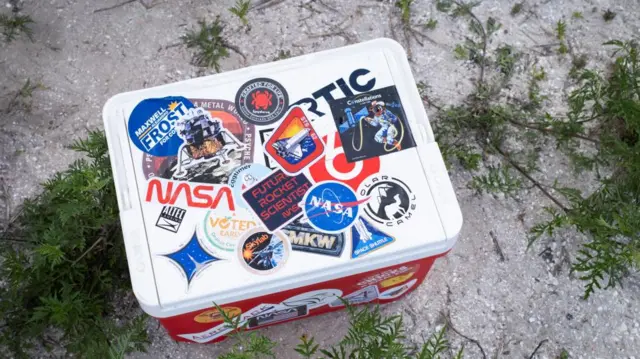
    Space-related stickers on a coolbox ahead of the launchImage source, Reuters
    Image caption,

    People are gathering near the launch site

    People watch on from Space View Park near the Kennedy Space Center ahead of the expected launchImage source, Reuters
    Image caption,

    People watch on from Space View Park near the Kennedy Space Center ahead of the expected launch

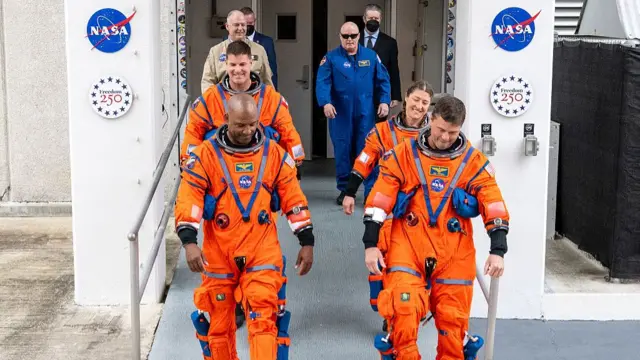
    The four astronauts walk out in their orange suitsImage source, AFP via Getty Images
    Image caption,

    Earlier we saw the astronauts on their way to the launch pad

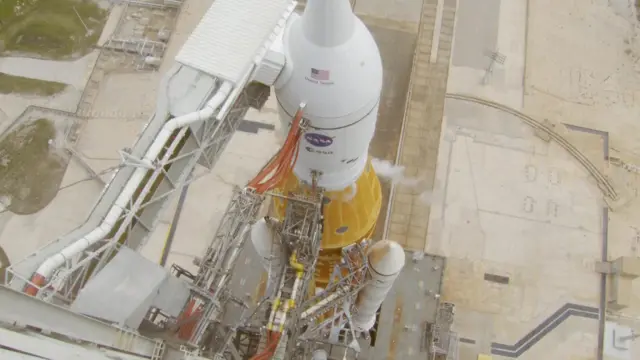
    The rocket as seen from above - it is huge, with the ground appearing far away from the topImage source, NASA
  8. Launch site played a role in Moon landing mission of the 1960spublished at 20:17 BST

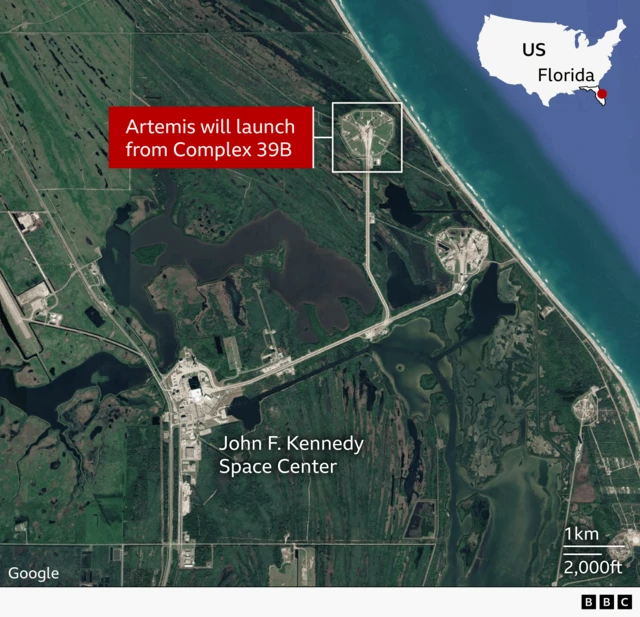
    Artemis II will launch from Launch Complex 39B, a pad specially built for larger missions at the Kennedy Space Center.

    The first to launch from this complex was Apollo 10, a rehearsal for the mission that would land on the Moon for the first time in 1969.

    The proximity to the Atlantic Ocean was chosen for Nasa’s operation strategically. Rockets can head eastwards towards the sea and reduce the risk to population centres.

    But by the 1960s, Cape Canaveral, the agency’s primary launching pad in the area, was not enough for the missions being planned. Launch Complex 39B accommodates larger rockets and, according to Nasa, has been improved to support the Space Launch System (SLS) rocket and Orion spacecraft.

    A satellite map of Florida’s east coast showing the John F. Kennedy Space Center and surrounding wetlands. A white box highlights Launch Complex 39B near the shoreline, with a red label stating “Artemis will launch from Complex 39B.” A small inset map of the United States marks Florida’s location. Scale markers for 1 km and 2,000 ft appear in the lower right corner.
  9. Crew are in the Orion capsulepublished at 19:58 BST

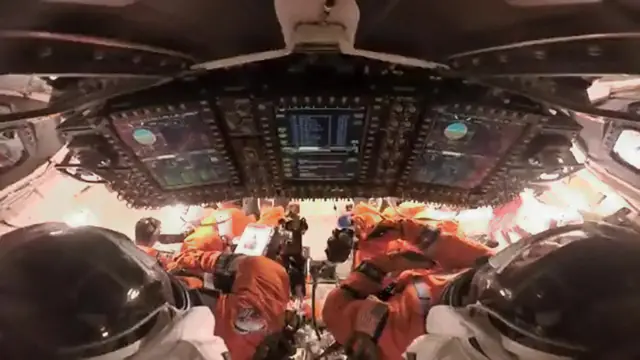
    We're seeing more images of the crew in the Orion capsule - which is about 5m (15ft) wide and 3m (9ft) high.

    There are four seats for the launch. Once in orbit the crew will pack them away to make more room.

    An image of two crew members at the controls in the capsuleImage source, NASA
  10. 'We are winning in space' - Trump messages ahead of launchpublished at 19:48 BST

    A file photo of Trump seated in the Oval Office addressing others in the room from behind his deskImage source, EPA

    US President Donald Trump has shared a message on his TruthSocial platform ahead of the planned launch.

    He says: "For the first time in over 50 YEARS, America is going back to the Moon! Artemis II, among the most powerful rockets ever built, is launching our Brave Astronauts farther into Deep Space than any human has EVER gone.

    "We are WINNING, in Space, on Earth, and everywhere in between — Economically, Militarily, and now, BEYOND THE STARS. Nobody comes close! America doesn’t just compete, we DOMINATE, and the whole World is watching."

    He also says "God bless" to the astronauts.

  11. The crew have named their capsule 'Integrity'published at 19:39 BST

    Pallab Ghosh
    Science correspondent, reporting from the launch site

    The astronauts have just entered the Orion crew capsule, which they named Integrity.

    They chose the name to reflect the values they believe will carry them safely to the Moon and back – trust, respect, candour and humility – not just within the crew, but across the huge team of engineers, technicians and mission planners who have built and prepared the spacecraft.

    The crew will begin configuring Orion for flight: powering up and checking flight computers and displays, confirming life‑support systems and running through communications checks with mission control.

    They will rehearse emergency procedures, review the timeline and then monitor the final stages of the countdown as the Space Launch System is fuelled below them.

    From this point on, Orion becomes both cockpit and - if there is a successful launch home – the place where they will work, eat and sleep during their ten‑day journey out around the far side of the Moon and back to Earth.

    Astronauts inside the Orion crew capsuleImage source, NASA
  12. Astronauts sign mission patches before boardingpublished at 19:36 BST

    Pallab Ghosh
    Science correspondent, reporting from the launch site

    In the white room at the end of the crew access arm, just outside the hatch, the astronauts have stopped to sign mission patches – one of Nasa’s small but deeply felt launch‑day rituals.

    This cramped, clean space is where the closeout crew strap them into their seats and run final checks, making it the last place the astronauts stand on Earth before climbing aboard.

    Adding a signature to the emblem for this specific flight, which they will wear on their suits for the entire journey, is a way of personally "claiming" the mission at the moment it finally becomes real after years of training, and a quiet thank‑you to the pad workers looking on, many of whom keep these signed patches or boards as mementos of the launch they helped send into space.

  13. Astronauts arrive at launch pad ahead of final checkspublished at 19:17 BST

    Pallab Ghosh
    Science correspondent, reporting from the launch site

    The astronauts have arrived at the launch pad, waving from their convoy of Nasa vans as they pass good-natured crowds lining the road into the launch complex.

    Families, space workers and spectators gathered along the route, holding signs and phones aloft to wish the crew good luck on the first mission to carry humans back towards the Moon in more than half a century.

    From here, the four Artemis II astronauts will head inside for final checks in the suit‑up facility, where technicians will run last‑minute medical and communications tests.

    After that, they’ll ride back out to the pad and make their way up the gantry to board Orion – the spacecraft that will take them around the lunar far side and safely home again.

  14. Some emotional moments as crew say goodbyepublished at 19:15 BST

    Leyla Khodabakhshi
    Reporting from the Kennedy Space Center

    The astronauts’ farewell was short and sweet - they didn’t stay out for long before heading on. There were some emotional moments. Mission specialist Jeremy Hansen looked visibly moved as the crew was met by loved ones and others who had gathered to see them off.

    The crew also stopped briefly to acknowledge Nasa’s chief Jared Isaacman before heading off.

  15. Astronauts greet those gathered to wave them offpublished at 19:08 BST

    We can bring you some more images now of the astronauts as they were greeted by family members and the media after suiting up.

    They are now making their way to the launch pad.

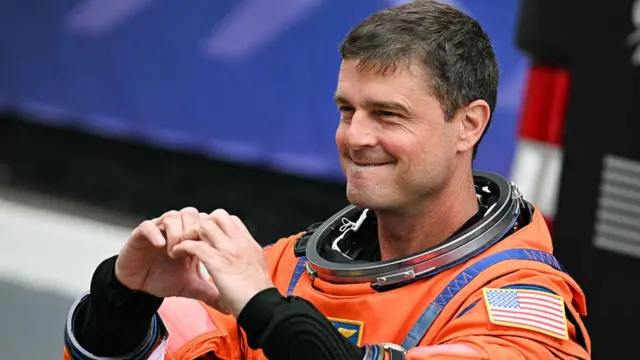
    NASA astronaut Reid Wiseman makes a heart sign with his handsImage source, Getty Images
    Image caption,

    Nasa astronaut Reid Wiseman makes a heart sign to those gathered to wave the astronauts off

    Pilot Victor Glover takes a photo with his family - putting his thumb upImage source, Getty Images
    Image caption,

    Pilot Victor Glover takes a photo with family members

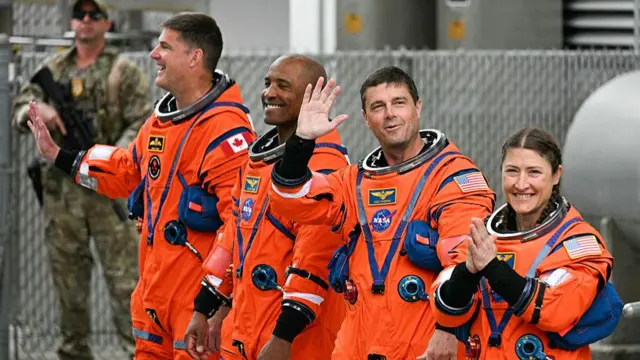
    Astronauts Victor Glover, Christina Koch and Reid Wiseman smile and waveImage source, Getty Images
    Image caption,

    Astronauts Victor Glover, Christina Koch and Reid Wiseman smile and wave

  16. Astronauts head to launch padpublished at 18:50 BST
    Breaking

    The four astronauts in their orange suits waveImage source, Getty Images

    The four astronauts have begun heading to the launch pad ahead of the launch window which is scheduled to open shortly after 23:20 BST (18:20 local time).

    You can watch live above.

  17. Astronauts play cards in suit-up room as part of long-standing Nasa traditionpublished at 18:44 BST

    Pallab Ghosh
    Science correspondent, reporting from the launch site

    Minutes before heading to the launch pad, the Artemis II crew have been playing cards in the suit‑up room – a small, light‑hearted moment that is in fact a long‑standing Nasa tradition.

    Seated in their orange launch and entry suits, with technicians making final checks, the astronauts gathered around a low table for a quick game.

    This ritual dates back at least to the space shuttle era and has since been adopted across Nasa’s human spaceflight programme, from missions to the International Space Station to today’s Moon mission.

    The rules are simple but symbolic: they keep playing until the commander loses a hand, taking the bad luck so the team can leave on a positive note.

  18. The distinctive orange Orion suit is designed for the riskiest momentspublished at 18:24 BST

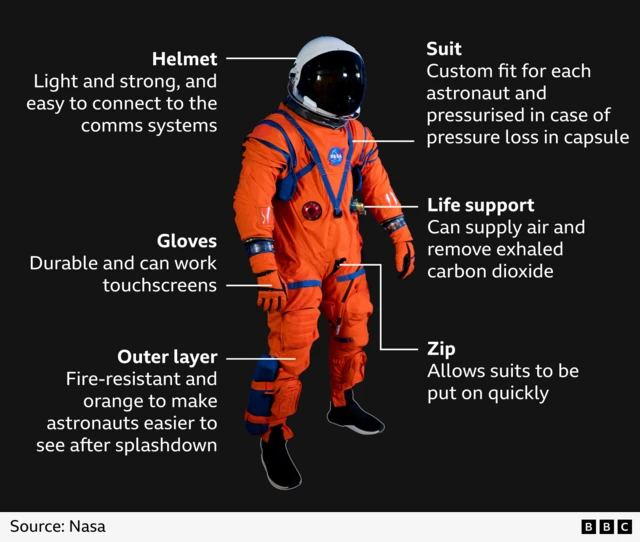
    We're continuing to see images of the four astronauts getting into their distinctive orange suits - known as the Orion Crew Survival System.

    They will wear them during launch, re-entry and at other key moments.

    It’s like a mini-wearable spacecraft, pressurised with inbuilt life-support systems.

    In the event of an emergency on their way to or from the Moon, the astronauts would quickly suit up – the spacesuit is designed to keep them alive for up to six days as they make their way back to Earth.

    Unlike Shuttle-era space suite, which came in off-the-shelf sizes, these are custom fitted for each crew member. That should keep them more comfortable when worn pressurised for a long time.

    A full-body image of a Nasa astronaut suit on a black background. The orange suit has a white helmet with a dark visor, blue straps, and black boots. Labels identify features: the helmet is described as light, strong, and easy to connect to communication systems; the suit is custom‑fitted and pressurised for emergencies; the life support system can supply air and remove carbon dioxide; a zip allows the suit to be put on quickly; gloves are durable and touchscreen‑capable; and the outer layer is fire‑resistant and bright orange to improve visibility after splashdown.
  19. Astronauts appear happy and relaxed ahead of launchpublished at 18:17 BST

    Pallab Ghosh
    Science correspondent, reporting from the launch site

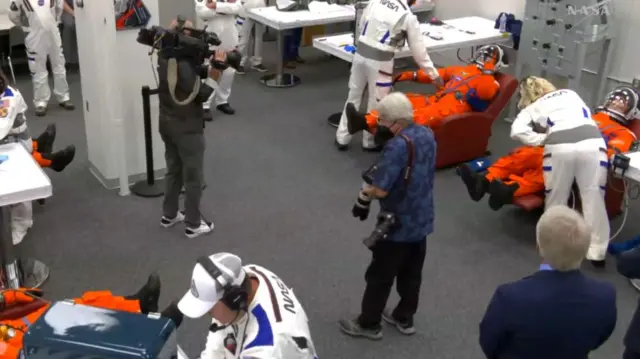
    Two astronauts can be seen lying in a seat while Nasa workers adjust their suitsImage source, NASA

    As we've reported, the astronauts are suiting up now - getting ready ahead of entering the capsule in about an hour or so.

    They’re all looking happy and surprisingly relaxed considering what is ahead of them.

  20. Meet the crew of Artemis IIpublished at 18:13 BST

    We've just had the first images of the astronauts Reid Wiseman, Victor Glover, Christina Koch and Jeremy Hansen suiting up.

    Here's a brief introduction:

Trending Now