Summary

  • Details from the final three minutes of the cockpit voice recorder have been shared by US officials investigating the deadly plane crash at New York's LaGuardia Airport

  • A truck is told to stop moving nine seconds before the cockpit recording ends. This direction happens again four seconds before the recording stops

  • The truck did not have a transponder, National Transportation Safety Board chair Jennifer Homendy says, which could have helped trigger an alarm on a runway warning system

  • Two pilots were killed and 43 passengers and crew were injured when the Air Canada plane operated by Jazz Aviation collided with a fire truck after landing on Sunday evening

  • Two people who were inside the truck were also injured and taken to hospital

  • Homendy says two air traffic controllers were in the tower at the time of the collision, which she says is standard for that time of night

  1. Officials warn against 'finger pointing' as investigation unfoldspublished at 20:37 GMT

    Investigators are still analysing the moments before an Air Canada plane and fire truck fatally collided at one of the nation's busiest airports on Sunday night.

    A preliminary assessment by the National Transportation Safety Board has raised concerns about overnight staffing levels at the air traffic control tower as well as technological lapses that may have contributed to the collision at New York City's LaGuardia Airport. The board released details of the last three minutes before the deadly collision.

    NTSB chair Jennifer Homendy has cautioned against "finger pointing" and speculation as investigators work their way through what happened.

    Pilots Antoine Forest and Mackenzie Gunther died as a result of the crash, external and several passengers and crew were injured.

    Flight attendant Solange Tremblay from Quebec survived after being ejected from the plane and was found alive strapped to her seat more than a hundred metres (300ft) from the plane, suffering multiple fractures.

    We are ending our live coverage for today but you can read more on this story here: Pilots killed in LaGuardia plane crash named
  2. Passenger recalls moment of impactpublished at 20:15 GMT

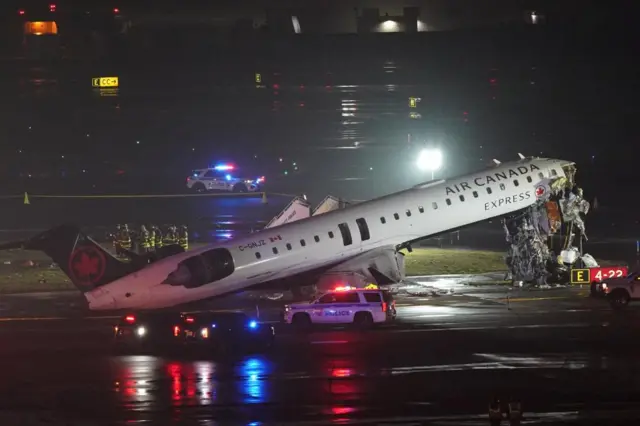
    An Air Canada plane with its cockpit missing tilts backward on its tail with emergency vehicles nearbyImage source, Reuters

    Passenger Rebecca Liquori, who was on the Air Canada Express plane arriving from Montreal when it hit the truck, told News12 Long Island there was a loud "boom" just after it landed.

    "As we were descending, we hit a lot of turbulence," she said. "Then we landed very roughly… Everyone felt it. It was like the plane jolted and you heard the pilot try to brake trying to prevent the collision."

    "As you heard the brake, a couple seconds later it was just a very loud boom," she added. "Everybody jolted out of their seats."

    Liquori described passengers helping each other slide down a wing to get out.

    "I'm just happy to be alive," she said. "I would have never pictured a one-hour flight that I've done countless times … ending like this."

    Read more eye witness accounts here: 'Like the plane got cut in half': LaGuardia crash that killed two pilots now under investigation

  3. What is the current status of LaGuardia Airport?published at 19:59 GMT

    LaGuardia Airport is open for international and domestic flights but there are some changes following Sunday's crash.

    Runway 4 at LaGuardia, where the crash happened is "closed nightly" from 03:00 GMT (10:00 PM EST) to 11:00 GMT (6:00 AM EST), according to an advisory by the Federal Aviation Administration.

    The closure is in effect until 27 March, the advisory says.

  4. Here's what investigators say happened in the three minutes before the crashpublished at 19:30 GMT

    Media caption,

    Official details cockpit voice recorder audio

    The news conference at LaGuardia Airport just took us through a detailed timeline of the three minutes leading up to Sunday's Air Canada plane crash, including what investigators have heard on the cockpit voice recorder.

    Here is a full timeline of what investigators say happened:

    3 minutes, 7 seconds - Air Canada pilots are instructed to contact LaGuardia tower

    2 minutes, 45 seconds - Aircraft lowers its landing gear

    2 minutes, 22 seconds - Flight crew checks in with LaGuardia tower

    2 minutes, 17 seconds - Tower clears plane to land on runway 4

    1 minutes, 12 seconds - Flight crew confirms landing checklist complete

    1 minute, 3 seconds - Airport vehicle makes transmission to the tower, but transmission was "stepped on" by another unidentified radio transmission

    54 seconds - Flight crew acknowledges plane was 500 feet (152m) above the ground and on a stable approach

    40 seconds - LaGuardia tower asks which vehicle needed to cross a runway

    28 seconds - Truck 1 makes radio transmission to the tower

    25 seconds - Truck 1 requests to cross runway 4

    20 seconds - Tower clears Truck 1 to cross runway 4

    9 seconds - Tower instructs Truck 1 to stop

    8 seconds - Sound consistent with airplane landing

    4 seconds - Tower again tells Truck 1 to stop moving

    0 seconds - Recording ends

  5. What did officials reveal about the crash in this latest briefing?published at 19:09 GMT

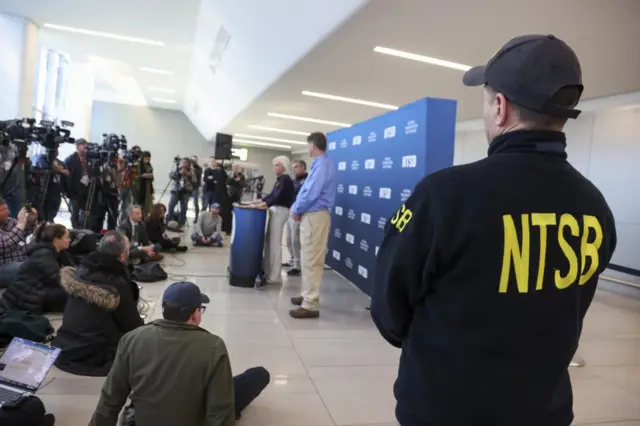
    A man in a cap and an NTSB jacket watches as officials brief the pressImage source, EPA
    Image caption,

    Officials from the National Transportation Safety Board brief reporters at LaGuardia Airport

    We have just heard from federal officials investigating Sunday night's crash at LaGuardia Airport in New York.

    Here is a round up of the major updates:

    • NTSB senior aviation investigator Doug Brazy gave a detailed account of the last three minutes before the Air Canada plane and a truck collided
    • NTSB chair Jennifer Homendy warned about speculation about air traffic control staffing, along with rumours about fatigue and distractions by staff
    • She confirmed there were two controllers in the control tower at the time of the collision and that the reduced overnight staffing was standard operating procedure even though her agency has raised concerns about it previously
    • Homendy also revealed that a ground radar system that could have alerted before the collision didn't give an alert and the truck did not have a transponder which would have helped
    • She says while the US airspace is remains very safe, it is using outdated technology and needs to be upgraded
  6. Communication issues may be key to investigationpublished at 18:47 GMT

    Homendy is asked to clarify the term "stepped on" with regards to communications between air traffic control, aircraft and airport vehicles.

    She explains that if a communication is "stepped on" it means there was interference and someone maybe not be able to hear part of a communication.

    Earlier, NTSB investigator Doug Brazy, said a radio communication was "stepped on" in the final minutes of the crash.

    Homendy is asked if the two crew members in the firefighting truck heard the control tower's directive to stop.

    She says she is not sure and interviews need to be conducted with both of those individuals.

    There is also no information she can share on whether the truck turned or braked in the seconds before the crash, she adds.

    With that, the news conference ends.

  7. Air traffic control system needs an upgrade, NTSB chair sayspublished at 18:41 GMT

    The air traffic control system needs an "upgrade", Homendy says.

    "Controllers should have all the information and the tools to do their job," she says. "You have to have information on the ground movements, whether that's aircraft or vehicles... this is 2026."

    She calls the current system "old".

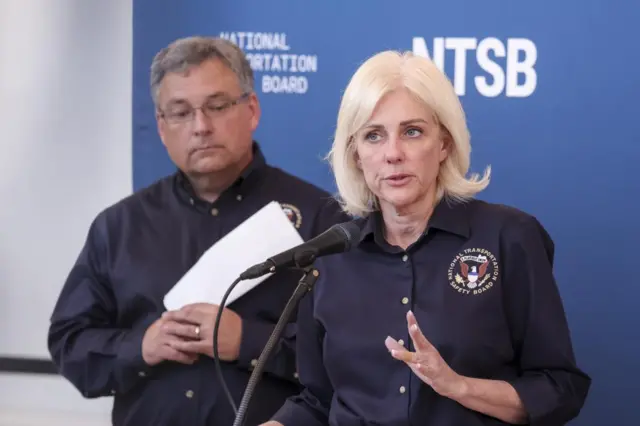
    A man and a woman stand in front of a blue background with NTSB written across itImage source, EPA
    Image caption,

    Doug Brazy (L) and Chair Jennifer Homendy (R) of the National Transportation Safety Board

  8. Lack of truck transponder made it difficult to detectpublished at 18:37 GMT

    Homendy is asked about the failure of ASDE-X to generate a collision alert.

    She says the truck that collided with the plane did not have a transponder making it difficult for the radar system to detect movement.

    It would have been helpful when you have a radar target, she says.

  9. If something goes wrong, many things have gone wrong, NTSB chair sayspublished at 18:34 GMT

    NTSB chair HomendyImage source, Reuters

    "This is a heavy workload environment," Homendy says of the control tower.

    She says when something goes wrong, "many, many things have gone wrong".

    She cautions against any reporting of what might have happened until they have all the information, and particularly cautions against reports that it could be caused by a distraction.

  10. NTSB chair cautions against 'pointing fingers'published at 18:33 GMT

    It's standard procedure to have two people on duty in the control tower, Homendy says.

    She adds that this is something air traffic controllers have expressed concerns about for years, especially on days when there is a heavy workload.

    Homendy cautions media and the public against "pointing fingers" at anyone at this stage.

  11. Ground surveillance system did not generate alertpublished at 18:32 GMT

    NTSB chair Homendy says the ASDE-X, a surveillance system at the airport using radar and other technology, did not generate an alert due to the close proximity of vehicles merging on the runway.

    She adds that runway status lights were functioning as normal.

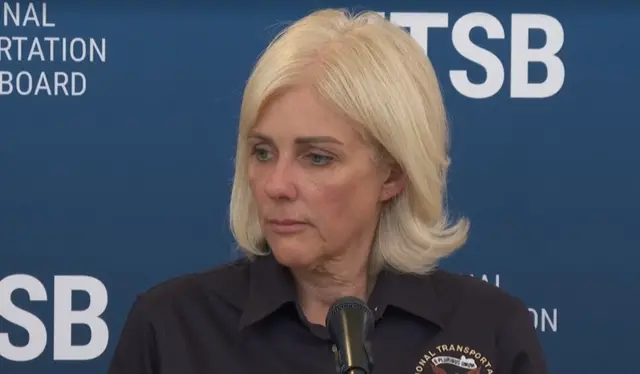
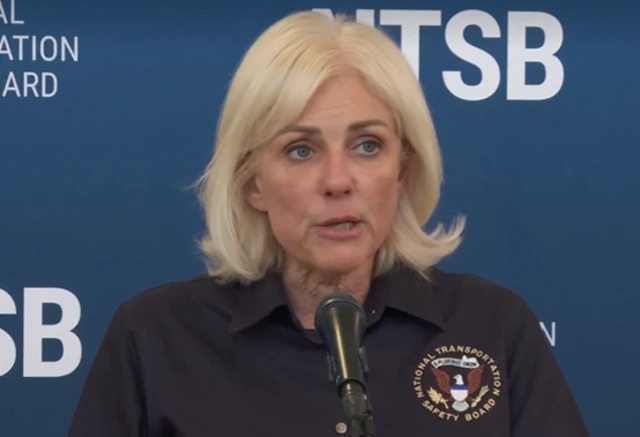
    A woman with blonde hair speaks into a microphone in front of a blue backgroundImage source, Reuters
  12. Two controllers in air tower, NTSB sayspublished at 18:30 GMT

    NTSB chair Homendy is giving information on the control tower. She says the midnight shift was operating under standard operating procedures.

    There were two people in the tower cab, the local controller and the controller in charge. The local controller signed on at 22:45 local time.

    The controller in charge clocked in at 22:30.

    It is not clear who was conducting the duties of the ground controller, and there is conflicting information, Homendy says.

    Homendy also mentions the truck that had requested to cross the runway.

    "We do know there were other vehicles behind truck 1 that did not cross the runway," NTSB chair Homendy says.

    She says truck 1 did not have a transponder.

  13. Officials gives account of final 10 seconds of recordingpublished at 18:29 GMT

    Aviation Accident Investigator Doug Brazy continues describing the moments leading up to the crash.

    Here's what he says happened in the final 10 seconds:

    10 seconds - An electronic "10" call out was heard

    9 seconds - The tower instructed truck one to stop

    8 seconds - A sound consistent with the aircraft's landing gear touching down on the runway

    6 seconds - Pilot transfer of controls from one pilot to the other

    4 seconds - Tower again instructs the truck to stop moving

    0 seconds - Recording ends

  14. Truck's request to cross runway was recorded in cockpit audiopublished at 18:28 GMT

    Doug Brazy, NTSB senior aviation investigator, has given a detailed preliminary account of the last three minutes before the collision.

    The Air Canada plane's landing gear lowered and shortly after that occurred, a transmission for a request for the fire truck to cross the runway came in.

    It was "stepped on by another transmission".

    The truck later got a positive signal to cross the runway.

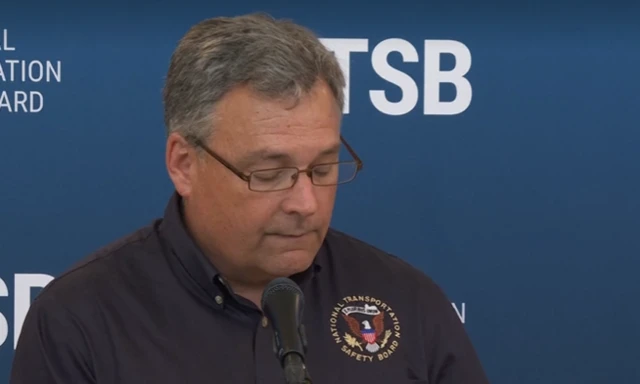
    A man in glasses speaks into a microphoneImage source, Reuters
    Image caption,

    Doug Brazy of the NTSB

  15. Officials to share final three minutes of cockpit voice recorderpublished at 18:18 GMT

    NTSB chair Jennifer Homendy speaks first. She says she has a lot of investigative information to share today, including preliminary information to share from the final three minutes of the cockpit voice recorder.

  16. Federal transportation investigators get news conference under waypublished at 18:13 GMT

    Officials from the National Transportation Safety (NTSB) Board are beginning a news conference to give an update on Sunday's fatal collision.

    The news conference is being held at LaGuardia Airport in New York and the NTSB, which investigates air traffic accidents, is expected to answer questions about what they know so far about the moments leading up to impact.

    You can watch the briefing live at the top of this page.

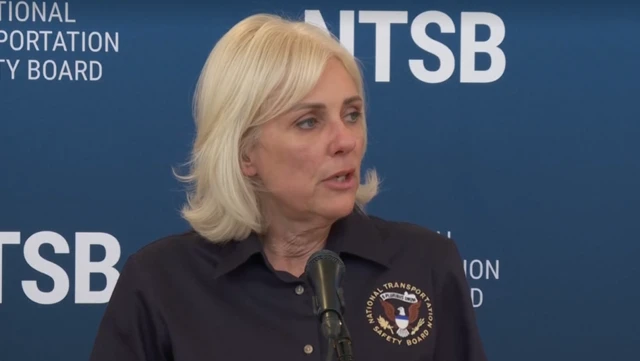
    NTSB Chair Jennifer Homendy speaks into a microphoneImage source, Reuters
    Image caption,

    NTSB Chair Jennifer Homendy

  17. Officials expected to provide information on flight data recorderspublished at 18:07 GMT

    The news conference at LaGuardia Airport has been pushed back again until 14:15 ET according to a member of staff.

    Officials, likely including NTSB chairwoman Jennifer Homendy, are expected to speak soon and we hope to get more information about what investigators found when listening to the cockpit recorder.

    Stick with us.

  18. Crash update delayed by half an hourpublished at 17:41 GMT

    We were expecting to hear an update on the crash from officials at the National Transportation Safety Board about 10 minutes ago.

    That news conference has now been pushed back to 14:00 local time (18:00 GMT).

    When it starts, we will bring you the key lines here, or you can click watch live above.

  19. Not unusual, but 'far from ideal', for one controller to cover both ground and airpublished at 17:27 GMT

    Nadine Yousif
    North America reporter

    Aviation safety experts who spoke to BBC say that having one controller in charge of both ground and air traffic at a busy airport like LaGuardia is not unusual, especially late at night when staffing tends to be low.

    "It's normal procedure to combine positions like that, because there's just not enough to keep everybody busy," says Margaret Wallace, a professor of aviation management at the Florida Institute of Technology.

    But having a controller in charge of both is also "far from ideal", says Kivanc Avrenli, a professor and commercial aviation safety expert at Syracuse University.

    The level of staffing at the control tower remains a major question after an Air Canada plane collided with an emergency vehicle on the runway Sunday evening, killing two pilots and injuring dozens of passengers.

    Air traffic control audio captured moments before the crash reveals the emergency vehicle was given permission by a controller to cross the runway before he abruptly asks it to stop repeatedly.

    Avrenli says he hopes investigators can answer what he says is a tough question: "Is this just human error, or does it expose cracks in how busy airports are managing workload and staffing?"

  20. A timeline of events surrounding the fatal crashpublished at 17:14 GMT

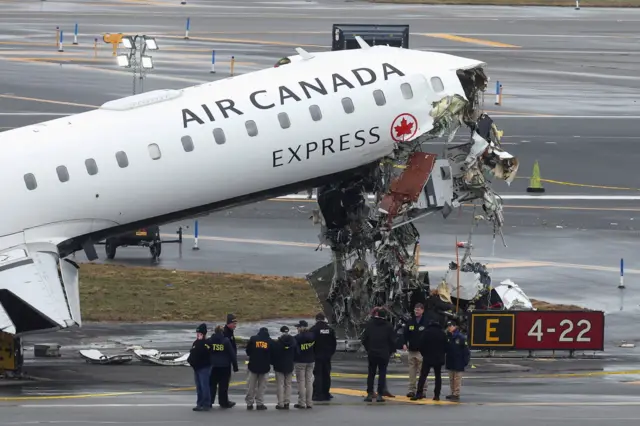
    The mangled front of a single aisle Air Canada Express passenger jet looms over a group of crash scene investigators at New York's LaGuardia AirportImage source, Reuters

    Here's a recap of the series of events leading up to, and after, an Air Canada flight from Montreal colliding with a fire truck on the ground after landing at LaGuardia airport on Sunday night, killing two pilots and injuring dozens of others.

    • 22:12 ET (02:12 GMT): Air Canada flight AC8646 departs Montreal, Canada, over two hours late, according to tracking website FlightAware
    • "Minutes before" 23:40: A Port Authority rescue and firefighter vehicle is called to a separate issue on a United flight at LaGuardia Airport in New York, that had "requested support"
    • The Air Canada plane lands at LaGuardia and collides with the firefighter truck that is crossing the runway, despite a panicked message from Air Traffic Control for the vehicle to stop
    • The plane is travelling at approximately 100 mph and the cockpit is crushed on impact with the truck, which flips over down the runway
    • 23:40: Emergency services "immediately responded"
    • 03:09: LaGuardia Airport says that the "airport is currently closed" due to the incident
    • At around 03:30: The "first portion" of National Transportation Safety Board (NTSB) - the investigation team - arrives
    • 04:48: Port Authority Chief Executive Kathryn Garcia holds a press conference, confirming that two Air Canada pilots have been killed, and nine people out of dozens injured remain in hospital
    • At around 10:00: The flight board displaying upcoming LaGuardia departures begins to get updated with flight times for later in the day. Previously, every flight was listed as "cancelled"
    • 14:00: LaGuardia Airport reopens with limited flights, as passengers face long lines to get through airport security
    • 15:30: Officials hold a news conference, expressing their condolences to the loved ones of the pilots killed, and reiterating that this is an ongoing investigation
    • Monday evening: Two officers who were in the fire truck when it collided with the plane were hospitalised - one was released late on Monday with the other remaining in hospital for another night for observation
    • Tuesday: NTSB officials will give an update concerning the cockpit audio and flight data recorders

Trending Now