Summary

  1. France and UK will lead mission to protect freedom of navigation of strait - Starmerpublished at 15:13 BST
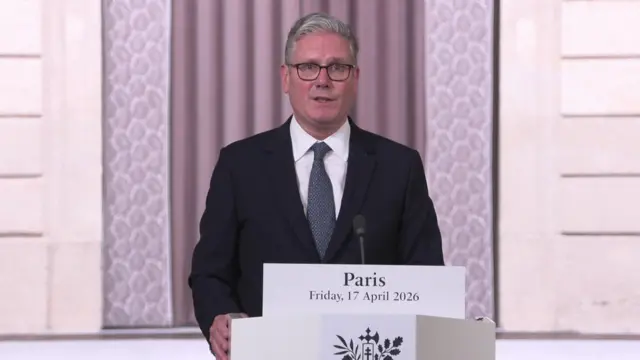
    Stamrer speaking at news conference

    British Prime Minister Sir Keir Starmer then speaks saying the leaders welcome the news that Iran is opening the Strait of Hormuz but adds that it needs to be a long lasting and workable solution.

    He says the international leaders came together to promote a unified message that the strait must be opened without tolls and without restrictions.

    Starmer calls for shipping to resume as soon as conditions permit to manage the economic shock.

    He says France and the UK will lead an international mission to protect freedom of navigation "as soon as conditions allow, strictly peaceful and defensive".

    He continues saying there will be a planning conference in London next week, with a dozen countries set to contribute assets to the mission.

    He finishes by saying "our citizens need to see a return to peace and stability".
  2. Macron says closure of strait affected the 'whole of the planet'published at 15:08 BST

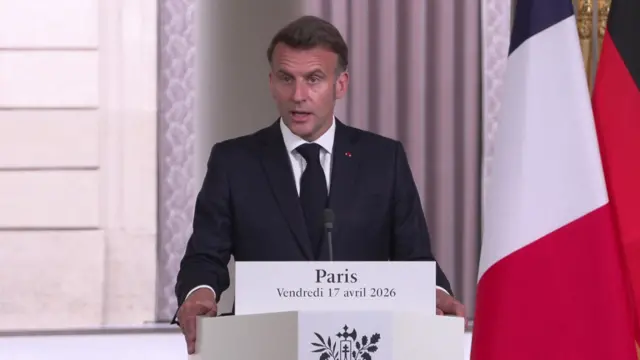
    Macron speaking at news conference

    French President Emmanuel Macron begins the news conference by setting out the "very severe consequences" the closure of the Strait of Hormuz has had "for the whole of the planet and the global economy".

    He says he welcomes recent announcements, including the ceasefire between Iran and the US, the recent ceasefire in Lebanon - which he says "has to be fully observed" - and the reopening of the strait.

    "Diplomacy is taking us forward," he says.

    He says the group of countries who have met today demand "the full immediate and unconditional reopening of the Strait of Hormuz by all parties", the "restoration of free passage conditions that existed before the war", and he says they oppose any attempts to privatise the strait and any type of toll system.

  3. Macron and Starmer speaking now - watch livepublished at 15:01 BST

    We are now hearing from French President Emmanuel Macron and UK Prime Minister Keir Starmer, who have been chairing a virtual meeting of around 40 countries today.

    The Chancellor of Germany Friedrich Merz and Italian Prime Minister Georgia Meloni are also with them.

    Their news conference is just starting, we will bring you the latest lines and you can also watch live by pressing watch live at the top of the page.

  4. No quick fix for return to normal shipping in Strait of Hormuzpublished at 14:58 BST

    Jonathan Josephs
    BBC business reporter

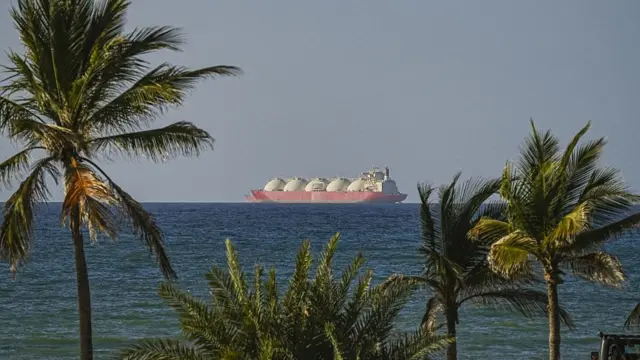
    Ship travelling along Strait of Hormuz, there are several trees in the foreground.Image source, Getty Images

    On the face of it, Iran’s reopening of the Strait of Hormuz is welcome news, but the reality could be more complicated.

    The major shipping companies have continually stressed that the safety of their crews and vessels is their top priority.

    It is likely they will want to see a sustained cessation of hostilities before they feel they can return to what was an important route for global shipping.

    Despite 10 seafarers being killed, smaller shipping companies have been more prepared to embrace those risks.

    The closest comparison is when ships avoided the route through the Red Sea and Suez Canal after Houthi rebels began attacking ships in December 2023.

    It took more than two years for a limited return to begin which only happened after months went by without any attacks.

    However, there are two key differences when it comes to the Strait of Hormuz.

    Firstly, there is no alternative route, and secondly moving huge quantities of oil and gas is vitally important to the global economy which means there are greater incentives to return.

  5. Stock markets rise after strait declared 'completely open'published at 14:48 BST

    Mark Broad
    Business news editor

    European and US stock markets have risen after Iran’s foreign minister declared the Strait of Hormuz “completely open”.

    The CAC in Paris and DAX in Frankfurt are both up by over 2%. In London, the FTSE’s rise was more modest, at 0.5%.

    In the US, in the opening minutes of trading, the Dow is up 1.3% and the S&P 0.7%.

  6. Oil price falls sharply after Strait of Hormuz announcementpublished at 14:41 BST

    Theo Leggett
    International business correspondent

    The price of crude oil has fallen sharply, after Iran’s foreign minister said the Strait of Hormuz would be completely open to commercial shipping for the “remaining period of ceasefire.”

    Following the announcement, the cost of a barrel of Brent crude fell to below $90 a barrel, having been above $98 earlier in the day.

    NYMEX light sweet crude, the US benchmark, also dropped significantly.

    Before the conflict, Brent crude was trading at just below $70 a barrel. It rose above $100 in early March and peaked at more than $119 later that month.

  7. Trump: Strait of Hormuz completely open for business, but US blockade of Iran's ports will remain in placepublished at 14:34 BST
    Breaking

    There's a follow-up Truth Social post from Donald Trump now, in which he says the Strait of Hormuz is "COMPLETELY OPEN AND READY FOR BUSINESS".

    He goes on:

    "BUT THE NAVAL BLOCKADE WILL REMAIN IN FULL FORCE AND EFFECT AS IT PERTAINS TO IRAN, ONLY, UNTIL SUCH TIME AS OUR TRANSACTION WITH IRAN IS 100% COMPLETE.

    "THIS PROCESS SHOULD GO VERY QUICKLY IN THAT MOST OF THE POINTS ARE ALREADY NEGOTIATED. THANK YOU FOR YOUR ATTENTION TO THIS MATTER! PRESIDENT DONALD J.TRUMP".

  8. What is the Strait of Hormuz, why does it matter?published at 14:22 BST

    It's a critical shipping route through which roughly 20% of the world's oil and natural liquefied gas is transported.

    The strait's geography has allowed Iran to use it as leverage throughout this war, selectively preventing vessels from passing through the narrow waterway and spiking oil prices in the process.

    Bounded to the north by Iran and to the south by Oman and the United Arab Emirates (UAE), the corridor - only about 50km (31 miles) wide at its entrance and exit, and about 33km wide at its narrowest point - connects the Gulf with the Arabian Sea.

    The strait is deep enough for the world's biggest crude oil tankers, and is used by major Middle Eastern oil and LNG producers, as well as their customers.

    In 2025, about 20 million barrels of oil and oil products passed through the Strait of Hormuz per day, according to estimates from the US Energy Information Administration (EIA). That is nearly $600bn (£447bn) worth of energy trade per year.

    The oil comes not only from Iran but other Gulf states such as Iraq, Kuwait, Qatar, Saudi Arabia and the UAE.

  9. 'THANK YOU!': Trump posts about strait being reopenedpublished at 14:14 BST
    Breaking

    US President Donald Trump just posted on Truth Social - he says:

    "IRAN HAS JUST ANNOUNCED THAT THE STRAIT OF IRAN IS FULLY OPEN AND READY FOR FULL PASSAGE. THANK YOU!"

  10. Iran foreign minister says Strait of Hormuz open for remainder of ceasefirepublished at 14:08 BST
    Breaking

    The Strait of Hormuz is "declared completely open" for the "remaining period of ceasefire," says Iranian Foreign Minister Abbas Araghchi.

    In a statement on X, he says: "In line with the ceasefire in Lebanon, the passage for all commercial vessels through [the] Strait of Hormuz is declared completely open for the remaining period of ceasefire, on the coordinated route as already announced by Ports and Maritime Organisation of the Islamic Rep. of Iran."

    The US announced it would begin a naval blockade of the Strait of Hormuz earlier this week, after Iran had effectively closed the world's busiest oil shipping channel for weeks in response to the US-Israeli attack on Iran in February.

    We have not heard an immediate response from the US. The two-week Iran-US ceasefire is due to expire on 22 April.

  11. Truce gives Lebanon respite, but many fear the fighting could resumepublished at 14:02 BST

    Hugo Bachega
    Middle East correspondent in Beirut

    Many of those heading south in Lebanon will not be returning to stay.

    In some places, the damage is too extensive. For some, there’s nothing to go back to, and some towns and villages near the border are still under Israeli occupation.

    The ceasefire deal does not mention when, or if, the invading troops will pull out. Israeli officials are warning they are there to stay.

    The truce gives Lebanon at least ten days of respite, but many fear the fighting could resume. Hezbollah says it has the right to resist.

    The government here has tried to disarm the group, which is financed by Iran, but says this cannot happen by force.

    Hezbollah, so far, has refused to negotiate.

  12. BBC Verify

    Videos show traffic crossing key bridge in Lebanonpublished at 13:50 BST

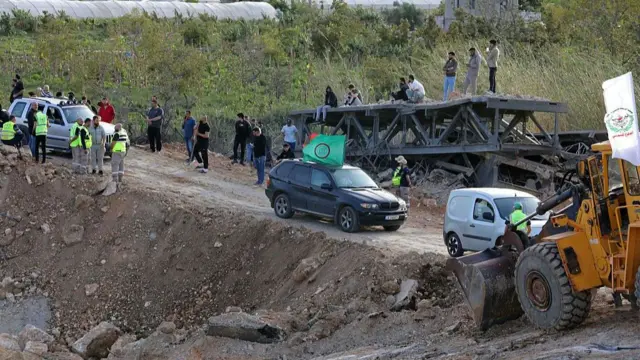
    Vehicles cross as repairs continue to the bridge over the Litani riverImage source, Getty Images

    By Kumar Malhotra and Peter Mwai

    We’ve been checking videos showing some vehicles attempting to cross a key road bridge in southern Lebanon which was struck in an air strike yesterday before the current Israeli-Lebanese ceasefire came into force.

    Verified footage shows bulldozers and earth-moving equipment in the area of al-Qasmiyeh bridge as well as a long queue of cars on the north side of the river waiting to cross.

    Our checks show this footage is new.

    The bridge lies between the Lebanese cities of Sidon and Tyre and is on the main route to the south of the country from the capital Beirut.

    It appears temporary repairs were carried out at the crossing after it was severely damaged in yesterday’s air strike.

    The bridge has been targeted previously by Israeli forces during the conflict with the Iran-backed Hezbollah group.

  13. 'Opportunity must not be squandered', Lebanese president sayspublished at 13:19 BST

    Lebanon's leader President Joseph Aounhas says that direct negotiations with Israel are crucial for the country.

    "A ceasefire is the gateway to proceeding with negotiations," Aoun says - reiterating Lebanon's goal is to "consolidate a ceasefire, secure the withdrawal of Israeli forces from the occupied southern territories, recover prisoners, and address outstanding border disputes".

    The statement adds: "The Lebanese people, who have endured much in the past years, are today facing a new reality that has the support of Arab and international backing, and this opportunity must not be squandered because it may not come again."

  14. Campaign against Hezbollah 'still not complete' - Israel defence ministerpublished at 13:00 BST

    Israel has warned that thousands of displaced Lebanese civilians who are returning home could face evacuation again from southern Lebanon if fighting resumes, according to AFP.

    Defence Minister Israel Katz said in a broadcast statement that the strikes in Lebanon "have achieved many gains" but the campaign against Hezbollah is "still not complete".

    He said: "If the fighting resumes, those residents who return to the security zone will have to be evacuated to allow completion of the mission".

    He also said the Israeli military will continue to hold all positions it has “cleared and captured”, according to Reuters.

    Reacting to news of the truce on Thursday, Hezbollah said: "Any ceasefire must be comprehensive across all Lebanese territory and must not allow the Israeli enemy any freedom of movement."

  15. Hezbollah leader tells BBC it will 'never disarm'published at 12:45 BST

    Nawal Al-Maghafi
    Senior international correspondent

    Senior Hezbollah leader Wafiq Safa has told the BBC the group will "never, ever" disarm, hours before a 10-day ceasefire between Lebanon and Israel began.

    Israel’s Prime Minister Benjamin Netanyahu has said disarming Hezbollah is a fundamental demand in further talks with the Lebanese government.

    Asked about disarmament, Safa said: "Not until a proper ceasefire, a real one. Not until Israeli withdrawal. Before the return of prisoners, before the return of displaced people and before the reconstruction. Until then, it is not possible to talk about Hezbollah’s weapons.”

    The interview, at a residential building in Beirut, offers a rare glimpse into the coordination between Hezbollah and its main regional backer, Iran.

    “Hezbollah and Iran are two souls in one body," Safa said. "There can be no Hezbollah without Iran, and no Iran without Hezbollah," he said, describing the relationship as "religious, legal and ideological".

    Hezbollah, a Shia Muslim political and military group, opposes Israel’s right to exist and is considered a terrorist organisation by the US, UK, Israel and many other countries.

    The group joined the latest conflict by firing rockets into Israel in early March, saying it was retaliating for the killing of Iran's supreme leader and the near-daily Israeli strikes on Lebanon since their last war in November 2024. Israel responded with intense air strikes and another ground invasion of southern Lebanon, saying its campaign would continue until Hezbollah was disarmed.

    Asked whether Hezbollah was prioritising the interests of people in Lebanon or Iran, Safa said: “Of course, Hezbollah is looking at Lebanese interests."

    He argued Iranian support, including pressure for a ceasefire, had helped Lebanon in the current conflict.But many Lebanese - including people the BBC has spoken to during recent reporting - say they want the group disarmed and blame it for dragging the country into conflict.

    And with Hezbollah refusing to disarm and insisting on broader conditions, and Israel maintaining its security demands, any ceasefire may prove only a pause in a much longer conflict.

  16. Watch: BBC reports from southern Lebanon as 10-day truce beginspublished at 12:22 BST

    The BBC's Carine Torbey has been reporting from Nabatieh in southern Lebanon, where residents who fled their homes many weeks ago are starting to return.

    Destruction is widespread and many are assessing whether their homes are still standing, or if they've been completely destroyed.

    Media caption,

    Watch: Carine Torbey reports on the huge destruction in Nabatieh

  17. Israeli strikes killed 13 in Tyre, southern Lebanon, just before ceasefirepublished at 11:47 BST

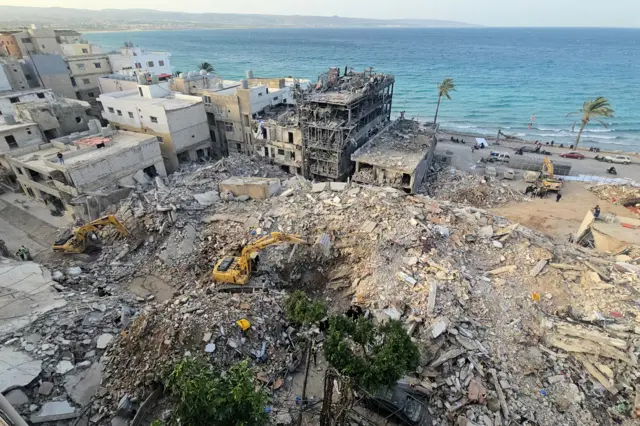
    A crater of rubble is seen from the air with diggers operating next to residential buildings adjacent to the sea in Tyre, LebanonImage source, Kawnat Haju / AFP via Getty Images

    Israeli forces hit the city of Tyre in Lebanon last night, killing 13 people and wounding 35, according to state-run media National News Agency.

    Earlier this morning search teams were still searching for 15 missing people under the rubble, it added.

    The strikes took place just before the 10-day ceasefire with Israel came into effect at midnight last night, AFP said, quoting a city official source.

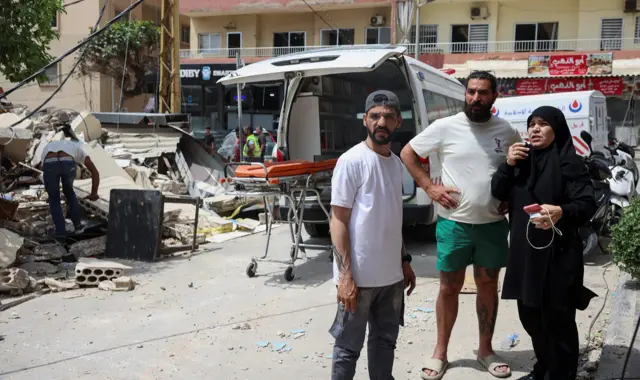
    People stand in front of an ambulance with a stretcher loaded into it next to people clearing rubble in Tyre on Friday.Image source, Louisa Gouliamaki / Reuters
  18. Starmer says he will do all he can to help open the Strait of Hormuzpublished at 11:31 BST

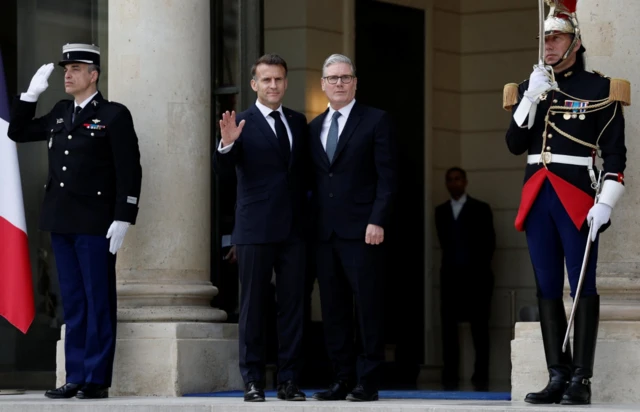
    French President Emmanuel Macron welcomes Britain's Prime Minister Keir Starmer for a lunch meeting at the Elysee PalaceImage source, Reuters

    Keir Starmer has just arrived at the Élysée Palace in Paris, and moments before meeting Emmanuel Macron, Starmer insisted he would “do everything I can” to alleviate the impact of the Iran war on the public and reopen the Strait of Hormuz.

    Starmer said: “It is very important that we build a coalition of countries around the principle that the ceasefire should be permanent, there should be a deal, and that the Strait of Hormuz is open.

    "It is in all of our interests to do that, because what’s happening in the war in Iran is affecting each of our economies. That’s why countries are coming together.

    "Everybody is clear that in order for that to happen, we need a diplomatic and political limb, we need a logistics and economic limb, and we need some military planning, and that is what we’re coming together to do today."

    This afternoon Starmer and Macron are chairing a virtual meeting of around 40 countries, aimed at establishing a multi-lateral mission to restore the safe passage of shipping through the Strait of Hormuz.

  19. Peace in interests of all stakeholders, Middle East expert tells BBCpublished at 11:06 BST

    Dr Lina Khatib is an associate fellow with the think tank Chatham House - with a focus on the Middle East - and she believes there is a "high likelihood" that this ten-day truce might lead to something more concrete.

    "That is because it is in the interests of all stakeholders to show success," Khatib tells BBC Radio 4's Today programme. "Of course, for the US, President Trump has already given himself credit for the ceasefire. He wants to show that he is ending wars.

    "For Israel, Prime Minister Netanyahu has said the ceasefire does not mean that Israel will withdraw from Lebanon, but he also needs to show results.

    "The same actually applies to Iran and Hezbollah. Iran has already given itself credit for the ceasefire claiming it is a result of its negotiations with the US in Pakistan.

    "So because everyone wants to show success - there is a greater opportunity for the ceasefire to hold."

  20. Watch: 'Unprecedented times' says Lyse Doucet, reporting from Iranpublished at 10:41 BST

    To think a deal between the US and Iran could be done in days seems hard to imagine, the BBC's chief international correspondent Lyse Doucet reports from Iran.

    Doucet outlines that in Iran, the leadership is still consolidating after so many top officials were assassinated during the war.

    Tehran's leadership is under pressure from hardliners within their own ranks, as well as many Iranians who want crippling sanctions lifted. But despite military and economic losses, Iran is not ready to surrender to what it sees as a deal on Washington's terms.

    Media caption,

    Iran not willing to make a deal on Washington's terms, says BBC's Lyse Doucet

Trending Now