Summary

Media caption,

'Will we lose? Of course not' - Zelensky speaks to BBC about war with Russia

  1. A day of solidarity from allies, as Ukraine enters fifth year of warpublished at 18:16 GMT 24 February
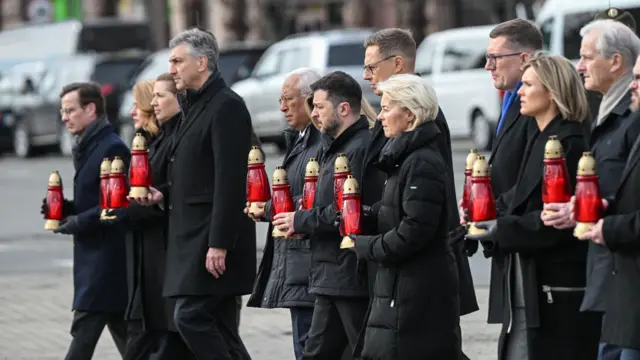
    Ukraine's President Volodymyr Zelensky (C-L), Estonia's Prime Minister Kristen Michal (C) and European Commission President Ursula von der Leyen (C-R) along with EU leaders attend a ceremony at the memorial to the fallen Ukrainian soldiers on Independence Square in Kyiv, Ukraine, 24 February 2026.Image source, EPA

    Four years ago today, Russia launched its full-scale invasion of Ukraine. It has been a day of solidarity from European allies, who have expressed their ongoing support, as commemorative events were held across Ukraine. Here's a recap.

    Zelensky: Putin has not achieved his goals

    Marking the anniversary today, Volodymyr Zelensky said Vladimir Putin "has not achieved his goals", and that Ukraine will do "everything to achieve peace and justice". Meanwhile, Russian state TV channels made no real mention of the significant date.

    Mapping Russia's progress

    As the war enters its fifth year, the battle between Russia and Ukraine is now mostly in the east - our map shows how military control of Ukraine has changed over the course of the war. Although Russia has been making some slow progress, it has come at significant cost in terms of casualties.

    Support from European allies

    UK PM Keir Starmer said that Ukraine's allies must "defeat the falsehood that Russia is winning", while French President Emmanuel Macron described the war as "a triple failure for Russia".

    A joint statement from G7 leaders - which technically includes Donald Trump - reaffirmed the group's "unwavering support for Ukraine in defending its territorial integrity and right to exist". Meanwhile, the 'coalition of the willing' called for an "unconditional ceasefire".

    Ongoing peace negotiations

    But after the latest round of US-led peace negotiations concluded without a breakthrough earlier this month - and with territorial issues still unresolved - there is still a big question mark over when the war could end.

    We're now closing our live coverage.

  2. Analysis

    Russia says it hasn't met its military objectives yet - but what are they?published at 18:07 GMT 24 February

    Paul Kirby
    Europe digital editor

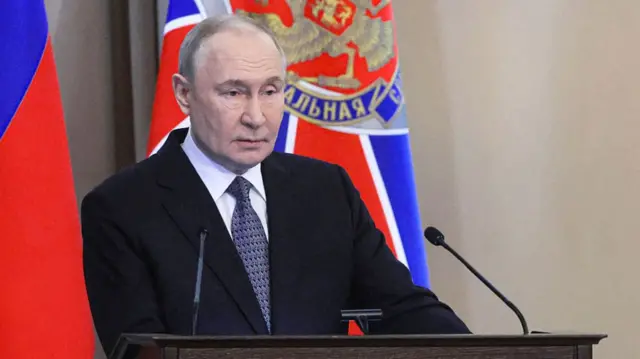
    Vladimir PutinImage source, Getty Images

    As we reported earlier, Russia has said its military objectives in Ukraine have not been met yet.

    But what are Russia's stated objectives?

    Soon after the launch of the full-scale invasion four years ago, President Vladimir Putin said his goal was to "demilitarise and denazify" Ukraine.

    Russia has repeatedly painted modern Ukraine as a Nazi state, in a crass distortion of history.

    The Russian leader has long questioned Ukraine's right to exist, claiming that "modern Ukraine was entirely created by Russia" after the communist revolution in 1917.

    Russia's state-run Ria news agency has said that "denazification is inevitably also de-Ukrainisation" - seemingly tying the idea of erasing Ukraine to the stated goal of the invasion.

    Ukrainian culture and identity have in fact existed for centuries independently of Russia.

    Another of his objectives was to ensure Ukraine stayed neutral. He has accused the Western defensive alliance, Nato, of trying to gain a foothold in Ukraine to bring its troops closer to Russia's borders.

    Putin has also refused to meet Volodymyr Zelensky, calling him an "illegitimate" leader - a false narrative that has also been repeated by Trump.

    As evidence Putin cites the postponement of Ukraine's March 2024 presidential election, although it is because of Russia's war that Ukraine is under martial law and elections are barred under the constitution.

  3. UN calls for lasting peace in Ukraine in ceasefire resolutionpublished at 17:50 GMT 24 February

    As we mentioned in our previous post, peace negotiations have shown little hope that a breakthrough is likely to be achieved soon.

    But the UN's General Assembly has again adopted a resolution calling for an immediate and unconditional ceasefire and "lasting peace in Ukraine".

    The resolution passed with 107 in favour, 12 against and 51 abstentions.

    That language was echoed by 'coalition of the willing' members today - with over 30 leaders including Keir Starmer calling for a "full, unconditional ceasefire".

  4. What progress is being made in peace negotiations?published at 17:35 GMT 24 February

    Vitaliy Shevchenko
    Chief analyst, BBC Monitoring

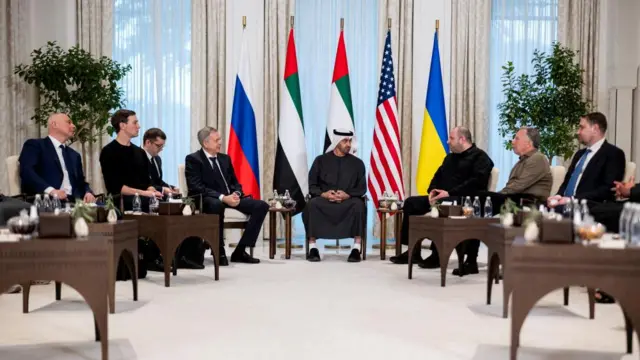
    We can see eight men sat in the photo in a palace in Abu Dhabi. At the centre is President of the United Arab Emirates Sheikh Mohamed bin Zayed Al Nahyan with Ukrainian, US, and Russian officials on either sideImage source, Reuters
    Image caption,

    The United Arab Emirates hosted trilateral talks between Russia, Ukraine, and the US in February

    Speaking at a meeting of the 'coalition of the willing', external earlier today, President Volodymyr Zelensky said that the next trilateral meeting involving negotiators from Ukraine, Russia and the US would take place later this week "or maybe within 10 days". Earlier, the head of the Ukrainian presidential office, Kyrylo Budanov, said the talks could be held in Geneva on 26-27 February.

    This will be the fourth round of such negotiations, all held this year.

    After the previous talks held in Abu Dhabi and then Geneva, officials said progress had been achieved on military issues, such as ways of monitoring any future ceasefire.

    Crucially, however, the talks have failed to change Moscow's position, which still rejects proposals to cease fire. It also demands that Ukrainian forces withdraw from the remaining 10% of Donbas region not currently controlled by Russian troops.

    Rhetoric from the Kremlin suggests that Russia's ambitions go far beyond controlling Donbas and amount to Ukraine capitulating or at least giving up significant elements of its sovereignty.

    There is little hope that a breakthrough is likely to be achieved on any of these issues at the negotiating table any time soon.

  5. Zelensky wants Trump to visit Ukrainepublished at 17:14 GMT 24 February

    Volodymyr Zelensky has invited Donald Trump to Ukraine, suggesting that it could help "understand what this war is really about".

    In an English version of his address to mark the fourth anniversary of the invasion shared on the presidency website, Zelensky says: "I really want to come here with the president of the United States one day.

    "I know for certain: only by coming to Ukraine, and seeing with one's own eyes our life and our struggle, feeling our people and the enormity of this pain - only then can one understand what this war is really about," he says.

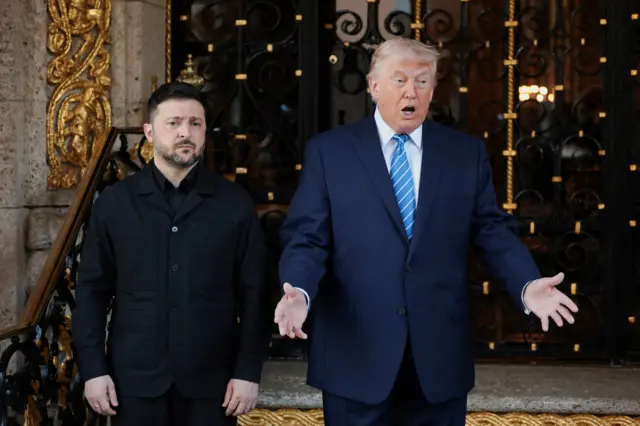
    Zelensky and Trump at a meeting in Mar-a-Lago in DecemberImage source, Reuters
    Image caption,

    Trump and Zelensky met at Mar-a-Lago in December

  6. Kyiv residents reflect on war four years onpublished at 16:58 GMT 24 February

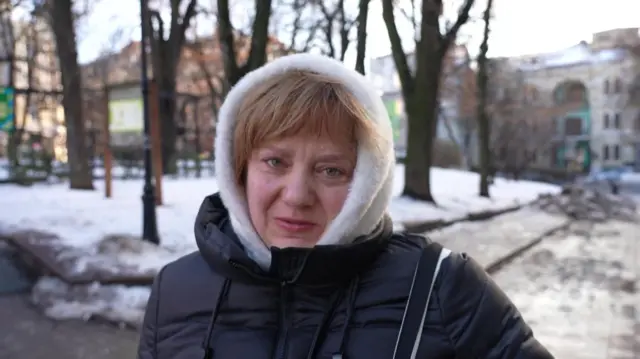
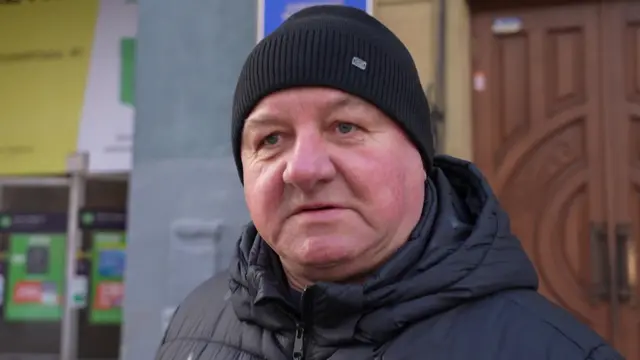
    Svitlana Yur speaks to Reuters in KyivImage source, Reuters
    Image caption,

    Kyiv local Svitlana Yur

    Four years after Russia launched its full-scale invasion of Ukraine, residents of Kyiv have been reflecting on the war.

    Forty-eight-year-old local Svitlana Yur says she "hoped until the very end" that there would not be war. "Even on the morning [of 24 February 2022] when I woke up from the explosions, I thought that tyres were bursting somewhere," she tells Reuters, according to a translated transcript of their conversation.

    A question many are asking is: how much longer will the war drag on? For 63-year-old teacher Viktor Buinovskyi, it's all down to Putin. "Everything depends on one person... the president of Russia," he says. "He started this war and he must end it."

    For another Kyiv resident, the mother of soldier Liudmyla Taran, the end of the war can't come soon enough. "Now my child has been at the front for four years... I want it to end today," she says. "Let those who are above us decide this issue. How they decide, I don't care. But I want peace."

    Viktor Buinovskyi speaks to Reuters in KyivImage source, Reuters
    Image caption,

    Teacher Viktor Buinovskyi

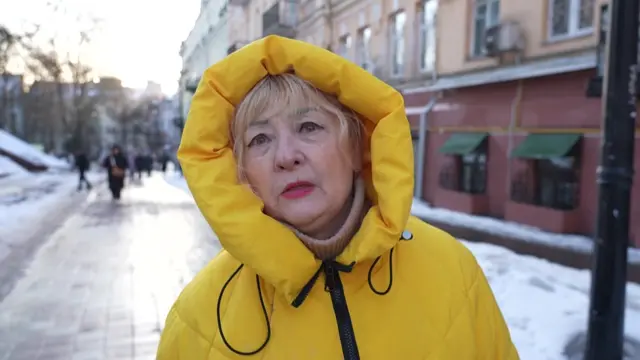
    Mother of soldier Liudmyla Taran speaks to Reuters in KyivImage source, Reuters
    Image caption,

    Mother of soldier Liudmyla Taran

  7. Armies around the world watch closely as drones transform the way the Ukraine war is foughtpublished at 16:49 GMT 24 February

    Jeremy Bowen
    International Editor, reporting from Ukraine

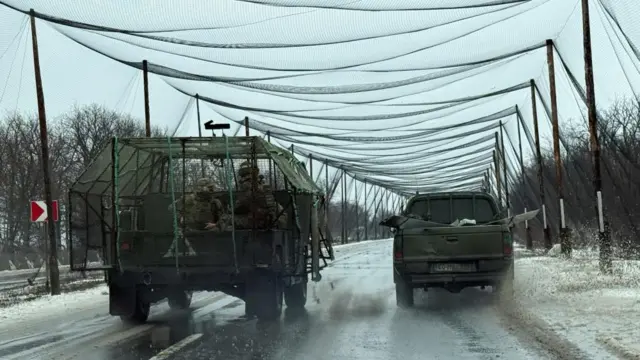
    A vehicle carrying Ukrainian soldiers is covered in netting next to a truck. Poles have been put up along the motorway which have fishing nets drapped over themImage source, Reuters

    On a dark and cold night in Donetsk in eastern Ukraine, the netting protecting the road from attacks by explosive drones shimmered and rippled in the headlights of our armoured Toyota Land Cruiser, as we drove down strange and surreal tunnels to get in and out of the most intensive area of fighting in eastern Ukraine.

    The nets go on for miles, suspended from wooden poles around 20ft high along the sides and over the top of the road.

    Nets snag the propellers of attacking drones, making them a cheap and surprisingly effective physical barrier.

    Much of the netting has been donated by European fishermen. Only this week the Scottish government announced it was sending over another 280 tonnes of salmon nets that were about to be recycled.

    Before any of it gets used, the Ukrainian military crashes drones into it to test its strength.

    After the full-scale invasion of Ukraine four years ago it still, for a while, felt like a 20th Century battlefield. But now drones have transformed the way the war is fought, and armies across the world are watching closely, being forced to change their ideas of how to fight.

  8. BBC visits metro station damaged by Ukraine warpublished at 16:37 GMT 24 February

    The BBC News special programme from Kyiv is live now, you can see that by clicking watch live at the top of the page.

    Presenter Lucy Hockings is at a metro station in Kyiv, where shrapnel has embedded into the marble walls and sometimes straight through into the station.

    It's near a military industry factory that's been targeted many times. Its worst attack was in July last year, where one person was killed and nine injured.

    But it's still a busy station, used every day as people come and go to work or university, as you can see in the clip below.

    Media caption,

    Watch: BBC at Kyiv metro station damaged by Ukraine war

  9. BBC News special programme reflects on four years of conflictpublished at 16:27 GMT 24 February

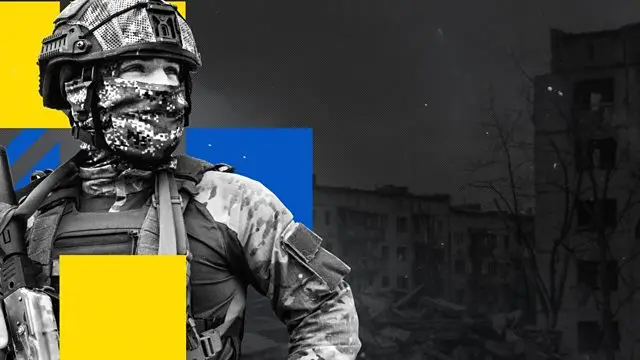
    An image of a Ukrainian soldier with blue and yellow squares, in the shades of the Ukrainian flag, behind him

    As the war in Ukraine enters its fifth year, BBC World News presenter Lucy Hockings presents a special programme from Kyiv, reflecting on the war with reporters on the ground and around the world.

    She will look at the impact that this devastating conflict has had and assess where it could be headed.

    Watch on the BBC News channel at 16:30 GMT or hit watch live at the top of the page.

  10. EU will deliver a €90bn loan to cover Ukraine's urgent defence needspublished at 16:17 GMT 24 February

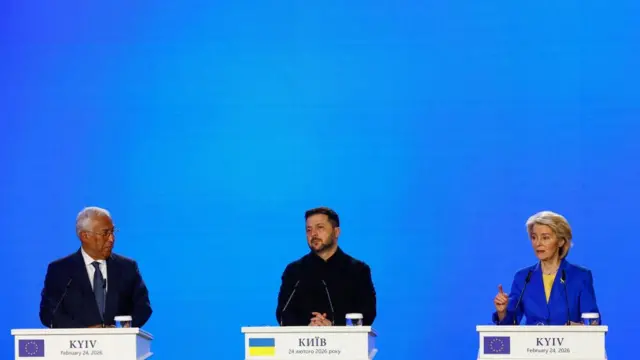
    Zelensky, von der Leyen and Costa stand at three separate podiums against a bright blue backgroundImage source, Reuters
    Image caption,

    Ukraine's President Volodymyr Zelensky, European Commission President Ursula von der Leyen and European Council President Antonio Costa attend a news conference

    In further European-led events, Ukrainian President Volodymyr Zelensky has been speaking at a news conference alongside European Commission President Ursula von der Leyen and European Council President Antonio Costa. It is the tenth time von der Leyen has visited Kyiv since the war first broke out four years ago.

    Here are the key points from the leaders:

    • Von der Leyen says the EU will deliver a €90bn loan to Ukraine "one way or another". She compared the loan to a "steel porcupine" and says it will make Ukraine "indigestible for potential invaders". She explains the loan will first be used for Ukraine's most urgent defence needs and aims to deliver the first package of support before Easter
    • Von der Leyen also says it is "deeply impressive" to see the progress Ukraine is making towards joining the EU despite fighting "a war for its survival". She says there is a lot of encouragement for Ukraine reforming and joining but could not give an exact date when it may become part of the trading bloc
    • Zelensky says there is no place for a Russian shadow fleet in European waters and that the leaders have been discussing changes to EU legislation to make it possible to stop Russian tankers and seize the oil they transfer
  11. G7 reaffirms support for Ukraine in joint statementpublished at 15:58 GMT 24 February

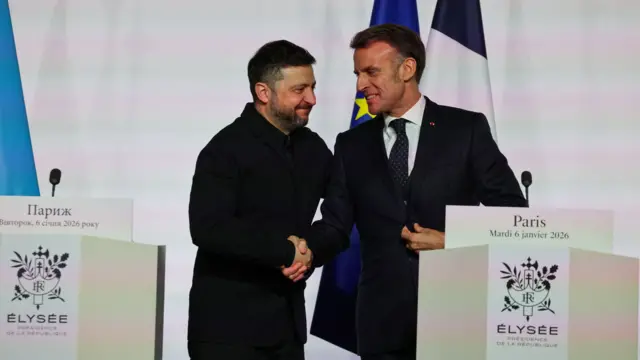
    France's President Emmanuel Macron and Ukraine's President Volodymyr Zelenskiy shake handsImage source, Reuters
    Image caption,

    Ukraine's Zelensky and France's Macron pictured earlier this year. France is chairing the G7 this year

    France is chairing the G7 this year, and the Elysée has today shared a joint statement from G7 leaders on its website. The message is one of support for Ukraine.

    The G7 statement makes reference to US-led peace efforts, but also emphasises Europe's role and the belief that "only Ukraine and Russia" can ultimately reach an agreement.

    "We express our continued support for President Trump’s efforts to achieve these objectives by initiating a peace process and bringing the parties to direct discussions," it says.

    "Europe has a leading role to play in this process, joined by other partners."

    It adds: "We acknowledge that only Ukraine and Russia, working together in good faith negotiations, can reach a peace agreement."

    Although Trump has been key in driving peace talks, he has previously been accused of being too aligned with Russia in negotiations. His administration has been putting pressure on Ukraine to give up strategic land and to hold elections.

    With the US being a G7 member, the message, technically at least in part, represents the Trump administration.

  12. Prince Harry says Ukrainian 'strength inspires the world' in anniversary messagepublished at 15:47 GMT 24 February

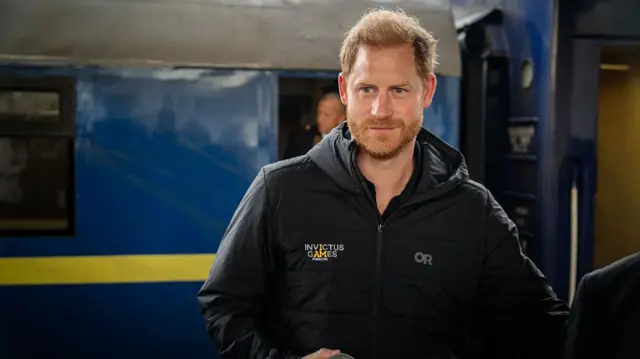
    Prince Harry in front of a train in KyivImage source, Getty Images
    Image caption,

    Prince Harry visited Ukraine in September last year

    Prince Harry says Ukraine "has shown the world what true resilience looks like", as it commemorates the fourth anniversary of Russia's full-scale invasion today.

    In a message shared with the Superhumans Center, a rehabilitation organisation for wounded veterans, Harry tells Ukrainian troops "your strength inspires the world".

    The royal says he has visited Ukraine twice in the last year, when he says he was "deeply moved by the courage, dignity and unbreakable spirit of the Ukrainian people".

    "Stay strong, stay brave, stay hopeful," he tells Ukrainians, finishing with the familiar message: "Slava Ukraini" - meaning 'glory to Ukraine'.

  13. Ukrainian refugees face changing attitudes in Polandpublished at 15:38 GMT 24 February

    Adam Easton
    Warsaw Correspondent

    Four years on since Russia’s invasion of Ukraine, there remain nearly one million Ukrainian refugees in Poland, on top of the roughly one million Ukrainian economic migrants who were already in the country.

    Around 12% of the refugees in Poland come from occupied territories in eastern Ukraine, according to the United Nations Refugee Agency, UNHCR.

    “Over time, Poland has created a win-win scenario: by turning the influx of refugees into a stronger Polish economy - with Ukrainian refugees generating 2.7% of the Polish GDP in 2024” Kevin J. Allen, UNHCR Representative in Poland said in a statement.

    But attitudes towards Ukrainians have evolved over time. In 2022, thousands of Polish families gave their spare rooms in their homes to fleeing refugees.

    Opinions among some Poles have hardened, encouraged by right-wing parties, who accuse Ukrainians of sponging off the state. Ukrainians have been verbally and physically assaulted on the streets.

    Most Poles, however, want to see Ukraine inside the European Union.

    According to a CBOS poll published Tuesday, 68.9% of respondents said they want Ukraine to join the EU, but most of them said Kyiv must meet the entry conditions beforehand.

    Farmers were the most sceptical, with 46.6% against Ukraine’s accession, amid concerns over cheaper Ukrainian competition.

  14. Flowers placed at Ukrainian monuments in Russiapublished at 15:30 GMT 24 February

    Olga Ivshina
    BBC Russian

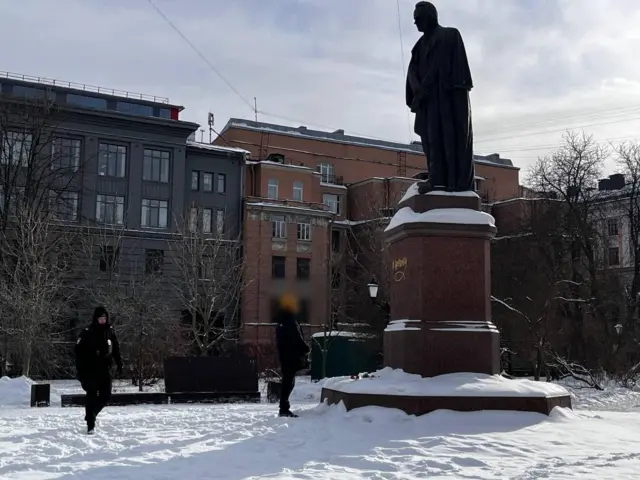
    A statue in the snow. Two people stand by it, their faces blurred, paying tributeImage source, Sirena News

    On the fourth anniversary of Russia’s full-scale invasion of Ukraine, some residents in Moscow and St Petersburg brought flowers to monuments to Ukrainian poets Lesya Ukrainka and Taras Shevchenko, local residents have told BBC Russian.

    In Moscow, people left several bouquets, leaflets and drawings with messages calling for peace, as well as a note quoting the biblical commandment: “Thou shalt not kill”.

    Police then blocked the only pedestrian route to the Lesya Ukrainka monument with a vehicle, as people continued to bring flowers there.

    In St Petersburg, police patrols have been seen on duty at the Shevchenko monument and other places where people might gather. They have not been detaining anyone, but took pictures of people, who were laying flowers.

    Even small, quiet gestures like laying flowers can be risky in Russia. Since 2022, the authorities have introduced laws on “discrediting” the armed forces and spreading “false information” about the military to punish public anti-war actions and statements. Depending on the case, people can get up to eight years in prison.

  15. Civilians to soldiers: How the war has changed ordinary Ukrainianspublished at 15:14 GMT 24 February

    Laura Gozzi
    Europe reporter

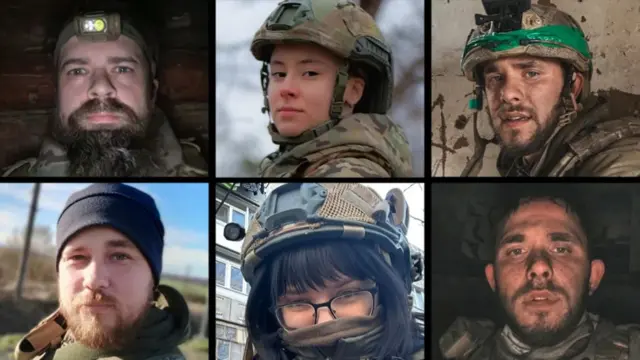
    Individual photos of six Ukrainian soldiers on a grid, all of which are wearing a uniform and/or protective equipment

    When Russian bombs began falling on Ukraine on 24 February 2022, many who had never held a weapon before rushed to take up arms.

    Not long ago, Olena worked as a nightclub administrator in Prague. "It felt like everything was ahead of me - and there was plenty of time," she says.

    In December 2024, she returned to Ukraine, joined the army and became a pilot.

    "I look at the 'before' photo and see myself calmer," Olena says. "More naive. Everything became different. I became different."

    While the fighting continues, she can't imagine another life: "My place is here as long as the enemy is in my house."

    Like the majority of Ukrainians, on 24 February 2022 Oleh, a publishing graduate, says was "confused, and scared".

    "I am not a military man, I have never seen myself like that," he says. But the next month, Oleh joined the army.

    As a soldier, he says, "you are constantly in a small room in your head, the space of which is getting smaller every time. Outside the window, others are living… while there is no handle on the door on your side to get out."

    These are just two stories of the Ukrainians I spoke to, four years since they became soldiers overnight. You can read on here.

  16. Analysis

    Four years into this war, the unspeakable is being normalisedpublished at 15:03 GMT 24 February

    Vitaliy Shevchenko
    Chief analyst, BBC Monitoring

    In Ukraine, civilians continue to be killed practically every day. Russian bombs and drones have left a million people without heating, light and water.

    The past year added an element of the bizarre to what was clearly abnormal. As civilian casualties soared in Ukraine, Trump accused Zelensky of starting the war and said Putin was keen to end it.

    US-led talks between Russia and Ukraine generated numerous official proclamations of progress but little else - the fighting continues, and they haven't changed Russia's maximalist position.

    This is hardly surprising, given that after cutting almost all of its aid, the US put most of the pressure on Kyiv, giving Putin little reason to stop.

    Instead, the talks are normalising the idea that Russia has legitimate interests in Ukraine that deserve to be discussed at the negotiating table.

    What negotiators from Russia, Ukraine and the US have been discussing, however, was until recently considered non-negotiable under international law: the sovereign right of states to choose their own alliances and foreign policy, and prohibitions on the use of force against the territorial integrity or political independence of any state and on the legal recognition of territorial acquisitions resulting from the use of force.

    All wars end at some point, but after four long years there is no sign this one will end any time soon.

  17. France uses humour to respond to Russia's unsubstantiated claims on nuclear bombpublished at 14:54 GMT 24 February

    Marianne Baisnée
    Reporting from Paris

    When asked about a statement by Russia’s Foreign Intelligence Service (SVR) accusing the UK and France of plotting to arm Ukraine with a nuclear weapon or a “dirty bomb,” a French government source respond by pointing to the X account French Response.

    The account was launched by the French Foreign Ministry last September to counter fake news and disinformation from France’s adversaries in the information war by using humour and irony to push back.

    In a series of six posts, reposting messages from accounts relaying the SVR accusation, French Response replied with lines such as: “Five years into its ‘three-day war’, Russia would really prefer you to focus on French and British nukes,” or “Year 5 of the ‘3-day war.’ Russian narrative: ‘FR-UK deterrence is the threat.’”

  18. Russia's wounded or killed now outnumbering recruitspublished at 14:35 GMT 24 February

    Jonathan Beale
    Defence correspondent

    Western officials say that over the past three months Russia has lost more men than they were able to recruit.

    An official, who asked not to be named, said that was "really significant" and would likely impact Russia's ability to generate enough forces for an offensive later this year.

    Russia has been recruiting between 30 to 35,000 soldiers a month. Over the past three months it's been suffering higher casualties - wounded or killed. The Western official said it was the first time such losses - with more injured or killed than recruited - had been sustained over a period of three months.

    UK Armed Forces Minister, Al Carns, has called the Russian manpower deficit "really important". Speaking on the fourth anniversary of Russia's full scale invasion, Carns said "the cost on Russia has been almost unimaginable".

    He said the UK Ministry of Defence estimated that Russia had suffered 1.25 million casualties overall. He said that was probably an under-estimate - and was higher than all US casualties suffered during World War Two.

  19. Zelensky calls for more air defence systemspublished at 14:19 GMT 24 February

    Abdujalil Abdurasulov
    Reporting from Kyiv

    Both Prime Minister Keir Starmer and President Volodymyr Zelensky spoke about the importance of supporting Ukraine’s air defence system during the meeting of the 'coalition of the willing' today.

    President Zelensky says that they need PAC-2 and PAC-3 missiles from the US.

    These are interceptors used by American-made Patriot air defence launchers.

    Crucially PAC-3 can intercept Russian ballistic missiles, which makes it an incredibly valuable weapon to have.

    Russia’s aerial attacks in January and February this year appears to have depleted Ukraine’s stock of those missiles.

    In January, President Zelensky complained about having empty Patriot divisions during aerial attacks.

    Without these interceptors, Ukraine’s energy infrastructure as well as other strategic facilities will be effectively defenceless against Russian ballistic missiles.

  20. Putin warns UK and France over unsubstantiated nuclear bomb plotpublished at 14:04 GMT 24 February

    Laura Gozzi
    Europe reporter

    Speaking at a board meeting of the FSB - Russia's security service - Russian President Vladimir Putin today made no substantial reference to the war he launched on Ukraine four years ago.

    Instead he referred to the unsubstantiated claims made by Russia's foreign intelligence service that the UK and France were plotting to arm Ukraine with a nuclear bomb. "[The UK and France] probably understand how any attack on Russia using a nuclear element could end," Putin warned.

    He also accused Kyiv of being behind what he called a "terrorist attack" near Savyolovsky station in Moscow on Monday, which killed a traffic police officer and injured two others. Putin said a person was "recruited" over the internet then made to carry an explosive device which was detonated remotely. (Russian officials had previously said the blast was a suicide attack.)

    Putin urged FSB officers to "intensify the fight against terrorism" and stated that Kyiv had placed its bet on "terrorism" as it had not been able to "defeat Russia on the battlefield".

    The Russian president also warned - without sharing evidence - that sabotage attempts on pipelines in the Black Sea were forthcoming, and accused Kyiv's Western partners of preventing a settlement between Kyiv and Moscow from being reached during peace talks.

Trending Now