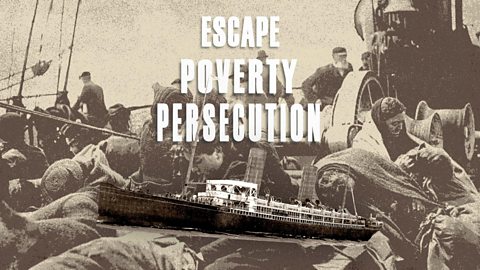
In the early 1800s, for tenant farmers of the Highlands, life was a struggle…
“They often felt what it was to want food … They were miserably ill clothed, and the huts in which they lived were dirty and mean beyond expression.”
Many farmers and crofters in the west of the Highlands and Western Isles relied on potatoes both as a source of food, and to sell. But starting in 1846, the potato crops were hit by the same blight that was ravaging Ireland. 200,000 people faced starvation.
For some time, landowners had been realising that they could make more money through sheep farming. They began evicting families from their lands, sometimes burning cottages to make sure their tenants could not return.
For those who lost their work and their homes in this way, there were two main choices – moving to the growing industrial cities in the central belt or England, or moving overseas.
There were many pull factors towards life in the city – paid work, wider community, sometimes even leisure activity such as football games.
But conditions weren’t easy…
“The … dwellings of the poor are situated in very narrow and confined closes or alleys …the space between the houses being so narrow as to exclude the action of the sun on the ground. … where I have noticed sewers they are in such a filthy and obstructed state that they create more nuisance than if they never existed“
Taking the risk of emigration could lead to a very different life.
The Canadian government even sent full time agents to Scotland - they toured markets persuading people to emigrate, with offers of free land.
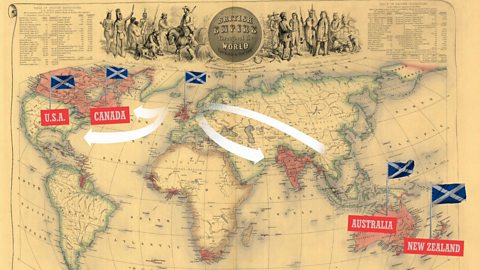
The British Empire needed workers, and Scots were seen as hard-working and adaptable. Unskilled labourers tended to opt for Canada, New Zealand and Australia, while skilled workers preferred India, South Africa and the USA.
There was a real opportunity to get better wages: a worker in America could earn as much in a day and a half of work as a worker in Scotland would earn in a week.
The result was a dramatic decrease in the Scottish population.
Between 1830 and 1914, 600,000 Scots moved to England – and two million crossed the oceans to start new lives in the countries of the Empire.
Description
During the 1800s, thousands of people in the Scottish Highlands migrated to start new lives elsewhere in Scotland or emigrated overseas to Canada, America, or Australia. This video explores the factors behind this migration.