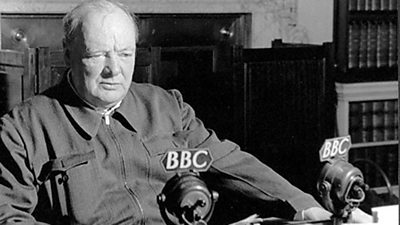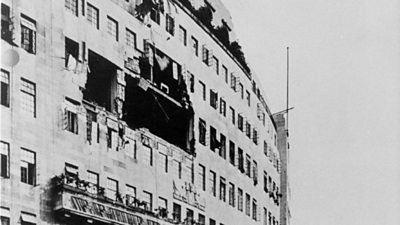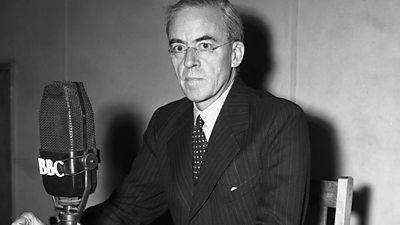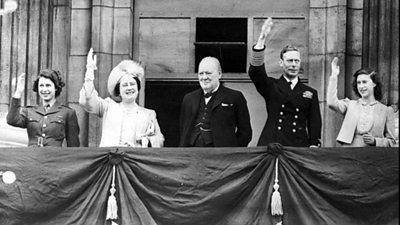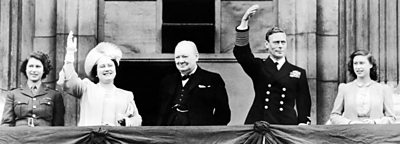
Winston Churchill announced the end of the War in Europe with a speech broadcast from Downing Street on 8 May 1945. He said "we may allow ourselves a brief period of rejoicing, but let us not forget for a moment the toils and efforts that lie ahead". King George VI also gave a speech, broadcast from bomb scarred Buckingham Palace, in which he thanked the nation. Both speakers reminded listeners that Japan was as yet undefeated.
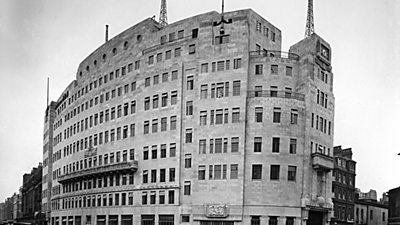
Anticipation was high after radio programmes were interrupted the previous evening with the announcement that the 8th would be Victory in Europe Day and that Churchill would speak at 3pm. Churchill's speech was preceded by a fanfare, and afterwards the BBC switched to a planned sequence of celebratory programmes. National celebrations were well under way as Broadcasting House was floodlit for the first time since 1937, and bedecked with the flags of the Allies.
The BBC's Listener Research Department recorded the best ever programme satisfaction figures, but conceded that these were all but inevitable due to the nature of the events being covered. The BBC survived the war, and established its reputation internationally with the authority of its news programmes.
World War 2 and the BBC
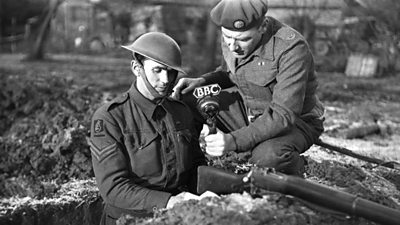
The BBC at War
The BBC reinvented itself during World War 2 and public perception of the institution changed dramatically. Explore its expansion into a global media network, the changing nature of its programming, and the way that war re-defined its relationship with both government and audiences.
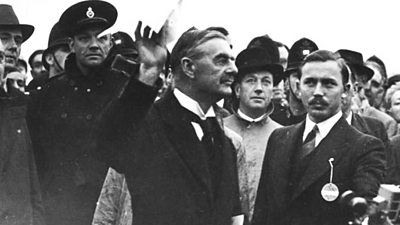
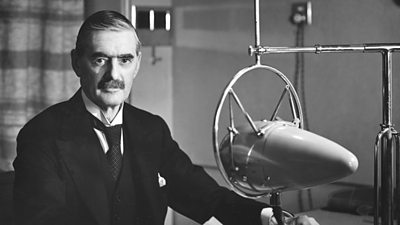
Chamberlain returns from Munich - 30 September 1938
Prime Minister Neville Chamberlain returns with a paper signed by Adolf Hitler.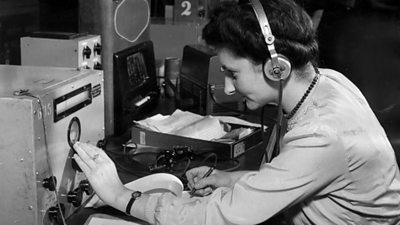
BBC Monitoring founded - 26 August 1939
As part of the intelligence war effort, BBC Monitoring gathered and interpreted international news from across the World.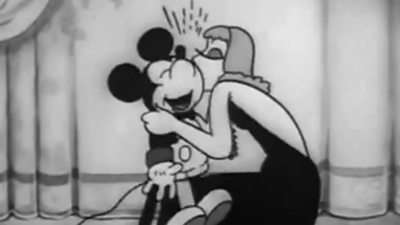
Close down of Television service for the duration of the War - 1 September 1939
Mickey Mouse is the last star seen on BBC Television for six years as the TV service is shut down for the duration of WW2.