Image: Getty
Introduction
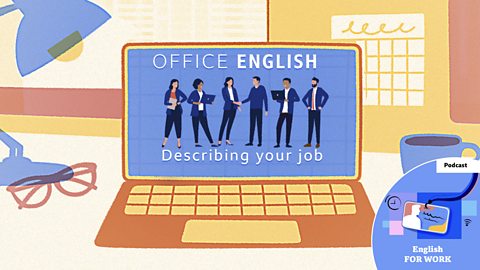
How would you describe your job? In this episode of Office English, Pippa and Phil talk about explaining job titles and your transferrable skills.
TRANSCRIPT
Note: This is a transcript of a spoken conversation and is not a word-for-word script.
Phil
How would you describe your job?
Neil
It's really difficult to explain what my job is to people. I think my parents still, after many years, don't really understand what I do.
Georgie
When I have to describe what a friend does to another friend, sometimes I feel like I sound really stupid because I'm, I don't exactly know how to explain it.
Pippa
Today on Office English, we're talking about how to make what you do clear to other people.
Phil
Hello and welcome to Office English, your podcast guide to the world of work. I'm Phil.
Pippa
And I'm Pippa. You can find a transcript for this episode to read along while you listen at bbclearningenglish.com.
Phil
So, Pippa, we heard from some colleagues at the start of the programme about their experience trying to tell other people what they do. Do you ever have difficulty understanding people's job titles and descriptions?
Pippa
Yes, I do have difficulty with that sometimes, and there's often a lot of jargon or generic words used for people's job titles. So some examples might be producer, project manager, consultant. And that could mean a lot of different things. So I find that a bit confusing sometimes.
Phil
I'll tell you what, I actually find it quite difficult to explain my own job to people who don't, who don't work in the same industry. The job title itself says very little, so I tend to find I just describe the things I do every day and hope that people work it out from there.
Pippa
Hmm. Yeah. And we can also find it difficult to see similarities with other jobs, other industries and recognise the skills that we use. So in this episode, we're going to talk about describing your job to people within your organisation, outside your organisation, and also how to describe your job when you want to apply for a new job or change career.
Phil
OK, Pippa, let's start by talking about describing your job to people within your company. Um, what do you need to consider when you do this?
Pippa
Well, think about what you do rather than just your job title. For example, you could say, 'I look after sales', for example, or 'I handle client complaints', and those two phrases just basically mean I'm responsible for, this is the area that I work in.
Phil
Yeah. And it can be helpful to give some context and talk about how your job relates to other people and other departments in your organisation. Sometimes we say where you sit within the organisation. So you might say, 'I work a lot with' a particular person or a particular department. And then you also might say you report to and you're talking about your manager, because it may be that people know the same manager. And so that helps them understand what you're working on.
Pippa
Another thing that might be useful to do, for example, in a meeting, is to tell people when they should contact you or in what situations they might encounter you at work. So you could say something like, 'if you ever have any questions about this element, you should email me'. And then that makes it really clear when the people that you're meeting are going to actually interact with you at work.
Phil
Of course, organisations have their own internal jargon, the language they use within the organisation. But of course people who are new to your organisation might not know that jargon yet.
Pippa
Yeah, and sometimes people who've been there a long time, still don't really understand it. They just use it every day.
So, we've talked about how to describe your job to people you work with. But what about people outside of your workplace, perhaps friends and family or maybe clients and customers? Do you need to approach this differently, Phil?
Phil
I think it does depend on the context. So if you're, if you're meeting someone as part of your job, maybe you're at a conference or you're meeting a client. You've got to keep things formal and professional. So you might say, 'I represent' and then the name of your company, and you'd probably say something like, 'I'm responsible for' and then say what you're responsible for. Um, but yeah, you probably keep it on quite a formal level there, which would be different if you're talking to your friends, wouldn't it?
Pippa
Yeah. If you were talking to your friends, you might just talk more generally. You might say 'I mostly work on' or you might find a relatable element. So you could say something like, oh, 'do you know this product or this company? My work is similar to that'.
Phil
Now, one common time we need to talk about our current job is when we apply for a new one. Um, it can be difficult to clearly explain your jobs and skills, and especially if you're planning a career change, which means to work in a different area to the one that you've worked in before.
Pippa
Yes. So in this situation, you want to say what you do and then give more detail. For example, you could say 'I have a background in' a particular area, 'which in practice means' and that phrase in practice means allows you to introduce what you do day to day, what your job actually involves.
Phil
And a really useful expression we have here is transferable skills. And what we mean by that are the skills that you have, that you use in your current job, or a job you've done in the past, which you can transfer to a different job and you can use them. So you might say something like, 'I have a lot of experience with sales. I'm very good at persuading clients, so I think I'd be useful in this role'. That's an example of a transferable skill.
Pippa
Mhm. Yeah. And it might be good to in your application for a job for example. Talk about why you'd like to change. So acknowledge that you've worked in a different area and that you're maybe changing to a slightly different one. So you could say something like 'I'd like to apply my skills to a new challenge', and then you're not just trying to hide that you haven't worked in this area before.
That's it for this episode of Office English. But if you'd like more tips for applying for jobs in English, try the Job Applications series on our website. There's a link in the notes below this episode.
Phil
We'll be back next week with another episode to help you with your business. English. Bye for now.
Pippa
Bye.
Now try this...
English for getting a new job
최신 Office English
Describing your job
Episode 260330 / 30 Mar 2026
Learn how to explain what you do to people in and outside of work.

Small talk
Episode 260209 / 09 Feb 2026
Learn which topics to use at work with people you don't know.
Deadlines and logistics
Episode 250526 / 26 May 2025
Learn the language for organising things at work