Why a debt-ridden council is hiking tax by 7.48%

 PA Media
Warrington Council is to increase council tax by more than the usually permitted level - and has also confirmed it needs further government support.
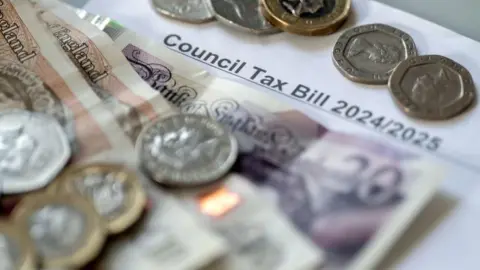
A 7.48% increase will begin from April after councillors backed the authority's latest budget - and it's also asking the government for assistance, through a system known as exceptional financial support to help it balance its books. But why is it in this situation?
Which party runs Warrington Council?
Warrington Council is a unitary authority - which means it has a single tier of administration that is responsible for all council services in the area.
Politically, it is led by Labour, who hold 40 of the seats. The Liberal Democrats are the opposition party with 12 councillors and there are also four independent councillors and two Conservatives.
What are the challenges it is facing?
Many councils across the country are facing challenges because of the rising costs of providing some statutory services - the services they legally have to provide.
These include providing care for those who need it, supporting children with special education needs and disabilities, collecting household waste, maintaining roads and footpaths, and providing a "comprehensive and efficient" library service.
They are not legally required to provide services such as leisure centres, public parks, public toilets and collecting garden waste.
Warrington Council said it currently spends 80p in every £1 on services for vulnerable people. These include adult social care, children's services, supporting residents with special education needs and disabilities, and providing accommodation for those at risk of homelessness.
The Institute for Government said councils' spending power was 8.3% lower in real terms in 2025/26 than it was in 2010/11, due to a reduction in central government grants.
It said these grants fell 40.1% in real terms between 2009/10 and 2019/20.
Why is Warrington Council in so much debt?
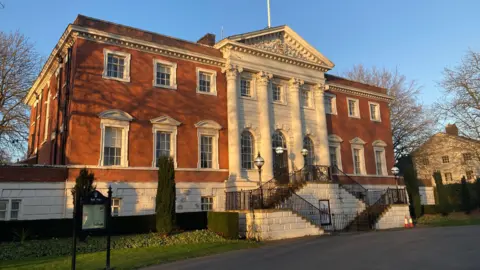
As well as the issues facing most councils, Warrington also has an additional challenge. It had built up some of the highest levels of debt out of any council in the country through an investment programme.
At its peak, Warrington Council had around £1.9bn of debt - BBC research last year found it was one of the most impoverished in the country for the size of its population.
A review of Warrington's debt portfolio by the Chartered Institute of Public Finance and Accountancy said the authority's portfolio of debt-funded investments was "very large and uniquely complex".
As well as loans to social landlords and companies, it also invested in business ventures and property.
Some of these are in Warrington such as the business park Birchwood Park and the Times Square development in the town centre.
But some are outside the borough, including buildings rented by supermarkets in Farnworth, Hulme and Sale in Greater Manchester and Widnes in Cheshire; an office block in Salford; and solar farms in Hull and Cirencester.
But some of the most controversial investments have been some of the firms it invested in.
This included borrowing money to take a one-third share of Redwood Bank, and an almost 50% stake in Together Energy, which collapsed in 2022.
Many of these were funded by borrowing from the Public Works Loan Board - which is a government body providing loans to local authorities.
What have been the consequences of this investment programme?
The significant levels of debt built up by the council led to the government intervening last year, sending in ministerial envoys to work with the authority to "support, challenge and advise".
As part of this, the council was told to come up with a debt reduction plan, including a review of its commercial investments.
Since then, the council's borrowing is now down to £1.4bn and it is also looking into selling some of its assets such as Birchwood Park and its stake in Redwood Bank.
What has Warrington Council asked the government for?
The council has asked the government for exceptional financial support.
This is not extra funding from the government, but is usually in the form of a capitalisation directive.
This allows councils to treat some day-to-day spending, what is called revenue spending, as longer term capital spending funded through borrowing.
Documents reveal that in December it asked the government for a package worth £240m over five years, but it submitted a revised request of £354m earlier this month, following the final local government finance settlement and a review of its charges around borrowing.
The cost of this over the five years is expected to be £708m.
How much will council tax increase by in Warrington?
Warrington Council had been given permission for an increase of up to 7.5% by the government.
It has now approved a council tax increase of 7.48% for the 2026/2027 financial year.
It means it will cost those who live in a band A home £1,338.34 for the year and £2,007.51 for those in a band D home.
This is before any aditional costs from parish or town councils, as well as contributions towards Cheshire Police and Cheshire Fire Service.
What else was in the budget?
The budget also included up to £40m of cuts over the next four years, as well as the use of exceptional financial support.
Some of the major cuts proposed include savings of £23m in adult social care through a number of reviews as well as £3.8m of savings in children's services and education.
There's also a plan to save cash by ending the live monitoring of CCTV at the town centre control room.
This has been criticised by Cheshire Police's chief constable but the council's cabinet member for finance said the authority was "willing to work with partners to ensure live monitoring continues" and that the council had met with the chief constable and the area's Police and Crime Commissioner on the issue.
See more Cheshire stories from the BBC and follow BBC North West on X. For more local politics coverage, BBC Politics North West is on BBC One on Sunday at 10:00am and on BBC iPlayer.