Summary

  • Party leaders faced questions from a live studio audience in a special BBC debate ahead of the Scottish Parliament election

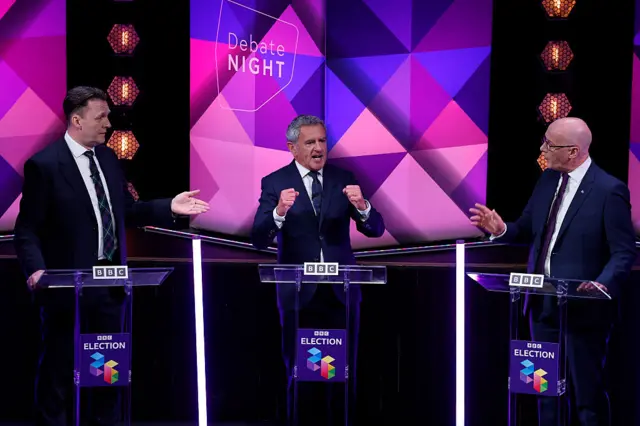
  • The party leaders clashed over questions about energy policy, public spending, the cost of living, immigration, independence and the NHS

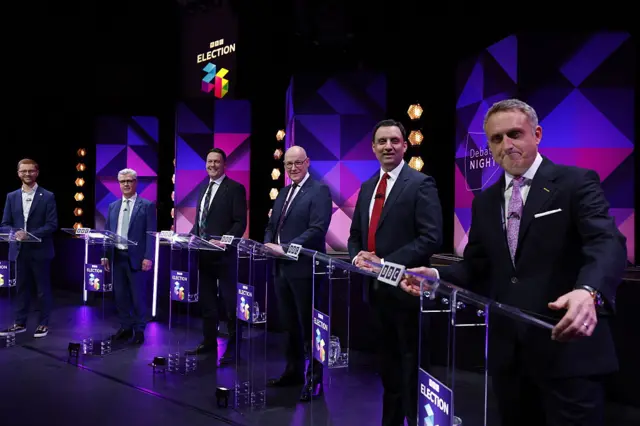
  • Taking part were Russell Findlay, Scottish Conservatives; Ross Greer, Scottish Greens; Anas Sarwar, Scottish Labour; Alex Cole-Hamilton, Scottish Liberal Democrats; John Swinney, Scottish National Party; and Malcolm Offord, Reform UK

  • The Debate Night special was hosted by Stephen Jardine at Paisley Town Hall

  • Voters in Scotland go to the polls on 7 May

  1. Debate Night Leaders Special: The headlinespublished at 22:33 BST 12 April

    If you're just joining us after a sometimes acrimonious leaders debate, here are the key lines that emerged:

    That's all from the live page team tonight, but we're back tomorrow with coverage of the campaign trail and the launch of Scottish Labour's manifesto.

  2. Analysis

    How did the leaders fare in BBC debate?published at 22:28 BST 12 April

    Glenn Campbell
    BBC Scotland Political Editor

    None of the leaders left this debate with their head in their hands feeling that they had blown it.

    Sometimes that is as good as a win for politician, that they have not inadvertently produced a viral video that will destroy their campaign.

    As the current first minister, John Swinney came under the most sustained pressure, particularly on the NHS.

    Yes, he could point to the longest waiting times coming down but, inevitably, he had to concede that there is much more to be done.

    That created the opportunity for Labour’s Anas Sarwar to point out that the SNP has had two decades to fix the NHS - and to appeal to voters to put him in charge for the next five.

    He seemed pleased to have landed his “give me five” and “gie's a break” lines in what was a polished performance.

    But what Labour needed tonight was a game-changer and I am not sure there were any exchanges that delivered that.

  3. BBC Verify

    How many vacancies are there in social care?published at 22:10 BST 12 April

    BBC Scotland: Andrew Picken

    Scottish Greens co-leader Ross Greer called for more immigration “to meet the needs of this country”.

    During the debate he claimed: “If every young person leaving school in Scotland today went to work in social care, there still wouldn't be enough care workers.”

    The party told BBC Verify that Greer was repeating a reference to a comment, external said to have been made by Donald Macaskill, boss of the private care home trade body Scottish Care, about the scale of vacancies.

    The number of Scottish school leavers in 2024-25 was 55,801 pupils, external.

    An annual vacancies survey of care providers is jointly published by the Scottish Social Services Council (SSSC) and the Care Inspectorate watchdog.

    The latest available one is for 2024, external. It suggests 44% of registered care services reported having staff vacancies.

    And in nine of the 32 local authority areas, 50% or more services reported vacancies.

    But the survey, which is published more than a year after it is gathered, does not provide numbers of social care vacancies.

    The report does state the vacancies are 6.4% of the total workforce on a whole-time equivalent basis.

    If 55,801 pupils would not be enough to make up a 6.4% shortfall then there would have to be a workforce of more than 872,000 people in social care.

    That would mean that about one third of all people working in Scotland would have to work in social care.

    However, census and market data suggests the figure is closer to 220,000.

  4. BBC Verify

    Are asylum seekers in Glasgow getting priority when it comes to housing?published at 21:47 BST 12 April

    BBC Scotland: Phil Sim

    Reform UK Scotland’s leader Malcolm Offord claimed “people arriving immediately to Glasgow, the asylum city of the UK, are given priority, they are jumping the queue” for services like housing.

    Glasgow could be referred to as the “asylum city” of the UK in that 3,686 asylum seekers were housed in the city by the Home Office in December 2025 - the largest number in any local authority in the UK.

    But the reality on housing is more complicated.

    Asylum seekers who require housing support are given accommodation by the Home Office.

    Those who are granted leave to remain are given 42 days to move on from that accommodation but many end up applying to the local council as being homeless.

    In Glasgow - which has a long-standing issue with housing - 44% of homelessness applications (1,685) between April and September 2025 involved people who had been granted leave to remain in the UK.

    Scottish councils have a statutory duty to find housing for anyone who is “unintentionally homeless”, which can take priority over those waiting for permanent accommodation.

    So if a flat becomes available, the council may need to use it as a temporaryhome for a refugee family which has claimed homelessness, in line with its legal duties - as well as the fact this is far cheaper than putting them in a hotel.

    However another family which has been waiting months or years in a temporary home for permanent accommodation may see people moving into that flat and feel they have been overtaken.

  5. Findlay called out SNP's 'dismal record'published at 21:39 BST 12 April

    Scottish Conservative deputy leader Rachael Hamilton describes the party as "in tune with the public" after the Debate Night special.

    She claims Swinney made it "crystal clear" he will push for independence if the SNP win a majority and adds only Russell Findlay challenged him on it.

    She says Findlay called out the SNP's "dismal record" and adds the Tories will "offer a real alternative to the failed left-wing consensus at Holyrood".

  6. BBC Verify

    Are energy bills £700 higher than promised?published at 21:34 BST 12 April

    BBC Verify: Anthony Reuben

    Talking about energy bills, SNP leader John Swinney said: "Labour came in, promised to reduce energy costs by £300, and by the summer energy costs for every household will be £700 higher than Labour promised they would be."

    The £300 that he is referring to was a prediction for how much bills could be lowered in 2030 if Labour managed, as promised, to generate almost all electricity from low carbon sources by that date, so it was not a promise for current prices.

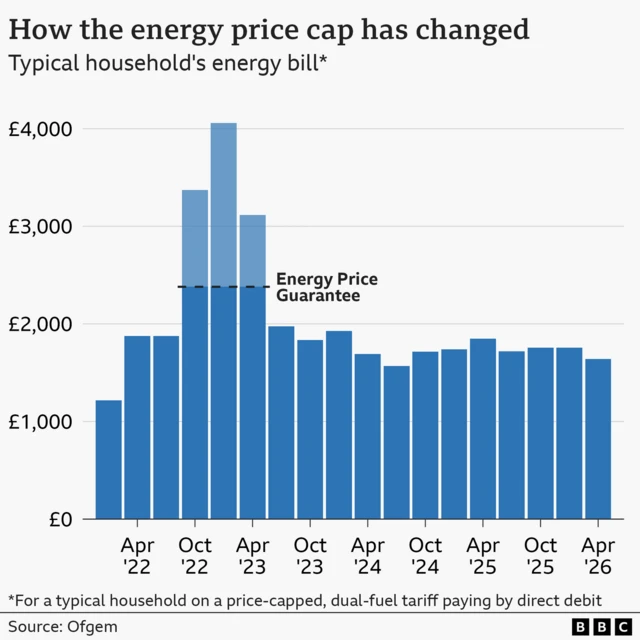
    When Labour came to power, the energy price cap for a typical family in Scotland, England and Wales paying by direct debit and on a dual fuel contract was £1,568 a year.

    The current rate running up to the end of June is £1,641, so that’s gone up by £73 a year.

    Swinney referred to what is going to happen in the summer and we do not currently know what will happen to the price cap in July - much will depend on what happens in Iran and the Strait of Hormuz.

    Analysts at Cornwall Insight are currently predicting, external that the cap will go up to £1,861 in July, but of course that is highly uncertain.

    If that happens then the cap will have gone up £293 since Labour came to office.

    Graphic looking at the energy price gap
    Image caption,

    Energy price gap

  7. Labour: Swinney 'rattled and out of touch'published at 21:27 BST 12 April

    The political reaction is starting to filter in from the parties after the leaders debate.

    Scottish Labour deputy leader Jackie Baillie, unsurprisingly, declares Anas Sarwar the “clear winner”.

    She claims Swinney looked “rattled and out of touch” and describes Offord’s performance as “hapless”.

    Baillie adds Labour will “get the basics right” and “fix the mistakes” of the SNP’s 19 years in government.

  8. BBC Verify

    How many people in Scotland are waiting more than two years?published at 21:22 BST 12 April

    BBC Scotland: Aimee Stanton

    Highlighting NHS waiting lists,Anas Sarwar said: "How many people in Scotland are waiting more than two years? 5,000. In England, ten times the size, its 300.”

    Public Health Scotland data, external does not show the number of people waiting more than two years. Instead it shows the number of ongoing waits over two years.

    The latest figures show there were 5,291 ongoing waits longer than 104 weeks for a new outpatient, inpatient or day‑case appointment or procedure, as of February.

    In Scotland's data a single patient could be on multiple waiting lists.

    Comparing waiting lists in Scotland with the rest of the UK is challenging due to differences in how the figures are recorded by the different health services.

    Guidance from the Office for National Statistics, external(ONS), external and Public Health Scotland (PHS) explicitly advises against comparing Scotland's hospital waiting times and lists with those in England and Wales.

    Data for England measures those waiting to start treatment, while Scottish data is a count of those at different stages between diagnosis and treatment.

    NHS England , externaldata shows, external that, at the end of January, there were 200 cases where patients had waited more than two years to start treatment.

  9. Analysis

    Swinney right about NHS waiting times for planned treatmentpublished at 21:13 BST 12 April

    Susie Forrest
    Health assistant editor, BBC Scotland

    John Swinney says the government has made progress on reducing long waits for planned treatment, and he's right.

    The number of waits over a year for inpatient and day case procedures - hospital operations - has reduced from around 37,000 two years ago to around 20,000.

    But there's acknowledgement that no-one should wait in pain more than a year for treatment - and there is still a lot of work to do post-pandemic.

  10. BBC Verify

    Are 800,000 Scots on an NHS waiting list?published at 21:02 BST 12 April

    BBC Scotland: Aimee Stanton

    After the debate moved on to health, the Scottish Liberal Democrat leader Alex Cole-Hamilton said: “800,000 Scots were currently on an NHS waiting list”.

    However, Public Health Scotland (PHS) says there is no single database for all patient data so it is not possible to definitively say, external how many people are on a NHS waiting list in Scotland.

    In the PHS waiting list data a single patient could be on multiple waiting lists.

    It estimates, external that 578,804 individuals - around one in 10 of Scotland's population - were on at least one new outpatient, inpatient or day‑case waiting list as of 28 February.

    This is a fall on the previous month’s figures, when around one in nine were estimated to be on a waiting list.

    This also doesn’t include all types of waiting lists, such as those for key diagnostic tests.

    The number of long waits of over a year for a planned hospital appointment or procedure in Scotland has been falling since July.

    But a target to eradicate long waits by the end of March was missed by the Scottish government.

  11. Analysis

    SNP attacked over state of the health servicepublished at 20:55 BST 12 April

    Lynsey Bews
    BBC Scotland chief political correspondent

    The SNP is the party with a record to defend when it comes to devolved areas like the NHS.

    So it's no surprise John Swinney faced a multi-pronged attack from Labour, the Lib Dems and the Tories over the health service.

    But this was also uncomfortable territory because of the reaction of the audience - many of whom seemed pretty unimpressed by what they were hearing.

  12. BBC Verify

    Is the North Sea losing 1,000 jobs a month?published at 20:50 BST 12 April

    BBC Verify: Nicholas Barrett

    Arguing for more drilling for oil and gas in the North Sea, Scottish Conservative leader Russell Findlay said that "1,000 jobs a month are being lost in the North Sea".

    The figure comes from a forecast made by the Energy Transition Institute (ETI) - a think-tank based at Robert Gordon University in Aberdeen.

    It has predicted that 1,000 North Sea oil and gas jobs will be lost every month until 2030.

    We spoke to the ETI about this figure and they said they expect 600 to 800 oil and gas jobs a month to go between now and 2030.

    The remainder - they told BBC Verify - would be “indirect” job losses, meaning people that benefit from the oil and gas industry indirectly such as taxi drivers and hospitality workers.

    In all, 70,000 jobs have been lost over the last decade according to a report, external by the Scottish Affairs Committee.

    That works out at 7,000 job losses a year or 583 a month.

  13. Analysis

    What makes a mandate for an independence referendum?published at 20:44 BST 12 April

    Phil Sim
    Scotland political correspondent

    There is a dispute ahead of every election in Scotland about whether it might lead to an independence referendum.

    The UK Supreme Court ruled in 2022, external that the constitution, including the union between Scotland and England, is a matter for Westminster rather than Holyrood.

    Former First Minister Nicola Sturgeon had brought the case to query whether MSPs could legislate for an independence referendum.

    Judges unanimously concluded that they could not do so without a transfer of powers from Westminster - known as a “section 30 order” - as happened ahead of the previous vote in 2014.

    The question is whether the SNP can persuade UK ministers to grant such an order again.

    The party had previously argued that a pro-independence majority at Holyrood should be enough to do this.

    But the SNP and Greens had just such a majority last term, at the time of the Supreme Court ruling, and John Swinney now says an outright SNP majority would provide a mandate - noting that this is what happened for the 2014 vote.

    This morning, Labour’s UK Health Secretary Wes Streeting ruled out a deal for a referendum saying “we’re not having one”, adding that “this country has had enough of chaos”.

  14. The leaders debate draws to a closepublished at 20:42 BST 12 April

    After that brief outbreak of consensus on the World Cup the leaders debate draws to a close.

    But don't go away, we will be fact checking and bringing you analysis from our correspondents of what was said during a frequently rancorous 90 minutes.

    leadersImage source, Getty Images
  15. How would the leaders celebrate if Scotland win the World Cup?published at 20:41 BST 12 April

    Stephen Jardine wraps up the evening by asking each of the leaders about what they would do to celebrate if Scotland win the World Cup this summer.

    John Swinney says a statue of Scott McTominay's iconic goal against Denmark would be a fitting addition to the mural on the south side of Glasgow.

    Ross Greer says another bank holiday, if Scotland lift the trophy, would be more than justified.

    A fitting legacy would be funding grassroot sports in our communities, he adds.

    Malcolm Offord says he would settle for a smile from Steve Clarke.

    Anas Sarwar agrees with Greer and says everyone should have access to sports.

    He says: "Imagine the final, England against Scotland, Scotland hammer them 3-0 and that's something else I'll disagree with Keir Starmer on."

    Alex Cole-Hamilton talks about the struggles faced by hospitality and says the change of licensing laws for the World Cup is important.

    Russell Findlay criticises Swinney's bank holiday but says because he is a Conservative, he believes in "aspiration and ambition" so hopes Scotland can win and then retain the World Cup.

  16. Findlay tells Swinney to 'get on with the day job'published at 20:38 BST 12 April

    Findlay accuses Swinney of attempting to “bludgeon” people into submission over a second independence vote.

    He says Scotland need a first minister that “gets on with the day job” of “fixing the country”.

    He claims Swinney “by every measure” has been distracted by independence.

    The Scottish Tory leader adds “Scotland has got worse” as a result.

    Russell FindlayImage source, Getty Images
  17. Swinney predicts indyref2 could happen by 2028published at 20:37 BST 12 April

    John Swinney says it is perfectly conceivable that indyref2 could happen by 2028.

    The SNP leader says he is appealing to the people of Scotland to give him an "emphatic mandate" through the election of an SNP majority.

    He adds this would allow the future the country to be decided through a referendum on independence two years from now.

  18. Cole-Hamilton not given independence 'a moment's thought'published at 20:34 BST 12 April

    Alex Cole-Hamilton says he hasn't given independence "a moment's thought" because constituents want him to concentrate of cost of living, health and education.

    He says his constituents wanted him to get things done and work with other people.

    The Scottish Lib Dem leader says he doesn't think it matters to people as much as Swinney does.

  19. Offord says no-one wants 'divisive' referendumpublished at 20:33 BST 12 April

    Offord says there were a number of factors at play when the 2014 independence referendum took place.

    But he adds no one on the doorsteps when he has been campaigning has been talking about another vote.

    He says the result was “divisive” and that voters did not want the “rancour” of another ballot 12 years later.

    Offord says people want Holyrood to “get on with the day job”.

    But he, like Nigel Farage, says if there was an appetite at 60% in favour of another referendum, that would be a different point of view.

  20. Analysis

    Independence: The dividing line in Scottish politicspublished at 20:32 BST 12 April

    Lynsey Bews
    BBC Scotland political correspondent

    A final question on the constitution - which for more than a decade has been the key dividing line in Scottish politics.

    And we're back to that recurring question - what circumstances would constitute a mandate for another referendum?

    Neither Anas Sarwar nor Russell Findlay give a clear answer.

    But their stance could become problematic if John Swinney succeeds with his ambition to win another overall majority at Holyrood.

Trending Now