When does spring start?

- Published
A spell of very mild weather is set to arrive in the UK just days before forecasters mark the start of spring at the beginning of March.
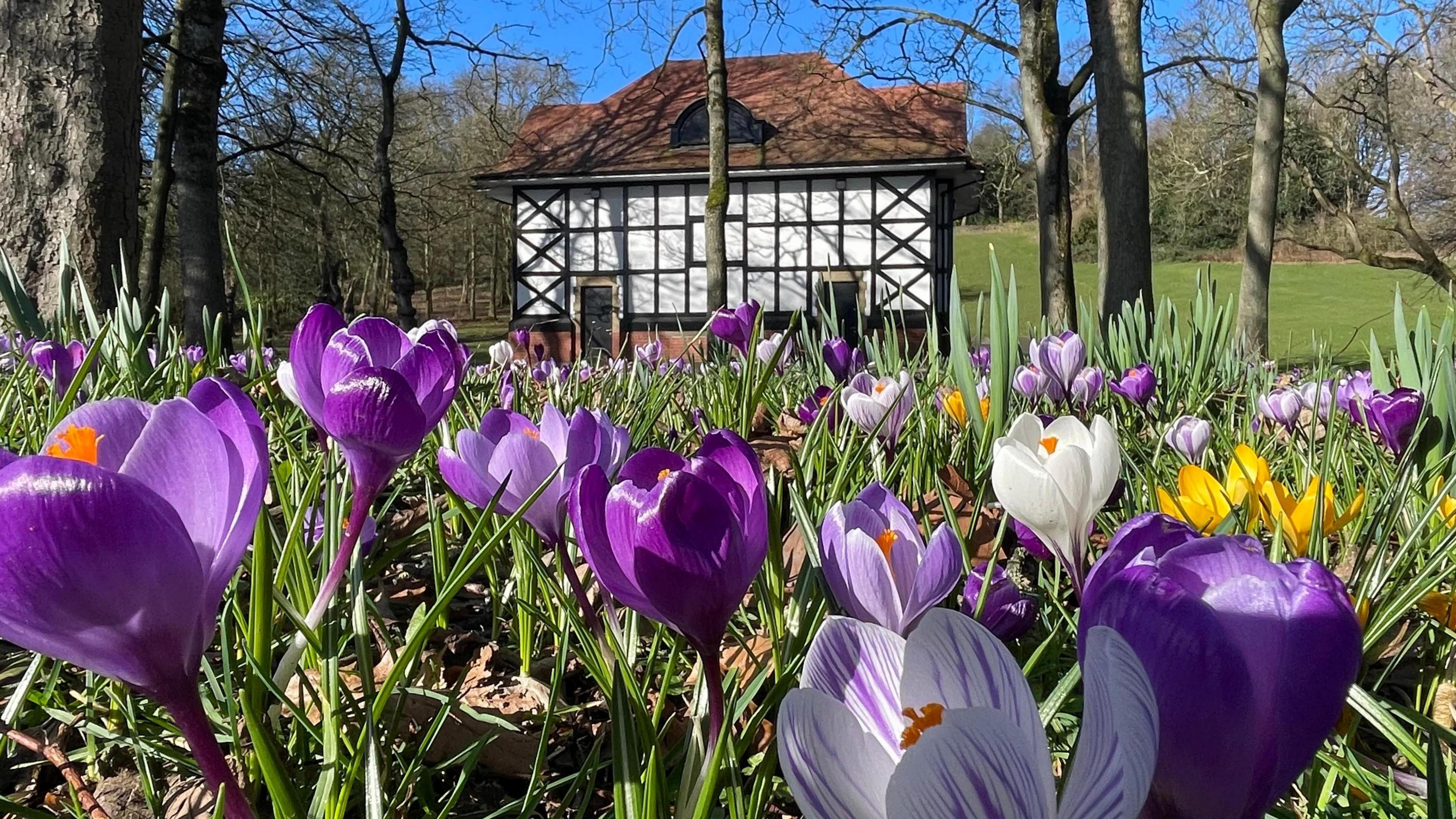
Spring is the season often referred to as a transition time of year. Days are longer, temperatures start to rise more significantly and gardens burst into life and colour.
But there are differences in opinion over when exactly winter ends and spring starts with some people preferring to refer to astronomical spring rather than meteorological spring.
Meteorological spring starts on March 1, while astronomical spring begins this year on 20 March.
What is meteorological spring?
In meteorology, the four seasons are grouped into three months. This gives a fixed time frame for statistical purposes, making it easier for comparisons.
The spring months are March, April and May.
Therefore, winter ends on the last day of February and summer begins on the first day of June.
This is unlike astronomical spring where the date will change slightly each year due to the orbit of Earth around the Sun.

Trees are starting to burst into life as it starts to warm up
When does astronomical spring begin?
What is the Equinox?
Astronomical spring follows the date of the spring equinox which is determined by the Earth's tilt as it travels around the Sun.
In the northern hemisphere the spring equinox varies between 19 to 21 March each year.
In 2026, however, it begins on 20 March.
On the equinox, the Sun crosses the equator, making day and night nearly equal in length.
The word "equinox" comes from Latin, where equi means "equal" and nox means "night." Beyond the equinox, days will be longer than nights.
Astronomically, spring ends on 21 June at the summer solstice and summer begins.
When do the clocks go forward?

Clocks will 'spring forward' to British Summer Time (BST)
Clocks change from Greenwich Mean Time (GMT) to British Summer Time (BST) in the early hours of the last Sunday in March, which this year is 29 March.
You may be familiar with the phrase, the clocks will 'spring forward' by an hour, meaning we 'lose' an hour from that day.
But after this our evenings will become significantly lighter.
The purpose of the clocks going forward is to maximize daylight during the warmer months which is aligned with the increase in daylight hours following the spring equinox.
Daylight Saving Time, known now as British Summer Time (BST), was first introduced during World War I in 1916 with the passing of the 'Summer Time Act' by Parliament.
The initiative was largely championed by William Willett, a British builder who advocated for moving the clocks forward to reduce energy consumption and make more productive use of daylight.
What about phenological spring?
You may also want to consider phenology - the behaviour of plants and animals in response to the changing weather and climate - as another marker for the start of spring.
For those who follow nature, dates for the start of phenological spring are highly variable due to the weather conditions and species.
But climate change is also having an impact on these dates. Analysis in 2025 showed that spring is the fastest-warming season in the United Kingdom largely down to climate change.
Recent studies by the Woodland Trust, external have shown that spring events like budburst, leafing and flowering are getting earlier.
Changing phenology is one of the first observed responses to climate change.
- Published14 August 2025