Key points
Overview
The poem is spoken by a man who feels rejected, unlucky, and full of self-pity. He compares himself to others and feels jealous of their success. However, when he thinks of someone he loves, his mood lifts and he feels rich and happy again. The poem was written around 1592 and published in 1609.
Themes
The poem explores jealousy, depression, and love. It shows how the speaker’s mood changes from despair to joy because of love. It also looks at social status, envy, and self-worth.
Tone and voice
The tone is bitter, restless, and sad at first. It becomes joyful and grateful when the speaker thinks of the person he loves. The speaker is an anonymous man who feels like an outsider. He envies others and feels ignored by heaven. His mood changes when he remembers someone who loves him.
Context
Shakespeare lived in a time when social class was very important. People were judged by wealth and status. He wrote this during a time when theatres were closed due to plague, and he may have felt isolated and anxious. Sonnets were often used to express love and deep emotions.
Form and structure
The poem is a Shakespearean sonnet with 14 lines. It has three quatrains and a final rhyming couplet. It uses iambic pentameter, but some lines break the rhythm to show the speaker’s emotional turmoil. The volta (turn in mood) comes early in line nine, which is unusual and shows how strong the speaker’s feelings are.
Poetic devices to spot
- Metaphor – the speaker compares himself to others to show envy.
- Repetition – words like “like him” and “state” show obsession and changing emotions.
- Symbolism – the lark and heaven represent joy and hope.
- Personification – “Fortune” and “heaven” are treated like people who ignore him.
- Synecdoche – “Men’s eyes” represent society judging him.
- Apostrophe – the speaker talks to someone who isn’t present.
- Caesura – pauses show emotional shifts.
- Enjambment – lines run on to reflect his flowing thoughts.
Sonnet 29
by William Shakespeare
When in disgrace with fortune and men's eyes,I all alone beweep my outcast state,And trouble deaf heaven with my bootless cries,And look upon myself and curse my fate,wishing me like to one more rich in hope,Featured like him, like him with friends possessed,Desiring this man's art, and that man's scope,With what I most enjoy contented least;Yet in these thoughts myself almost despising,Haply I think on thee—and then my state,Like to the lark at break of day arisingFrom sullen earth sings hymns at heaven's gate;For thy sweet love remembered such wealth brings,That then I scorn to change my state with kings.
The text of this poem is available in the CCEA Poetry Anthology, which can be downloaded from the CCEA website.
The BBC is not responsible for the contents of any other sites listed.
Summary
This is a sonnet in which the speaker bemoans his poor luck and lack of wealth or status, but then muses on how the love of the person to whom the sonnet is addressed makes his life worthwhile. Published in 1609, but thought to have been written well over a decade earlier.

- Title: Like many sonnets, this one is known only by its number or its first line.
- Themes: Despair, discontent, isolation, envy, luck, love, wealth.
- Tone: Resentful, depressed, restless, jealous.
- Speaker: First person; the speaker is an anonymous character or persona, who may or may not have been based on Shakespeare's own life or experiences.
Applicable context
- Shakespeare is so renowned as a playwright and poet that his influence remains worldwide in theatre and literature, over four centuries after he first wrote and performed. He was married, but his family resided in Stratford while he worked in London, and many scholars believe he had affairs with both women and men, to some of whom he dedicated famous sonnets such as this one.
- While we can’t be sure of the date of the sonnet, some speculate it may have been written in 1592, during a period of time when plague outbreaks had closed the theatres of London. Shakespeare couldn’t earn a living, hence the pessimistic and self-pitying tone in the first section of the poem.
- The speaker’s anxieties about wealth and social status – outward markers of success – reflect the rigid social structure of Elizabethan England, which was obsessed with wealth and social class. The government even passed laws deciding what kinds of clothes people from each class were allowed to wear, visually reinforcing the separation. As a member of the emerging capitalist class, who did not inherit his money but earned it through theatre and other business, Shakespeare would have been personally attuned to such anxieties.
Only a little context is needed for each poem; where used, it should be applied to the point you're making.
Form and structure
- Sonnet 29 is an A 14-line poem written in iambic pentameter with a specific rhyme scheme (ABAB CDCD EFEF GG), (also known as a Shakespearean sonnet) . whose 14 lines are arranged in three A type of stanza - or a complete poem - consisting of four lines that have a rhyming scheme. (four line sets of alternately rhyming lines) and a final In poetry, a pair of lines that rhyme and have the same length and metric pattern.. This form was not invented by Shakespeare, but he popularised it so much it is also known as a Shakespearean sonnet. A fourteen-line poem, usually with ten syllables in each line.were a classic form for love poetry. While this one is very focused on the speaker and his feelings about himself and his own life at the start, it is ultimately revealed to be about, and dedicated to, a loved one.
- One thing that makes this different from a typical Elizabethan sonnet is that the A change in focus within a poem, perhaps revealing a ‘twist’ with further information, new detail or emotion that may make us feel differently about the first part. occurs in line nine, with the word “Yet”. This is more typical of an Used by the Italian poet Petrarch it's a 14-line poem split in two parts: the first 8 lines (octave) use the rhyme scheme ABBAABBA and show a problem or idea. The last 6 lines (sestet) often use CDECDE or CDCDCD and give a response. – Shakespeare usually confined the volta to the last rhyming couplet in his sonnets. This change may show the speaker is too upset by his bad luck to control his feelings the way he often would.
What is a sonnet? revision-guide
Learn about the conventions of a sonnet, Shakespearean sonnets and Petrarchan sonnets, iambic pentameter and rhyme in this KS3 English BBC Bitesize article.
- The The rhythm of a line of poetry based on how many syllables it has and where they are stressed or emphasised – likes beats in music. of Sonnet 29 is also disrupted, suggesting the speaker is upset by and even obsessed with his bad luck. Sonnets were typically written in One ‘iamb’ is a two-beat combination: an unstressed syllable followed by a stressed (emphasised) syllable, making a ‘da-DUM’ pattern, like a heartbeat. Pentameter means five of these two-beat units per line, making ten syllables altogether. One ‘iamb’ is a two-beat combination: an unstressed syllable followed by a stressed (emphasised) syllable, making a ‘da-DUM’ pattern, like a heartbeat. A line of poetry that has five metric feet or beats in it. means five of these two-beat units per line, making 10 syllables altogether:
| I all ; | a-lone; | be-weep |my out-; |cast state|
|da-DUM |da-DUM | da-DUM |da-DUM| da-DUM |
However, some of the lines disrupt this regular rhythm (line three is a good example) and this is thought to be done on purpose, to disrupt the traditional rules Shakespeare usually used for sonnets and to show the extent of the speaker’s inner turmoil.
Language and poetic methods
- Apostrophe: Sonnet 29 uses Not the punctuation mark, but a figure of speech where the poet addresses someone who cannot answer back because they are absent, or an inanimate object.. This could be someone who has departed for another place, or even an inanimate object; in this case it is someone with whom the speaker is in love. Their love means so much to him that it can overcome his disappointment and depression, because that love makes him feel as if he's so lucky he wouldn't trade places with a king.
- Repetition: Shakespeare’s use of repetition helps to evoke the sense that the speaker is not only thinking but obsessing about his bad fortune, spiralling into a cycle of anxiety that makes positivity seem impossible. In line five, he uses the word “like”, then repeats “like him” twice more in line six, showing the discontent he feels at comparing himself to others. This is further emphasised in the following line, with “this man’s” and “that man’s”, making it seem that he finds every aspect of his life unbearable and every other person worthy of envy. He repeats “state” three times in the poem, each time with slightly different meaning: his “outcast state” in line two may refer to his social circumstances, whereas in line 10 he may intend “state” to mean his mental or emotional circumstances. The final use in line 14 reinforces the idea of “state” as being the realm of a king (a ‘Head of State’), while also implying he would not change his conditions for anything since he has the love of the addressee.
Featured like him, like him with friends possessed,
Desiring this man's art, and that man's scope,
- Symbolism: The speaker feels “deaf heaven” does not hear him when he asks for help or mercy, making his pleas “bootless” (pointless); yet the image of the lark which “sings hymns at heaven’s gate” represents how the addressee’s love makes the speaker feel, in spite of his other troubles – he is finally heard by God, for whom heaven is used as a symbol in this poem. The lark itself is a common symbol of joy (for its singing) and of morning time (more so here since Shakespeare specifies “at break of day”); suggests that while the speaker’s depression is a downward spiral, his beloved causes his spirits to rise and darkness to become light, making the lark symbolic of the love he feels and its effect on his mood.
I all alone beweep my outcast state,
And trouble deaf heaven with my bootless cries,
And look upon myself and curse my fate,
- Synecdoche: In the first line, “men’s eyes” are referenced; this is an example of A figure of speech where a part of something is used to represent the whole thing, such as calling a car ‘wheels’ in which the eyes of the men represent the whole of society and its judgement. The speaker feels he is regarded poorly by all who see him, and that no one views him with respect or admiration; the imagery of being “in disgrace with… men’s eyes” both implies the feeling of being physically stared at and judged, and evokes the larger representation of his feeling that all society is disappointed by him.
- Personification: The speaker feels he has made enemies of both “fortune” and “heaven”, and he uses A type of imagery in which non-human objects, animals or ideas are given human characteristics. when mentioning both, as though they are personally working against him. His use of the term “fortune” is apt as it could mean both wealth and luck – two things he feels he lacks – and he notes he is “in disgrace with fortune” as though good luck were a person and could decide against him. Likewise, he feels heaven is “deaf” to his pleas – as if God himself were ignoring him. This makes it seem as though he feels everything bad that happens to him is meant personally and intentionally, strongly evoking a tone of self-pity and a sense that he feels the whole world is against him.
This is not a list of every method or notable use of language and structure in Sonnet 29.
Look at the poem again. Can you find any of the following?
Imagery of wealth
The speaker is certainly preoccupied with symbols of worldly status – friends, success, achievements and most of all, money – because he feels has none of these. Language choices such as “rich in hope”, “fortune” and “wealth” all reinforce this preoccupation since all can apply to financial gain, but they also underscore that the speaker can recognise the love he receives from the addressee is a form of wealth or treasure itself.
A simile is a word or phrase used to make a comparison for dramatic effect, using 'like' or 'as'.
The speaker compares his love “like to the lark at break of day” – larks in literature are commonly associated with song and morning time, so the image of the lark rising into the air and singing gives a sense of joyousness and freedom; Shakespeare’s simile compares this to the way his beloved makes him feel, showing they can free him of his worries and lift his spirits.
A poetic device where a sentence continues beyond the end of the line or verse.
While the earlier part of the poem has a bitter, melancholy feel and a sense of weariness from its end-stopped lines and multiple listed woes, lines 11-12 and 13-14 use enjambment to capture a sense of new energy, joy and freedom. They echo the image of a lark ascending with the flow of the lines across each other. This suggests the speaker being freed from his listed troubles.
Like to the lark at break of day arising
From sullen earth sings hymns at heaven's gate;
For thy sweet love remembered such wealth brings,
That then I scorn to change my state with kings.
If you have found these methods, consider what you know about the poem and the poet already.
What effects do these methods create? Why has he used them?
What other poems could I compare with Sonnet 29?
- Invictus – a poem in which the speaker is steadfast and sure against adversity, in partial contrast to the speaker in Sonnet 29.
- I Remember, I Remember – the speaker also shows some self-pity and feelings of discontent and envy, and lacks the saving grace of love that appears in the Shakespeare poem.
- The Road Not Taken – this poem’s concern with perpetual regret and ‘what ifs’ could be compared to the negativity and regret in Sonnet 29.
Practice questions
Use these questions to hone your knowledge of Sonnet 29, and to practise using your notes and analysis in organised paragraphs that focus on how particular themes or ideas are shown in the poem. There is an example answer in the following section to demonstrate how you can do this.
- How does Shakespeare show the sense the speaker is unhappy and dissatisfied in Sonnet 29?
- What does Sonnet 29 show us about the speaker’s attitude towards the addressee?
- What poetic methods does Shakespeare use to show his feelings about success and happiness in Sonnet 29?
- How does Shakespeare create a resentful and restless tone in Sonnet 29?
Example answer
Below is a demonstration of how to use the material in this section to answer an example essay question. The answer below is not a full essay. It is only an extract of a longer answer, showing some of the points that could be made.
Q: How does Shakespeare show the sense the speaker is unhappy and dissatisfied in Sonnet 29?
A: Shakespeare's Sonnet 29 was mostly set out in the Elizabethan sonnet form, but it deviates slightly from this. Firstly, a classic sonnet would use iambic pentameter, but Shakespeare deviates from this regular metre in a few places (eg line three) which gives the poem a slightly unsettled or awkward feel; this is probably intended to mirror the emotional state of the speaker, who spends the first two quatrains of the sonnet dwelling on his bad luck and lack of success. Likewise the volta, which Shakespeare would usually confine to the last rhyming couplet in other sonnets, takes place at line nine, more like an Italian sonnet. These disruptions to the usual form and structure suggest that the speaker is so upset at his lot in life that he cannot confine his emotions enough to meet the requirements of a regular sonnet. His despair is disrupting the poem’s shape and layout, showing the extent to which the speaker is unhappy and dissatisfied.
The speaker’s dissatisfaction also shows in his use of synecdoche in the first line. The line “When in disgrace with… men’s eyes” means the eyes to represent the whole of society and its judgement. The speaker feels he is regarded poorly by all who see him and that no one views him with respect or admiration. The imagery of being “in disgrace with… men’s eyes” both implies the feeling of being physically stared at and judged, and evokes the larger representation of his feeling that all of society is disappointed by him. This gives the reader a clear understanding of his unhappiness and dissatisfaction with life.
This essay could go on to make the following points, backed up by evidence from the poem and detailed analysis of that evidence:
- Shakespeare uses personification of heaven and fortune to show how his bad luck feels specific and personal, showing a sense of persecution aligned with unhappiness.
- Shakespeare’s use of repetition shows an obsessive quality that shows how completely he is dwelling on his unhappiness and dissatisfaction, and illustrate his attempts to compare his life to the lives of others.
- Shakespeare employs imagery of wealth to show the speaker is very concerned with financial status, showing his dissatisfaction with what he currently has.
Test your knowledge of Sonnet 29
More Shakespeare
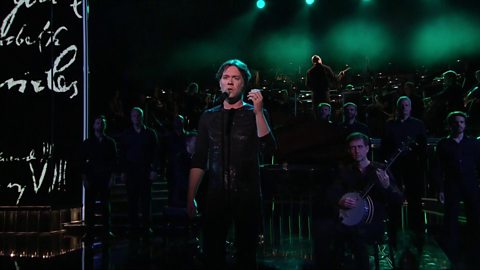
Rufus Wainwright performs Sonnet 29. video
Shakespeare Live! From the RSC. Rufus Wainwright performs Sonnet 29 with the ENO Chorus.
My Own Shakespeare. podcast
Poet Wendy Cope chooses Sonnet 29 as the piece of Shakespeare that inspired her most. Performed by Don Warrington.
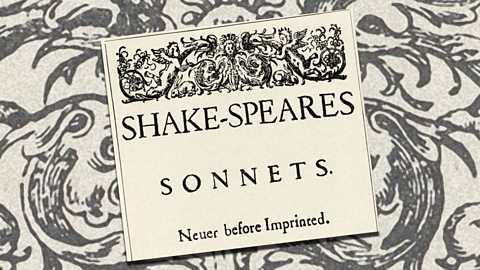
In Our Time - Shakespeare's Sonnets. audio
Discussion on 154 sonnets collected and printed in 1609 of which some are famous, many are glorious, most are inspiring and several are unsettling.
More on Anthology One: Identity
Find out more by working through a topic
- count3 of 11

- count4 of 11
- count5 of 11
- count6 of 11