On his first day as President, Franklin Delano Roosevelt was facing a broken country - with mass unemployment, businesses and banks collapsing, and democracy itself in danger.
The speech he gave made fixing things sound easy…
“Let me assert my firm belief that the only thing we have to fear is fear itself”
But he knew that his government would have to change everything…
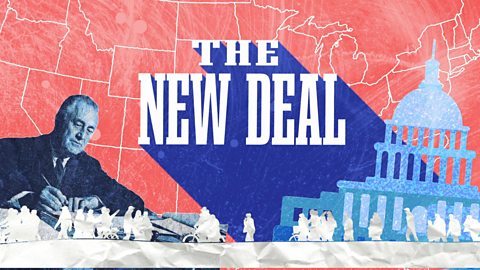
Roosevelt believed that the state had a duty to care for its citizens. To get the country moving again, the federal government would have to get into debt, and spend money - what he called the ‘New Deal’.
His plan was summed up as the ‘Three ‘R’s’. First came Relief, then Recovery, and finally, Reform.
To implement them, he set up a number of Federal Government programs, or ‘alphabet agencies’.
The Federal Emergency Relief Administration provided basic welfare – soup kitchens, and payments to the poor for clothing or school costs.
But it was very unpopular with many state governments, who believed that people needed to solve their own problems.
To create recovery, Roosevelt’s focus was on getting people back into work.
As soon as people were earning, they were also spending – providing demand for businesses, and creating more jobs.
The Public Works Administration launched massive spending on construction projects, for roads, dams, schools and hospitals – providing hundreds of thousands of people with work, and building vital infrastructure for the nation.
The Emergency Banking Act was passed, providing millions in state funding to support failing banks.
In return for the bailouts, the government required the banks to stick to strict new regulations, which prevented them from taking dangerous risks.
And the President used radio broadcasts - his ‘fireside chats’ - to urge the public to put their money back into banks - and most people trusted him.
Together, the measures of the New Deal went a long way to restoring confidence in the economy – and in the value of democracy.
But there were many problems that the New Deal didn’t solve. Many of the jobs it created were short term.
In the end, what finally fixed the US economy was World War II… The war effort created huge demand for industry, and military service solved unemployment.
And the President used radio broadcasts - his ‘fireside chats’ - to urge the public to put their money back into banks - and most people trusted him.
Together, the measures of the New Deal went a long way to restoring confidence in the economy – and in the value of democracy.
But there were many problems that the New Deal didn’t solve. Many of the jobs it created were short term.
In the end, what finally fixed the US economy was World War II… The war effort created huge demand for industry, and military service solved unemployment.
Description
With the US economy stuck in a depression, President Roosevelt launched his ‘New Deal’ reforms to restore confidence in American banks. His social reforms also provided jobs for millions of unemployed men. Find out more in this video.
Now playing video 4 of 8