Key points
Overview
A tank commander returns to the site of a battle and finds the decaying body of a German soldier he killed weeks earlier. Among the wreckage is a photo of the dead man’s girlfriend, Steffi. The poem explores the dehumanising effects of war, the fragility of life, and the contrast between love and violence.
Main themes
Warfare, love, loss, dehumanisation, indifference to suffering, technology, human fragility.
Tone and voice
Initially detached, matter-of-fact and pitiless; later more reflective and sombre. The speaker is a first person voice, almost certainly Douglas himself, drawing on his own experience as a tank commander in World War Two.
Context
Written in 1943 during Douglas’s recovery from injuries sustained in a landmine explosion. Douglas was born in 1920 and died in action in 1944, aged just 24. He described his style as 'extrospective' – focused on external observation rather than internal emotion. His poetry reflects the clinical, large-scale killing of World War Two, contrasting with the more personal tone of World War One poets. The poem is based on Douglas’s experience at the Battle of El Alamein in Egypt.
Form and structure
The poem is divided into six quatrains, each end-stopped and self-contained. This defined structure supports the detached tone, making the poem feel like a report rather than an emotional reflection. It uses iambic tetrameter as its primary rhythm, though many lines vary. Douglas uses slant rhyme and pararhyme to create a sense of incompleteness and emotional dissonance.
Poetic devices to spot
- Symbolism – the photo of Steffi represents the human cost of war and the emotional lives of soldiers.
- Personification – the "frowning" gun and equipment that "mock" the dead soldier show the emotional detachment of war machinery.
- Repetition – "Gone" repeated in the opening line emphasises death, time and destruction.
- Juxtaposition – the decaying body beside intact equipment highlights human fragility versus technological power.
- Alliteration – "Soldier sprawling in the sun" uses sibilance to evoke heat and decay.
- Consonance – "Hard and good when he’s decayed" uses dull 'd' sounds to emphasise lifelessness.
- Simile – "Like a cave" describes the burst stomach, evoking horror.
- Metaphor – "Paper eye" suggests fragility and dehumanisation.
- Volta – the final stanza shifts to a reflection on the soldier as both "lover" and "killer".
- Tone – detached, pitiless, reflective, tragic.
Vergissmeinnicht
by Keith Douglas
Three weeks gone and the combatants gone
returning over the nightmare ground
we found the place again, and found
the soldier sprawling in the sun.
The frowning barrel of his gun
overshadowing. As we came on
that day, he hit my tank with one
like the entry of a demon.
Look. Here in the gunpit spoil
the dishonoured picture of his girl
who has put: Steffi. Vergissmeinnicht.
in a copybook gothic script.
We see him almost with content,
abased, and seeming to have paid
and mocked at by his own equipment
that’s hard and good when he’s decayed.
But she would weep to see today
how on his skin the swart flies move;
the dust upon the paper eye
and the burst stomach like a cave.
For here the lover and killer are mingled
who had one body and one heart.
And death who had the soldier singled
has done the lover mortal hurt.
The text of this poem is available in the CCEA Poetry Anthology, which can be downloaded from the CCEA website.
The BBC is not responsible for the contents of any other sites listed.
Summary
A tank commander returns to the scene when an enemy combatant he killed lies decaying, and finds a photo of the dead man’s girlfriend. Written during 1943, as Douglas recovered from injuries sustained in a landmine explosion.

Title: The German word for the phrase “Forget me not”, a gentle imperative. German was the language of the ‘enemy’ in World War Two, but the word sounds out reasonably closely to the English equivalent phrase, suggesting a loose parallel between the soldiers of the opposing forces.
Themes: Warfare, love, loss, dehumanisation, indifference to suffering, technology, human fragility.
Tone: Initially detached, matter-of-fact and pitiless; later more reflective and sombre.
Speaker: A first person speaker who is almost certainly the poet himself – Keith Douglas saw active service during World War Two and his poetry was heavily based on his real experiences.
Applicable context
- Keith Douglas was born in England in 1920. Despite a difficult family life – his mother was sick, his parents separated and there were serious financial difficulties – Douglas received a good education through a mixture of charity, luck and talent, and excelled in both writing and sports. He won a place at Oxford in 1938, where his talent for poetry was recognised by many, including his tutor, the World War One veteran and war poet Edmund Blunden.
- By the time World War Two broke out in 1939, the alarming rise of A type of far-right government that first appeared in Europe in the early 1900s. Fascist countries are usually ruled by one party, led by a dictator who has all of the power. Other features of a fascism include the use of violence against political opponents, the government keeping tight control of different aspects of everyday life, racist beliefs and discrimination against minority groups.throughout the thirties had led many who had been pacifists during World War One (among them the American poet Edna St. Vincent Millay. They concluded that World War Two was justified and righteous in the fight against tyranny. Douglas had previously been opposed to militarism, but enlisted just days after war was declared and began training in 1940 before being deployed to North Africa as a tank commander. Check your connection, refresh the page and try again. was based on his experiences during the Battle of El Alamein in Egypt and written in 1943; tragically Douglas was killed in action the following year, not long before the war ended. He was aged just 24 when he died.
- Douglas described his style as ‘extrospective’ – based on clear, objective and unsentimental observation of external events rather than focusing on internal feelings. Some critics described his poetry as cold and detached because of this style; others felt it appropriately challenged the reader to examine their own feelings in response to the brutality and destruction Douglas witnessed first-hand and recorded in his work. The style was perhaps especially suited to World War Two, which featured technological advances that meant killing took place on a larger scale and in less direct, more clinical ways than ever before. The detached tone of Douglas’s ‘extrospection’ is a main feature of Vergissmeinnicht, showing how dehumanising and desensitising war could be to those who experienced its horrors every day.
Only a little context is needed for each poem; where used, it should be applied to the point you're making.
Form and structure
- Vergissmeinnicht is divided into six quatrains (four line A grouped set of lines within a poem.), all of which are end-stopped and self-contained. This fairly straightforward and defined structure complements Douglas’s detached tone in making the poem feel more like a terse, observant report than an expressive piece.
- The The rhythm of a line of poetry based on how many syllables it has and where they are stressed or emphasised – likes beats in music. in Vergissmeinnicht makes use of Line of verse written in four pairs of syllables each made up by an unstressed syllable followed by a stressed syllable. as its primary rhythm, though a number of the lines vary from this. One ‘iamb’ is a two-beat combination: an unstressed syllable followed by a stressed (emphasised) syllable, making a ‘da-DUM’ pattern, like a heartbeat. Tetrameter means four of these two-beat units per line, making eight syllables altogether:
| that day | he hit | my tank | with one |
| da-DUM | da-DUM | da-DUM | da-DUM |
The lines that stray from this pattern often simply feature an extra syllable or two (eg line six) or have slightly different stresses (eg line 12), but it’s worth noting the deliberate variation used in line one to open the poem:
| Threeweeksgone | and the | com-bat- | -ants gone |
| DUMDUMDUM | da-da | DUM-da | da-DUM |
It starts with three stressed syllables, opening the poem with a strong thud of triple beats that sounds heavy and unrelenting, as if reflecting the experience of being at war itself – tedious, tiring, dull and serious most of the time, occasionally punctuated by violent chaos. The rhythm established is not the one that continues, giving an unsettling sense of unpredictability that also reflects the soldiers’ experiences of being open to attack at any time. - As with the metre, the rhyme scheme is present but not regular or predictable throughout the poem, giving a further unsettling air and showing how irregular life in combat could be. There is also some use of slant rhyme or ‘half rhymes’ (examples include rhyming “Vergissmeinnicht” with “gothic script”, “gone” with “sun” or “spoil” and “girl”) and pararhyme (paired words which share their consonants but have varied vowels to create a sense of rhyme, such as “heart” and “hurt” in Vergissmeinnicht), which was a favoured technique of the World War One poet Wilfred Owen. The not-quite-right, inexact nature of the half rhymes Douglas uses adds to the unsettled, unsatisfying and troubling atmosphere of the poem.
Language and poetic methods
Symbolism: The central A literary device where an object, person, place, or event represents something beyond its literal meaning. of this poem is the photograph of Steffi, the girlfriend of the dead German soldier. The picture represents all the people at home who loved each individual soldier in the combat, and the human side of each of those soldiers; Douglas notes at the end of the poem that the soldier was not only his enemy, a “killer”, but also a “lover” who cared for Steffi and was cared for by her.
Douglas and his comrades are desensitised to war and feel indifference – maybe even some shameful sense of triumph – towards the dead soldier; they do not have pity for him, but there is a tiny flicker of compassion for Steffi, who Douglas recognises “would weep” to see what has become of her lover and will be deeply affected by losing him. The poem implies that those who fight have lost their basic human sympathy and only those at home, symbolised by the picture, retain a real ability to feel. This makes it even more tragic that the war will bring them such pain and loss.Personification: Douglas shows the callous indifference of the war through A type of imagery in which non-human objects, animals or ideas are given human characteristics. the weapons used – the “frowning” gun and the soldier’s “own equipment” which is said to “mock” him with its intact state as his fallible human body decays beside it. These are no longer inanimate objects, but seem sentient and invested in the fight, displaying the same negative emotions as the soldiers. This could be to show the focused deadliness of the more advanced war machinery of World War Two – as though the technology is personally invested in killing people.
It could also imply the distortion of the emotional range of the soldiers themselves through exposure to such horrors, showing them as more like machines. Death is also personified as having “singled” out (or specially chosen) the German soldier for his miserable fate, again illustrating the personal consequences of combat for individuals and the high price they and their loved ones pay.Repetition: The lumbering opening line, with its first three beats stressed and heavy, helps give a sense of the periods of boredom experienced by the soldiers; the repetition of “gone” in this opening line adds to this, emphasising not just the deaths and desertions of the enemy (“the combatants gone”) but also the tedious passing of time (“three weeks gone”). It even hints at the destruction involved – everything is “gone”.
In the final stanza, Douglas uses repetition of “one” in “who had one body and one heart”, emphasising the paradox of the man being both “lover and killer” at the same time in the same form. This repetition helps to sketch out the staggering impact of war on its soldiers, who could never reconcile those opposing identities and had to live with the traumatic consequences – or die in battle, like the German soldier.Juxtaposition: The repellent state of the dead soldier – the dried-out eyes, collapsed torso and the flies that have infested the body – is described in brief but awful detail with a A simile is a word or phrase used to make a comparison for dramatic effect, using 'like' or 'as'.(“like a cave”) and a A metaphor is a word or a phrase used for dramatic effect, to describe something as if it were something else. (“paper eye”), horrifying the reader. The body is not only lifeless but visibly ruined, showing how fragile and fallible human life is. This terrible image is worsened by the Two things placed side by side to highlight their differences. Douglas uses, setting the soldier’s decomposing body alongside his protective gear and weaponry “that’s good and hard when he’s decayed”. It scornfully hints that people are too weak for war, and that this man was not “hard” enough to kill his enemies before they killed him.
It also underlines the unsettling idea that the technology of World War Two is stronger and more powerful than humanity, something that cannot be overcome by human morals or sympathy for fellow men. This is a chilling insight given that World War Two would ultimately involve both nuclear weapons and large scale genocide, changing the known world forever. Douglas further juxtaposes Steffi’s grief for the “lover” with the men’s detached sense of satisfaction that their “killer” enemy is dead: “We see him almost with content”.Alliteration and consonance: The harsh and detached tone of the poem is enhanced through the sounds Douglas chooses to describe the situation. Marked by alliteration - the repetition of a sound at the beginning of consecutive words, such as ‘the big, bold, blue sea' of Alliteration or repetition of s sounds, producing a hissing sound like that of 's' or 'sh'. ‘s’ sounds, for example, in “soldier sprawling in the sun” gives an unpleasant hissing quality that evokes the desert heat and its unforgiving treatment of the dead body. The repeated sounds of plosive ‘p’s and ‘t’s in the third stanza are a mix of alliteration and The repetition of similar consonant sounds in nearby words. that evokes a kind of bitter contempt in the description of them discovering the “dishonoured picture” of Steffi.
Elsewhere, the consonance of the dull thudding ‘d’ sounds in “hard and good when he’s decayed” emphasises the lifelessness of the body and the tragic harshness of the juxtaposition between the rotting corpse and the equipment that’s ready to kill.
This is not a list of every method or notable use of language and structure in Vergissmeinnicht.
Look at the poem again. Can you find any of the following?
Simile
The attack on Douglas’s tank in which the now-dead soldier hit them with a blast three weeks earlier is described as being “like the entry of a demon”, showing how threatening and hellish it was to be shot at. The danger they were in helps explain the men’s lack of pity now for the one who attacked them. Douglas uses another A simile is a word or phrase used to make a comparison for dramatic effect, using 'like' or 'as'. to describe the soldier’s gruesome decomposition: “the burst stomach like a cave”. Likening the man’s torso to the hollowness of a “cave” shows he is in the process of disappearing, erased by the violence of the war.
A break in poetic rhythm in the middle of the line, a momentary pause.
In the third stanza, the use of a full stop after the single word “Look” adds a brief pause that suggests the speaker indicating something for the reader’s attention, including them. The colon in the third line of the stanza sets up and presents Steffi’s two-word message, helping to show its significance even though Douglas relates it without quotation marks. This makes it as lifeless and redundant as the soldier who has been killed. The last stanza adds a full stop at the end of line two, even though it is followed by an “And” in the next line, showing a sense of solemnity and gravitas. The speaker pauses briefly to consider the truth about the soldier they’ve killed and what his loss means.
Verbs that give commands, instructions, or requests directly to the reader or a specific character
Stanza three starts with the single word sentence “Look”, an imperative instructing the reader, and possibly also Douglas’s companions, to take in the grim details of the scene. He urges the reader to participate and engage, not allowing them to stand back and avoid the situation; the command is not excited or exclaimed but level-headed and sober, showing how disaffected the soldiers have become with seeing such horrible sights in the course of the war.
What other poems could I compare with Vergissmeinnicht?
Mametz Wood – Sheers’ poem focuses on a burial site filled with dead fighters long gone, which offers some comparison with the decaying soldier in Vergissmeinnicht, as well as some contrasting details and attitudes.
Anthem for Doomed Youth – the idea of mourning by loved ones at home appears in both poems in different ways; it is also worth contrasting the attitudes of the poets, comparing Owen’s bitter anger with Douglas’s more detached and arguably callous viewpoint.
The Man He Killed – the contrasting attitudes and experiences of both poems’ speakers offers an insight into how war affects those who fight; there is also some sense of parallel, or just recognisable humanity, between the soldiers and their enemies in both poems.
Practice questions
Use these questions to hone your knowledge of Vergissmeinnicht, and to practise using your notes and analysis in organised paragraphs that focus on how particular themes or ideas are shown in the poem. There is an example answer in the following section to demonstrate how you can do this.
- How does Douglas show the sense that war is dehumanising in Vergissmeinnicht?
- What does Vergissmeinnicht show us about Douglas’s attitude to war?
- What poetic methods does Douglas use to show his feelings about death in Vergissmeinnicht?
- How does Douglas create a pitiless tone in Vergissmeinnicht?
Example answer
Below is a demonstration of how to use the material in this section to answer an example essay question. The answer below is not a full essay, but only an extract of a longer answer showing some of the points that could be made.
Q: How does Douglas show the sense that war is dehumanising in Vergissmeinnicht?
A: Vergissmeinnicht is divided into six quatrains, all of which are end-stopped and self-contained. This fairly straightforward and defined structure complements Douglas’s detached tone in making the poem feel more like a terse, observant report than an expressive piece. Douglas described his style as ‘extrospective’ – based on clear, objective and unsentimental observation of external events rather than focusing on internal feelings. Some felt his poetry was cold and detached because of this style; others felt it appropriately challenged the reader to examine their own feelings in response to the brutality and destruction Douglas witnessed first-hand and recorded in his work. The style was perhaps especially suited to World War Two, which featured technological advances that meant killing took place on a larger scale and in less direct, more clinical ways than ever before. The detached tone of Douglas’s ‘extrospection’ is a main feature of Vergissmeinnicht, showing how dehumanising and desensitising war was to those who experienced its horrors every day.
Although the poem uses a lot of iambic tetrameter, it starts with three stressed syllables – “Three weeks gone” –, opening the poem with a strong thud of triple beats that sounds heavy and unrelenting. As if reflecting the experience of being at war itself – tedious, tiring, dull, and serious most of the time. Then occasionally punctuated by violent chaos. The rhythm established is not the one that continues, giving an unsettling sense of unpredictability that also reflects the soldiers’ experiences of being open to attack at any time. Douglas describes the attack on his tank by the now-dead soldier three weeks earlier with the simile “like the entry of a demon”, showing how threatening and hellish it was to be shot at. The danger they were in and how close they came to death helps explain the men’s lack of pity now for the one who attacked them; they “see him almost with content”, close to being happy he has died, and take a certain satisfaction in seeing him “abased” or humiliated in death, dehumanising him. They have no sympathy whatsoever for him, even though he was technically in a similar situation to them – forced to fight for his life, and kill or be killed. The fact they cannot feel for him shows they have lost their human empathy. The conflict has deadened their feelings, showing how dehumanising war can be.
This essay could go on to make the following points, backed up by evidence from the poem and detailed analysis of that evidence:
- Douglas uses the symbol of Steffi’s picture to show the difference between the attitudes of those at home and those who fight, showing how the latter have been desensitised and can only dehumanise their enemy.
- Douglas uses a simile and metaphor to describe the gruesome state of the soldier, relating it in a detached way that dehumanises him, and further juxtaposing Steffi’s imagined grief with his own sense of satisfaction at the enemy’s death. Showing how war dehumanises its fighters.
- Douglas uses personification of the weaponry and equipment of war, insinuating that the machinery is as human as the desensitised, detached soldiers and showing how dehumanising the war can be.
Test your knowledge of Vergissmeinnicht
More Keith Douglas
Canoe, by Keith Douglas. video
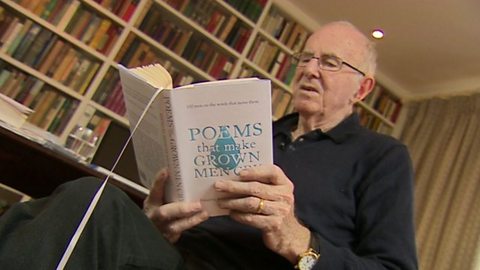
To mark the publication of an anthology of poetry entitled Poems That Make Grown Men Cry, the journalist and broadcaster Clive James reads Canoe, by Keith Douglas.
World War Two collection
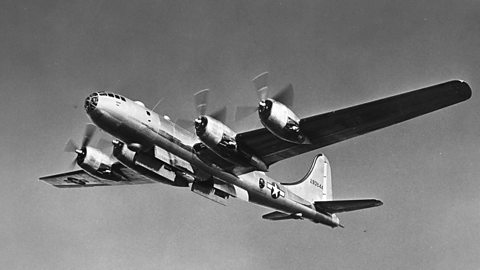
A collection of short films, interactive articles and timelines covering the major events and people of World War Two.
More on Anthology Three: Conflict
Find out more by working through a topic
- count8 of 11

- count9 of 11

- count10 of 11
- count11 of 11