Christopher Sykes made his BBC directing debut on the 10th of June 1972, at 22.10, with the BBC 2 series Pets and Vets. His first programme looked at pigeons, racing pigeons and ‘fancy’ pigeons of all shapes and colours - the result of years of highly selective breeding. He then went on to work extensively on arts documentaries, and Horizon wasn’t the most obvious next choice for Chris.
However, in 1980 he wrote and produced 'The Slatemakers' for Horizon. It was this programme that triggered his own unique approach to science television. For Chris, people were the key to successful science documentaries.
Many Horizon directors and producers speak of a very important creative relationship – that between themselves and their film editor. For new Horizon recruits that relationship was even more important, as there was much to be learnt in terms of what was possible and realistic, technically and creatively.
Interviews

Peter Goodchild
After having trained in studio direction Peter Goodchild (the longest surviving editor of the programme) was asked by Aubrey Singer, then Head of BBC Science and Features, to make a choice. Did he want to be an educationalist or an entertainer for the rest of his BBC career?

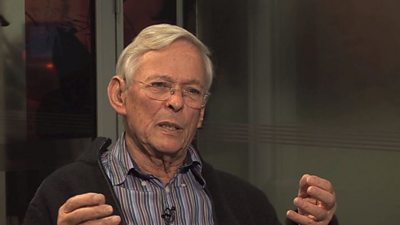
Alec Nisbett
Alec Nisbett, has been described by fellow programme makers as ‘the quintessential Horizon producer’, never shying away from putting hard science on TV.
Deborah Cadbury
The first programme Deborah worked on for the BBC was on a series which was something of a training ground for many a Horizon producer, Tomorrow's World (BBC: 1965-2003). She won many awards for her work on Horizon including Emmys and BAFTAS.
Simon Campbell-Jones
Simon’s first film for Horizon was broadcast in January 1969, and was called The Miraculous Wonder: the Human Eye. Narrated by Christopher Chataway, the programme asked if human eyes “were windows to your soul, the receiver of irrelevant information, respectable substitutes for sex, something like footballs? Or a piece of the brain looking out at the world?”