
In February 1971 Producer Peter Jones brought the British public closer to the realities of the arms race in his seminal Horizon: 'Rumours of War'. In the 25 years prior to the making of his film more than 7,000 increasingly sophisticated nuclear weapons had been developed, and the hours once available for calling off a bomber attack had been reduced to minutes with new missile systems.
For this edition of the programme, Horizon filmed at a missile base in Missouri, an H-bomb museum in New Mexico, and talked to scientists personally involved in the dynamics of the arms race. It was an experience Peter would never forget. His editor at the time was Peter Goodchild who sent him to United States to see what he could find.
Peter Jones had been watching Horizon from the very early days, soon after the studio based magazine format was phased out, and just knew he had to be part of the programme. By the late 60s he had made a formal approach, one which he has never regretted. It enabled him to combine his twin passions of science and writing.
Interviews

Peter Goodchild
After having trained in studio direction Peter Goodchild (the longest surviving editor of the programme) was asked by Aubrey Singer, then Head of BBC Science and Features, to make a choice. Did he want to be an educationalist or an entertainer for the rest of his BBC career?

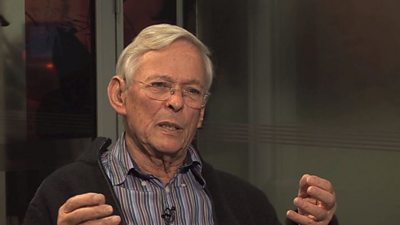
Alec Nisbett
Alec Nisbett, has been described by fellow programme makers as ‘the quintessential Horizon producer’, never shying away from putting hard science on TV.
Deborah Cadbury
The first programme Deborah worked on for the BBC was on a series which was something of a training ground for many a Horizon producer, Tomorrow's World (BBC: 1965-2003). She won many awards for her work on Horizon including Emmys and BAFTAS.
Simon Campbell-Jones
Simon’s first film for Horizon was broadcast in January 1969, and was called The Miraculous Wonder: the Human Eye. Narrated by Christopher Chataway, the programme asked if human eyes “were windows to your soul, the receiver of irrelevant information, respectable substitutes for sex, something like footballs? Or a piece of the brain looking out at the world?”