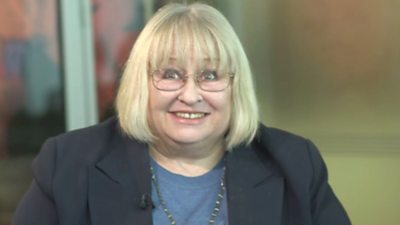
It took until 1990 for the BBC to appoint a women to the position of Editor, Horizon. It had not been a straightforward journey for Jana Bennett who took the job, having faced some less than positive views about the role of women in broadcasting. Up to this point, Jana had followed a successful programme making career, beginning in 1979, after she completed the BBC’s News Trainee scheme.
She worked on The Money Programme, Nationwide and Newsnight, and set up ‘Antenna’ which looked at science and technology with a current affairs edge. She explains how she had to be made aware of the significance of her new role on Horizon, given her previous experience working with very senior women elsewhere in the BBC.
Jana was series editor on such editions of Horizon as ‘Life is Impossible’ (1993) an investigation into how life began on earth, ‘No Ordinary Genius’ (1993) examining the life and work of physicist Richard Feynman, ‘Hide and Seek in Iraq’ (1992) on weapons inspections in Iraq, and ‘Assault on the Male’ (1993) which dealt with declining male fertility.
Other credits include ‘Inside Chernobyl Sarcophagus' (1996), 'Fermat's Last Theorem' (1996), 'Molecules with Sunglasses' (1992), and 'Ulcer Wars' (1994). Occasional special series within the Horizon strand, also under Jana’s editorship, include the three-part 'Red Star in Orbit: The Invisible Spaceman’ (1990), about Soviet science and space exploration.
At the time, her appointment was considered controversial by some, with critics asserting that she had been brought in mainly to improve ratings. However for Jana what was important to her and the series, was a commitment to telling good science stories, not for just the scientific community but also to non-specialists.
Interviews

Peter Goodchild
After having trained in studio direction Peter Goodchild (the longest surviving editor of the programme) was asked by Aubrey Singer, then Head of BBC Science and Features, to make a choice. Did he want to be an educationalist or an entertainer for the rest of his BBC career?

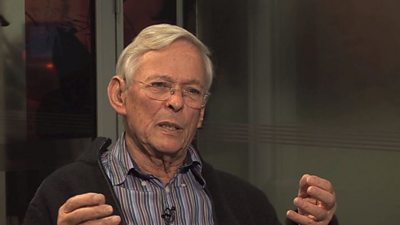
Alec Nisbett
Alec Nisbett, has been described by fellow programme makers as ‘the quintessential Horizon producer’, never shying away from putting hard science on TV.
Deborah Cadbury
The first programme Deborah worked on for the BBC was on a series which was something of a training ground for many a Horizon producer, Tomorrow's World (BBC: 1965-2003). She won many awards for her work on Horizon including Emmys and BAFTAS.
Simon Campbell-Jones
Simon’s first film for Horizon was broadcast in January 1969, and was called The Miraculous Wonder: the Human Eye. Narrated by Christopher Chataway, the programme asked if human eyes “were windows to your soul, the receiver of irrelevant information, respectable substitutes for sex, something like footballs? Or a piece of the brain looking out at the world?”