The pressures of the multi-channel world were not a concern for earlier Horizon film makers. Although Martin Freeth experienced some of the changes brought about by the digital TV, his Horizon career (1971–1997) rarely encountered pressure to deliver anything other than ‘a good programme’.
For him there was pretty much free reign to tackle virtually any subject, provided it met with the approval of Horizon Editor, Peter Goodchild.
Without strict formats or constraints imposed on Horizon film makers in this period, it would be easy to imagine the series becoming incoherent and un-focussed. This in fact was not the case, although different approaches and styles did result in a wide variety of films.
For Martin Freeth this has always been one of Horizon’s strong points, and for him, he always relished playing with the approach to a subject.
Interviews

Peter Goodchild
After having trained in studio direction Peter Goodchild (the longest surviving editor of the programme) was asked by Aubrey Singer, then Head of BBC Science and Features, to make a choice. Did he want to be an educationalist or an entertainer for the rest of his BBC career?

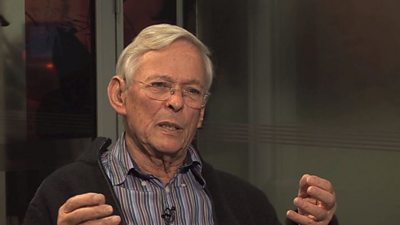
Alec Nisbett
Alec Nisbett, has been described by fellow programme makers as ‘the quintessential Horizon producer’, never shying away from putting hard science on TV.
Deborah Cadbury
The first programme Deborah worked on for the BBC was on a series which was something of a training ground for many a Horizon producer, Tomorrow's World (BBC: 1965-2003). She won many awards for her work on Horizon including Emmys and BAFTAS.
Simon Campbell-Jones
Simon’s first film for Horizon was broadcast in January 1969, and was called The Miraculous Wonder: the Human Eye. Narrated by Christopher Chataway, the programme asked if human eyes “were windows to your soul, the receiver of irrelevant information, respectable substitutes for sex, something like footballs? Or a piece of the brain looking out at the world?”