
2 May 1964, a quarter to 9 in the evening on BBC Two, the start of something big for the BBC, the launch of one of the longest ever running science TV strands in history - Horizon. It has remained one of the top-rated science documentary series ever since, and began with a simple philosophy, stated in the first ever programme:
The aim of Horizon is to provide a platform from which some of the world's greatest scientists and philosophers can communicate their curiosity, observations and reflections, and infuse into our common knowledge their changing views of the universe.
Broadly speaking this is still the aim of the programme, but its format has changed over the years. The first ever Horizon was The World of Buckminster Fuller, produced and directed by Ramsay Short. It was an insert in a magazine programme based in a studio, and ran alongside shorter un-related items - as was the fashion in programme making at the time. Initially viewing figures were low, as very few people were able to watch BBC Two - you needed to invest in a new TV set to see it!
The story begins with excerpts from interviews with three key Horizon staff, Peter Goodchild (Horizon: 1965-1975), Alec Nisbett (Horizon: 1965-1995) and Deborah Cadbury (Horizon: 1992-1999).
Interviews

Peter Goodchild
After having trained in studio direction Peter Goodchild (the longest surviving editor of the programme) was asked by Aubrey Singer, then Head of BBC Science and Features, to make a choice. Did he want to be an educationalist or an entertainer for the rest of his BBC career?

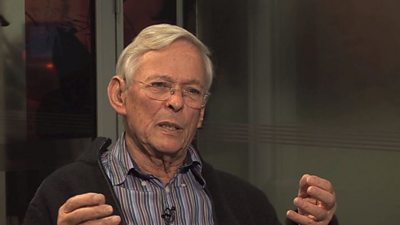
Alec Nisbett
Alec Nisbett, has been described by fellow programme makers as ‘the quintessential Horizon producer’, never shying away from putting hard science on TV.
Deborah Cadbury
The first programme Deborah worked on for the BBC was on a series which was something of a training ground for many a Horizon producer, Tomorrow's World (BBC: 1965-2003). She won many awards for her work on Horizon including Emmys and BAFTAS.
Simon Campbell-Jones
Simon’s first film for Horizon was broadcast in January 1969, and was called The Miraculous Wonder: the Human Eye. Narrated by Christopher Chataway, the programme asked if human eyes “were windows to your soul, the receiver of irrelevant information, respectable substitutes for sex, something like footballs? Or a piece of the brain looking out at the world?”